Check out these china prototyping images:
Fast prototyping Protei 011 “Optimist”
Image by cesarharada.com
(Source from rapid prototyping from China blog)
Check out these china prototyping images:
Fast prototyping Protei 011 “Optimist”
Image by cesarharada.com
Some cool china fast prototyping images:
Protei 011 “Optimist” Kit
Image by cesarharada.com
scoutbots.com/
protei.org
A handful of good china speedy prototyping photos I found:
Protei 011 “Optimist” Kit
Image by cesarharada.com
scoutbots.com/
protei.org
A few nice precision engineering pictures I located:
Clamp Variety Knurling tool
Image by tudedude
The clamp sort of knurling tool is suggested as they put far significantly less strain on the lathe.
Identical tool as ahead of but different background and lighting, trying to boost all black pictures and to improve the detail shown.
A few nice precision engineering photos I located:
Collet Holder Morse Taper
Image by tudedude
View On Black
Just a Tiny Drill
Image by tudedude
Old Metal functioning Lathe
Image by tudedude
Verify out these high precision engineering pictures:
Egyptian Obelisk – St. Peter’s Square
Image by HuTDoG83
Vibrant Rome – Photo 1 of 6
The Ancient Romans have been strongly influenced by the obelisk form, to the extent that there are now far more than twice as many obelisks standing in Rome as stay in Egypt. All fell soon after the Roman period except for the Vatican obelisk and were re-erected in distinct areas.
Re-erecting the obelisk had daunted even Michelangelo, but Sixtus V was determined to erect it in front of St Peter’s, of which the nave was but to be built. He had a complete-sized wooden mock-up erected inside months of his election. Domenico Fontana, the assistant of Giacomo Della Porta in the Basilica’s building, presented the Pope with a tiny model crane of wood and a heavy tiny obelisk of lead, which Sixtus himself was in a position to raise by turning a little winch with his finger. Fontana was provided the project.
The obelisk, half-buried in the debris of the ages, was first excavated as it stood then it took from April 30 to Might 17, 1586 to move it on rollers to the Piazza: it needed nearly 1000 males, 140 carthorses, 47 cranes. The re-erection, scheduled for September 14, the Feast of the Exaltation of the Cross, was watched by a big crowd. It was a well-known feat of engineering, which created the reputation of Fontana, who detailed it in a book illustrated with copperplate etchings, Della Trasportatione dell’Obelisco Vaticano et delle Fabriche di Nostro Signore Papa Sisto V (1590),[ten][11] which itself set a new regular in communicating technical details and influenced subsequent architectural publications by its meticulous precision.[12] Before getting re-erected the obelisk was exorcised. It is stated that Fontana had teams of relay horses to make his getaway if the enterprise failed. When Carlo Maderno came to build the Basilica’s nave, he had to place the slightest kink in its axis, to line it precisely with the obelisk.
Source: Wikipedia
Ideal viewed Huge | On Black
As often, comments/suggestions/critiques/faves are often welcome! Thank you all for viewing my photo!
A handful of good metal parts china images I discovered:
mong kok, supplies
Image by cesarharada.com
A couple of good higher precision engineering pictures I discovered:
1965 – 1976 Lancia Fulvia Coupé
Image by Georg Sander
The Lancia Fulvia is an Italian auto introduced at the Geneva Motor Show in 1963 by Lancia. It was made by that company by means of 1976. Fulvias are notable for their role in automobile racing history, including winning the International Rally Championship in 1972. On testing it in 1967, Road & Track summed up the Fulvia as "a precision motorcar, an engineering tour de force".
(Wikipedia)
– – –
Der Lancia Fulvia ist ein Automobil des italienischen Herstellers Lancia. Es wurde von Herbst 1963 bis Ende 1976 gebaut und gilt als Nachfolgemodell des Lancia Appia.
Wie andere nach dem 1950 vorgestellten Aurelia entwickelten Lancia-Modelle war der Fulvia nach einer klassischen Römerstraße, hier der Via Fulvia, benannt. Im Herbst 1972 wurde dieses Method der Benennung wieder geändert: der unter Fiat-Regie gebaute Nachfolger des Fulvia war der Lancia Beta.
Der Fulvia war als Berlina (Limousine) und als Coupé erhältlich. Außerdem gab es wie bei Lancia üblich ein bei Carrozzeria Zagato entworfenes und in Kleinserie gebautes Fließheckcoupé mit dem traditionellen Namen Sport. Das technische Konzept des Fulvia stammt von Antonio Fessia, die Type wurde von Pietro Castagnero bei Lancia entworfen.
(Wikipedia)
A couple of good fast prototyping images I found:
DTJ_010564
Image by dagtj
Workshop: Excellent Design and style More rapidly, Day 2: Paper prototyping
DEMO-Founder-College-Muir-01562
Image by The DEMO Conference
Clover Foods CEO Ayr Muir offers a keynote entitled ‘Rapid Prototyping in The Fast Food Business’ in the course of DEMO Fall 2013 at the Santa Clara Convention Center in Santa Clara, California Wednesday October 16, 2013. Full coverage of DEMO, the Launchpad for Emerging Technologies and Trends, can be located at bit.ly/DEMOsite.
DEMO-Founder-College-Muir-01566
Image by The DEMO Conference
Clover Foods CEO Ayr Muir gives a keynote entitled ‘Rapid Prototyping in The Quickly Food Business’ for the duration of DEMO Fall 2013 at the Santa Clara Convention Center in Santa Clara, California Wednesday October 16, 2013. Comprehensive coverage of DEMO, the Launchpad for Emerging Technologies and Trends, can be located at bit.ly/DEMOsite.
Some cool prototype china images:
Ubco Assembly
Image by locusresearch
2×2 in assambly, China 2015
Ubco Assembly
Image by locusresearch
2×2 in assambly, China 2015
Ubco Assembly
Image by locusresearch
2×2 in assambly, China 2015
Sarasota, FL (PRWEB) June 09, 2015
Internationally renowned ROBRADY design and style studio garnered four Green Very good Design awards for submissions ranging from a human powered exoskeleton to an energy efficient cookstove for building nations. The awards, presented by the Chicago Athenaeum Museum of Architecture and Design and style in association with the European Centre for Architecture Art Design and Urban Research, represent the best examples of sustainable and environmental merchandise and architectural style.

“We strive to humanize technologies,” says ROBRADY CEO and Style Director, Rob Brady. “Not just for the individual but the global neighborhood and these awards are affirmations that we’re hitting the mark.”

ROBRADY’s 4 submissions had been varied but every met the criteria for sustainable environmental design and style and received accolades:

The FORTIS Exoskeleton
ROBRADY design teamed with Lockheed Martin, the forerunner in exoskeleton technologies, to provide a lightweight, human-powered suit. Retooled and ready for the industrial marketplace, this cutting-edge technology drastically enhances worker endurance and strength.

The Envirofit Cookstove
Addressing serious issues of security and efficiency, the design and style collaboration amongst Envirofit and ROBRADY resulted in a high-high quality, emission-totally free stove that performs in the rugged terrain of developing nations with lowered use of all-natural sources.

The Merlin Fuel Cell
ROBRADY and sister organization ARMORIT designed the Merlin Fuel Cell enclosure to be a ruggedized energy source that can go exactly where other energy sources cannot and function without having causing added harm to currently compromised environments such as disaster locations. The fuel cell also garnered an international Red Dot Design and style award in 2014.

The Merlin Solar Tracker
Created by ROBRADY and sister company ARMORIT, the innovative tracker is a rapidly-deployable energy supply that can be set up by a single individual without having tools. Like the Fuel Cell, the Tracker is made for robust environments with sensors that automatically adjust to maintain optimal positioning and stay away from wind damage, yielding improved energy output (up to 40% in some conditions).

For more than two decades, ROBRADY style has worked with consumers to take their ideas from analysis to reality, delivering results that make a optimistic impact on the atmosphere as nicely as the marketplace.

About ROBRADY design and style
ROBRADY design and style is a multi-disciplined solution style and improvement studio that offers its worldwide client base progressive industrial design and style, mechanical design and style and solution engineering, graphics / packaging / UI-UX / internet, marketplace insights, brand and retail development, complete speedy prototyping and production program management.

ROBRADY style delivers comprehensive speed-to-market place product options from start off-up to Fortune 100 by collaborating to determine the greatest regions of chance and generating innovative styles that drive profitable final results. ROBRADY delivers style, production and capital solutions to clientele in assistance of their research to reality philosophy.


Related Quick Prototyping Press Releases
Check out these rapidly prototyping images:
150210-N-HW977-495
Image by NAVSEA Corona
150210-N-HW977-495
SAN DIEGO, Calif. (Feb. ten, 2015) Rear Adm. Lorin Selby, commander of Naval Surface Warfare Center (NSWC), left, Troy Clarke, NSWC Corona public affairs officer, and Arman Hovakemian, NSWC Corona chief technology officer, discuss the Griffin missile launcher as an example of NSWC Corona’s speedy prototyping capability. (U.S. Navy photo by Greg Vojtko/Released)
My office
Image by juhansonin
Lots of magnetic wall space (covered with project layouts and comps), two dry erase boards, dual 30" monitors (overkill) and lots of drawing space on the table.
Note the lack of image stitching (30 seconds in photoshop).
For a bigger picture, see flickr.com/photo_zoom.gne?id=356025851&context=pool-four…
Ripley Engineering Business Card
Image by Ripley Engineering
Download a Ripley Engineering Enterprise Card.
Ripley Engineering delivers:
– Precision Sheet Metal Fabrication
– Laser cutting Quickly-TRACK service
– Powder Coating (plus Wet Spraying)
– Electro-mechanical Assembly
– Style Help and Prototyping
Verify out these prototype producers in china photos:
Steven F. Udvar-Hazy Center: South hangar panorama, like Vought OS2U-three Kingfisher seaplane, B-29 Enola Gay, among other people
Image by Chris Devers
Quoting Smithsonian National Air and Space Museum | Vought OS2U-3 Kingfisher:
The Kingfisher was the U.S. Navy’s principal ship-primarily based, scout and observation aircraft during Globe War II. Revolutionary spot welding methods gave it a smooth, non-buckling fuselage structure. Deflector plate flaps that hung from the wing’s trailing edge and spoiler-augmented ailerons functioned like further flaps to enable slower landing speeds. Most OS2Us operated in the Pacific, where they rescued a lot of downed airmen, like World War I ace Eddie Rickenbacker and the crew of his B-17 Flying Fortress.
In March 1942, this airplane was assigned to the battleship USS Indiana. It later underwent a six-month overhaul in California, returned to Pearl Harbor, and rejoined the Indiana in March 1944. Lt. j.g. Rollin M. Batten Jr. was awarded the Navy Cross for creating a daring rescue in this airplane below heavy enemy fire on July four, 1944.
Transferred from the United States Navy.
Manufacturer:
Vought-Sikorsky Aircraft Division
Date:
1937
Country of Origin:
United States of America
Dimensions:
Overall: 15ft 1 1/8in. x 33ft 9 1/2in., 4122.6lb., 36ft 1 1/16in. (460 x 1030cm, 1870kg, 1100cm)
Materials:
Wings covered with fabric aft of the main spar
Physical Description:
Two-seat monoplane, deflector plate flaps hung from the trailing edge of the wing, ailerons drooped at low airspeeds to function like further flaps, spoilers.
Steven F. Udvar-Hazy Center: P-40 Warhawk with “sharktooth” nose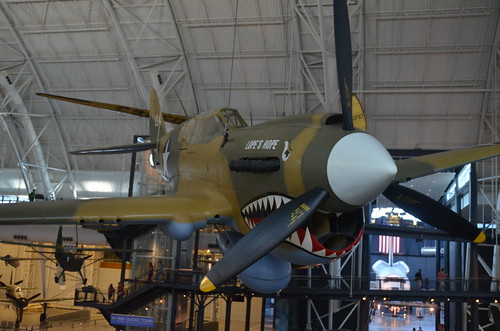
Image by Chris Devers
See a lot more pictures of this, and the Wikipedia article.
Specifics, quoting from Smithsonian National Air and Space Museum | Curtiss P-40E Warhawk (Kittyhawk IA):
No matter whether identified as the Warhawk, Tomahawk, or Kittyhawk, the Curtiss P-40 proved to be a effective, versatile fighter throughout the first half of Globe War II. The shark-mouthed Tomahawks that Gen. Claire Chennault’s "Flying Tigers" flew in China against the Japanese remain among the most well-known airplanes of the war. P-40E pilot Lt. Boyd D. Wagner became the 1st American ace of World War II when he shot down six Japanese aircraft in the Philippines in mid-December 1941.
Curtiss-Wright built this airplane as Model 87-A3 and delivered it to Canada as a Kittyhawk I in 1941. It served until 1946 in No. 111 Squadron, Royal Canadian Air Force. U.S. Air Force personnel at Andrews Air Force Base restored it in 1975 to represent an aircraft of the 75th Fighter Squadron, 23rd Fighter Group, 14th Air Force.
Donated by the Exchange Club in Memory of Kellis Forbes.
Manufacturer:
Curtiss Aircraft Firm
Date:
1939
Country of Origin:
United States of America
Dimensions:
All round: 330 x 970cm, 2686kg, 1140cm (10ft 9 15/16in. x 31ft 9 7/8in., 5921.6lb., 37ft four 13/16in.)
Supplies:
All-metal, semi-monocoque
Physical Description:
Single engine, single seat, fighter aircraft.
Long Description:
Whether or not it was the Tomahawk, Warhawk, or Kittyhawk, the Curtiss P-40 was a effective and versatile fighter aircraft for the duration of the 1st half of Globe War II. The shark-mouthed Tomahawks that General Claire Chennault led against the Japanese remain among the most well-known airplanes of the war. In the Phillipines, Lt. Boyd D. Wagner became the initial American ace of Planet War II whilst flying a P-40E when he shot down six Japanese aircraft in the course of mid-December 1941. P-40s had been first-line Army Air Corps fighters at the begin of the war but they quickly gave way to far more advanced styles such as the Republic P-47 Thunderbolt and the Lockheed P-38 Lightning (see NASM collection for each aircraft). The P-40 is not ranked amongst the very best all round fighters of the war but it was a rugged, effective style obtainable in big numbers early in the war when America and her allies urgently necessary them. The P-40 remained in production from 1939 to the end of 1944 and a total of 13, 737 have been built.
Design engineer Dr. Donovan R. Berlin layed the foundation for the P-40 in 1935 when he created the agile, but lightly-armed, P-36 fighter equipped with a radial, air-cooled engine. The Curtiss-Wright Corporation won a production contract for 210 P-36 airplanes in 1937-the biggest Army airplane contract awarded because World War I. Worldwide, fighter aircraft styles matured rapidly in the course of the late 1930s and it was soon apparent that the P-36 was no match for newer European designs. Higher altitude overall performance in particular became a priceless commodity. Berlin attempted to increase the P-36 by redesigning it in to accommodate a turbo-supercharged Allison V-1710-11 inline, liquid-cooled engine. The new aircraft was designated the XP-37 but proved unpopular with pilots. The turbo-supercharger was not trustworthy and Berlin had placed the cockpit as well far back on the fuselage, restricting the view to the front of the fighter. Nonetheless, when the engine was not giving difficulty, the more-streamlined XP-37 was a lot more quickly than the P-36.
Curtiss attempted once more in 1938. Berlin had modified yet another P-36 with a new Allison V-1710-19 engine. It was designated the XP-40 and very first flew on October 14, 1938. The XP-40 looked promising and Curtiss supplied it to Army Air Corps leaders who evaluated the airplane at Wright Field, Ohio, in 1939, along with numerous other fighter proposals. The P-40 won the competitors, soon after some modifications, and Curtiss received an order for 540. At this time, the armament package consisted of two .50 caliber machine guns in the fuselage and 4 .30 caliber machine guns in the wings.
After production began in March 1940, France ordered 140 P-40s but the British took delivery of these airplanes when Paris surrendered. The British named the aircraft Tomahawks but identified they performed poorly in higher-altitude combat over northern Europe and relegated them to low-altitude operations in North Africa. The Russians bought much more than 2,000 P-40s but information of their operational history stay obscure.
When the United States declared war, P-40s equipped numerous of the Army Air Corps’s front line fighter units. The plucky fighter ultimately saw combat in practically each and every theater of operations being the most powerful in the China-Burma-India (CBI) Theater. Of all the CBI groups that gained the most notoriety of the complete war, and remains to this day synonymous with the P-40, is the American Volunteer Group (AVG) or the Flying Tigers. The unit was organized right after the Chinese gave former U. S. Army Air Corps Captain Claire Lee Chennault virtually 9 million dollars in 1940 to buy aircraft and recruit pilots to fly against the Japanese. Chennault’s most critical assistance within the Chinese government came from Madam Chiang Kai-shek, a Lt. Colonel in the Chinese Air Force and for a time, the service’s overall commander.
The income from China diverted an order placed by the British Royal Air Force for one hundred Curtiss-Wright P-40B Tomahawks but getting airplanes was only one particular important step in making a fighting air unit. Educated pilots had been required, and rapidly, as tensions across the Pacific escalated. On April 15, 1941, President Franklin D. Roosevelt quietly signed an Executive Order permitting Chennault to recruit straight from the ranks of American military reserve pilots. Within a few months, 350 flyers joined from pursuit (fighter), bomber, and patrol squadrons. In all, about half the pilots in the Flying Tigers came from the U. S. Navy and Marine Corps even though the Army Air Corps supplied 1-third. Factory test pilots at Bell, Consolidated, and other firms, and commercial airline pilots, filled the remaining slots.
The Flying Tigers flew their 1st mission on December 20. The unit’s name was derived from the ferocious fangs and teeth painted on the nose of AVG P-40s at either side of the distinctive, large radiator air intake. The concept is mentioned to originate from images in a magazine that showed Royal Air Force Tomahawks of No. 112 Squadron, operating in the western desert of North Africa, adorned with fangs and teeth painted about their air intakes. The Flying Tigers had been the first genuine opposition the Japanese military encountered. In much less than 7 months of action, AVG pilots destroyed about 115 Japanese aircraft and lost only 11 planes in air-to-air combat. The AVG disbanded on July four, 1942, and its assets, which includes a few pilots, became a component of the U. S. Army Air Forces (AAF) 23rd Fighter Group in the newly activated 14th Air Force. Chennault, now a Brigadier Common, assumed command of the 14th AF and by war’s end, the 23rd was one of the highest-scoring Army fighter groups.
As wartime expertise in the P-40 mounted, Curtiss made several modifications. Engineers added armor plate, greater self-sealing fuel tanks, and far more potent engines. They modified the cockpit to enhance visibility and changed the armament package to six, wing-mounted, .50 caliber machine guns. The P-40E Kittyhawk was the very first model with this gun package and it entered service in time to serve in the AVG. The last model created in quantity was the P-40N, the lightest P-40 constructed in quantity, and significantly more quickly than preceding models. Curtiss constructed a single P-40Q. It was the quickest P-40 to fly (679 kph/422 mph) but it could not match the functionality of the P-47 Thunderbolt and the P-51 Mustang so Curtiss ended development of the P-40 series with this model. In addition to the AAF, several Allied nations purchased and flew P-40s like England, France, China, Russia, Australia, New Zealand, Canada, South Africa, and Turkey.
The Smithsonian P-40E did not serve in the U. S. military. Curtiss-Wright built it in Buffalo, New York, as Model 87-A3 and delivered it to Canada as a Kittyhawk IA on March 11, 1941. It served in No. 111 Squadron, Royal Canadian Air Force (RCAF). When the Japanese navy moved to attack Midway, they sent a diversionary battle group to menace the Aleutian Islands. Canada moved No. 111 Squadron to Alaska to assist defend the region. Right after the Japanese threat diminished, the unit returned to Canada and at some point transferred to England without having its P-40s. The RCAF declared the NASM Kittyhawk IA surplus on July 27, 1946, and the aircraft at some point returned to the United States. It had several owners prior to ending up with the Explorer Scouts youth group in Meridian, Mississippi. Throughout the early 1960s, the Smithsonian started looking for a P-40 with a documented history of service in the AVG but discovered none. In 1964, the Exchange Club in Meridian donated the Kittyhawk IA to the National Aeronautical Collection, in memory of Mr. Kellis Forbes, a local man devoted to Boys Club activities. A U. S. Air Force Reserve crew airlifted the fighter to Andrews Air Force Base, Maryland, on March 13, 1964. Andrews personnel restored the airplane in 1975 and painted it to represent an aircraft of the 75th Fighter Squadron, 23rd Fighter Group, 14th Air Force.
• • •
Quoting from Wikipedia | Curtiss P-40 Warhawk:
The Curtiss P-40 Warhawk was an American single-engine, single-seat, all-metal fighter and ground attack aircraft that 1st flew in 1938. It was employed by the air forces of 28 nations, such as these of most Allied powers in the course of World War II, and remained in front line service till the finish of the war. It was the third most-made American fighter, following the P-51 and P-47 by November 1944, when production of the P-40 ceased, 13,738 had been constructed, all at Curtiss-Wright Corporation‘s primary production facility at Buffalo, New York.
The P-40 design and style was a modification of the preceding Curtiss P-36 this lowered improvement time and enabled a speedy entry into production and operational service.
Warhawk was the name the United States Army Air Corps adopted for all models, generating it the official name in the United States for all P-40s. The British Commonwealth and Soviet air forces utilised the name Tomahawk for models equivalent to the P-40B and P-40C, and the name Kittyhawk for models equivalent to the P-40D and all later variants.
The P-40’s lack of a two-stage supercharger produced it inferior to Luftwaffe fighters such as the Messerschmitt Bf 109 or the Focke-Wulf Fw 190 in high-altitude combat and it was rarely utilized in operations in Northwest Europe. In between 1941 and 1944, however, the P-40 played a crucial role with Allied air forces in three main theaters: North Africa, the Southwest Pacific and China. It also had a considerable role in the Middle East, Southeast Asia, Eastern Europe, Alaska and Italy. The P-40’s functionality at high altitudes was not as crucial in those theaters, where it served as an air superiority fighter, bomber escort and fighter bomber.
P-40s 1st saw combat with the British Commonwealth squadrons of the Desert Air Force (DAF) in the Middle East and North African campaigns, in the course of June 1941. The Royal Air Force‘s No. 112 Squadron was amongst the first to operate Tomahawks, in North Africa, and the unit was the initial to feature the "shark mouth" logo, copying related markings on some Luftwaffe Messerschmitt Bf 110 twin-engine fighters. [N 1]
Even though it gained a post-war reputation as a mediocre design, appropriate only for close air assistance, much more current analysis like scrutiny of the records of individual Allied squadrons indicates that the P-40 performed surprisingly properly as an air superiority fighter, at instances suffering extreme losses, but also taking a extremely heavy toll on enemy aircraft. The P-40 supplied the further benefit of low cost, which kept it in production as a ground-attack fighter extended following it was obsolete in the air superiority function.
As of 2008, 19 P-40s were airworthy.
• • • • •
See far more pictures of this, and the Wikipedia write-up.
Information, quoting from Smithsonian National Air and Space Museum | Space Shuttle Enterprise:
Manufacturer:
Rockwell International Corporation
Country of Origin:
United States of America
Dimensions:
General: 57 ft. tall x 122 ft. lengthy x 78 ft. wing span, 150,000 lb.
(1737.36 x 3718.57 x 2377.44cm, 68039.6kg)
Materials:
Aluminum airframe and physique with some fiberglass characteristics payload bay doors are graphite epoxy composite thermal tiles are simulated (polyurethane foam) except for test samples of actual tiles and thermal blankets.
The 1st Space Shuttle orbiter, "Enterprise," is a full-scale test automobile used for flights in the atmosphere and tests on the ground it is not equipped for spaceflight. Although the airframe and flight handle elements are like these of the Shuttles flown in space, this automobile has no propulsion system and only simulated thermal tiles due to the fact these attributes had been not necessary for atmospheric and ground tests. "Enterprise" was rolled out at Rockwell International’s assembly facility in Palmdale, California, in 1976. In 1977, it entered service for a nine-month-long strategy-and-landing test flight system. Thereafter it was employed for vibration tests and fit checks at NASA centers, and it also appeared in the 1983 Paris Air Show and the 1984 World’s Fair in New Orleans. In 1985, NASA transferred "Enterprise" to the Smithsonian Institution’s National Air and Space Museum.
Transferred from National Aeronautics and Space Administration
A few nice china prototype photos I located:
Dragon Shaped Vessel at Sanxingdui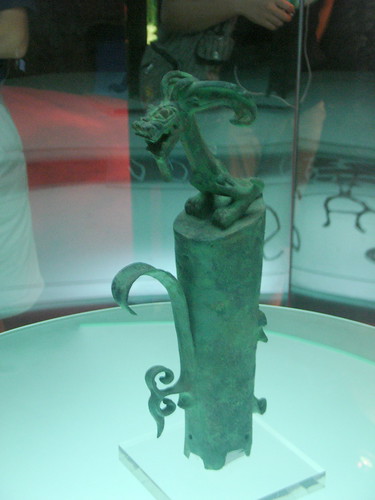
Image by drs2biz
This dragon-shaped piece appears to be an attachment to yet another, larger one particular. It looks lengthy, slender and a tiny like a lizard, being sometimes named the Sacred Goat since of its huge ears and horns. Various dragon-shaped ornaments show, to virtually an extreme, a grotesque and exaggerated style of art, specifically with some distinctive types of expression such as a horse-head, a twisted physique, human fingers and blade-shaped wings from which an early prototype of the dragon figure in China could be detected.
Pictured in Hong Kong on board a single of the Wright Group’s tri-axle double deckers purchased by the Kowloon Motor Bus Business (KMB)
Image by Northern Ireland Executive
Enterprise Minister Arlene Foster today congratulated The Wright Group on its export good results in Hong Kong.
The Minister was speaking during a go to to the Kowloon Motor Bus Company (KMB), which lately took delivery of a prototype two-axle vehicle from the Ballymena firm. Arlene Foster stated: “As one of Northern Ireland’s most innovative manufacturing firms, The Wright Group recognises the value to be gained by continued investment in product development."
The Wright Group lately secured orders for 290 entirely constructed up tri-axle double decker buses from the Kowloon Motor Bus Firm. A number of these automobiles have currently been shipped and are in service in Hong Kong.
The Minister concluded: “Clearly, the Wright Group’s investments in innovation, supported by my Division via Invest Northern Ireland, are now bearing fruit and will continue to help the future growth of the firm.”
Left to right, Edmond Ho, Managing Director, Enterprise Minister Arlene Foster, Evan Auyang, Deputy Managing Director KMB and Alastair Hamilton, Chief Executive, Invest NI.
Beijing
Image by Mr Thinktank
yet another Navy prototype
Verify out these china prototype images:
Protei 11. 1st commercial prototype. 20140331 Hong Kong.
Image by cesarharada.com
protei.org
A few good sheet metal parts china pictures I identified:
Image from page 194 of “Burma” (1900)
Image by Internet Archive Book Pictures
Identifier: cu31924023498557
Title: Burma
Year: 1900 (1900s)
Authors: Ferrars, Max Ferrars, Bertha
Subjects: Ethnology
Publisher: London : S. Low, Marston & Co., Ltd.
Contributing Library: Cornell University Library
Digitizing Sponsor: MSN
View Book Web page: Book Viewer
About This Book: Catalog Entry
View All Photos: All Images From Book
Click here to view book on the web to see this illustration in context in a browseable on the internet version of this book.
Text Appearing Ahead of Image:
rch over to thespot exactly where the toe-post of the Indian patten is set. Tanned leather slippersof European shape produced by Chinese are now ousting the Burman sandal andwood patten. Most of the properly-known metals are discovered in Burma. Ahead of the importationof pig, bar, and sheet metals, and of metal manufactures from the West began,Lawd settlers from Zimme (Chiengmai, Tyin-mai) practised the smelting ofiron, copper, tin, zinc, and lead. Theseindustries have disappeared. Metalgoods utilised to come in from the ShanStates-and China, but the principalmanufacture was carried on by Bur-mans and Taliings. Even at present,the only heavy metal goods importedare iron cauldrons, anvils, sledge-ham-mers, and vices—besides machinery.Saws, files, chisels, augers, hinges andlocks, nails and screws, dies and taps,pocket-knives and fancy metal goods,are imported. Bells for the templeprecincts were, until not too long ago, the , ^ ■ 224. ETCHED Design ON LACQUER (HNQEP- heaviest castings made, but of late a pyittaunq).
Text Appearing Soon after Image:
I04 BURMA rivalry has sprung up between the towns in casting massive pictures. For the bestbells, a bronze consisting of four components copper to two of tin is used. The alloyis enriched—as they fancy—by pious donors who cast silver into the melting-pot. Ordinary bells are made of brass pictures also are cast in brass. The J y —C /*r , * »» v,f.j ^ ■ ■1 % •■ £i J MB % ^ i- ■ «S- ^^K^HKkl) |t^?^| r^t^ m –i^^M ■„.. ~=^».j y: „^^
Note About Images
Please note that these photos are extracted from scanned page photos that could have been digitally enhanced for readability – coloration and appearance of these illustrations may not perfectly resemble the original operate.
A handful of good rapid prototyping china images I identified:
pfc_07_09-copy-1
Image by core.formula
A collection of fast prototyping models (ZPrint) developed in the Pratt Institute School of Architecture 2007 PreFab China Design and style Studio:Evan Douglis, Richard Sarrach, Che-Wei Wang, Eric Wong
Operate made by: Dan Breitner, Andres Correa , Brad Rothenberg
Please go to www.core.form-ula.com + www.prefabchina.com for a lot more
pfc_07_12-copy-1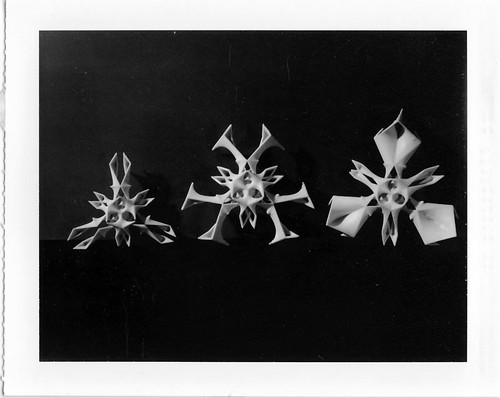
Image by core.formula
Prefab china
A collection of speedy prototyping models (ZPrint) created in the Pratt Institute School of Architecture 2007 PreFab China Style Studio,Evan Douglis, Richard Sarrach, Che-Wei Wang, Eric Wong
Function made by: Dan Breitner, Andres Correa , Brad Rothenberg
Please check out www.core.form-ula.com + www.prefabchina.com for more
All pictures are scanned from the proof poloroid of a huge format 4×5 camera. The photographer is Kim Keever and will be portion of the upcoming publication Autogenic Structures by Evan Douglis
Some cool higher precision engineering photos:
Vice and Drill Chuck
Image by tudedude
View On Black
Aligning the vice on a mill employing a .five inch High speed steel Dowel. The vice is only quite lightly bolted whilst carrying out this.
A few nice precision engineering services photos I found:
Red Arrows Show Group for 2014
Image by Defence Pictures
The Royal Air Force Aerobatics Group (RAFAT), The Red Arrows for the 2014 show season line up in front of one particular of their Hawk aircraft at RAF Scampton.
The Royal Air Force Aerobatic Team, The Red Arrows, is one of the world’s premier aerobatic show teams.
Representing the speed, agility and precision of the Royal Air Force, the Team is the public face of the service.
They help in recruiting, contribute to Defence Diplomacy when displaying overseas and act as ambassadors for the United Kingdom.
The Red Arrows also market the Best of British, supporting market and demonstrating the capabilities of the nation’s gear and engineering knowledge.
——————————————————-
© Crown Copyright 2013
Photographer: Senior Aircraftsman Adam Fletcher (RAF)
Image 45157029.jpg from www.defenceimages.mod.uk
Use of this image is subject to the terms and conditions of the MoD News Licence at www.defenceimagery.mod.uk/fotoweb/20121001_Crown_copyrigh…
For most recent news pay a visit to www.gov.uk/government/organisations/ministry-of-defence
Comply with us:
www.facebook.com/defenceimages
www.twitter.com/defenceimages
Image from page 270 of “Pacific service magazine” (1912)
Image by Internet Archive Book Pictures
Identifier: pacificservicema1627paci
Title: Pacific service magazine
Year: 1912 (1910s)
Authors: Pacific Gas and Electric Business
Subjects: Pacific Gas and Electric Business Electric utilities Electrical engineering Public utilities
Publisher: San Francisco : Pacific Gas and Electric Firm
Contributing Library: San Francisco Public Library
Digitizing Sponsor: San Francisco Public Library
View Book Page: Book Viewer
About This Book: Catalog Entry
View All Pictures: All Images From Book
Click here to view book online to see this illustration in context in a browseable on the web version of this book.
Text Appearing Ahead of Image:
rk within the estimated timeand, also, inside the estimated price. Theconstruction operate, in fact, was remarkablefor the mathematical precision with whichthe three major features, namely, the di- version dam. the tunnel and the energy-residence, have been carried to completion within afew days of one another, so that all vexa-tious delays have been eliminated from the con-struction system. It was indeed regardedas an achievement that a power-plant ofso fantastic magnitude, involving the construc-tion of a diversion dam 130 feet high and470 feet long and a concrete-lined tunnelnearly 4 miles in length, must be vehicle-ried via to completion in the space ofabout twenty-five months. Since its building Pit No. Three hasbeen doing yeoman service. The engineer-ing department had estimated its probablecontribution to the Pacific Service powerpool at 400,000,000 kilowatt hours a year.It might be mentioned now that the plant hasbravely lived up to the predictions madefor it, and at the present time is respon-
Text Appearing Following Image:
Diversion dam and tunnel intake at Pit River No. 3 Improvement. The gate-residence isseen at the intense right of the picture. 236 Pacific Service Magazine sible for about twenty per cent of the regu-lar output from our companys comprehen-sive electric producing technique. Pit No. Three, apart from its servicevalue, is exceptional for uncommon and pic-turesque attributes of building. The verydiversion dam that stretches across theriver is in itself a perform of art, surmountedas it is by a highway bridge which whenbrilliantly lit at evening presents a spec-tacle worth the view. This bridge wasbuilt by our company, with the complete con-sent of the Board of Supervisors of ShastaCounty, as part of a new highway routebetween the towns of Burney and Bartle.Prior to that travelers along that routecrossed the Pit river at Pecks bridge, butthat time-honored wooden structure nowlies fifty feet below the surface of LakeBritton, by which name the forebay reser-voir created by impounding the waters ofth
Note About Pictures
Please note that these photos are extracted from scanned web page photos that might have been digitally enhanced for readability – coloration and look of these illustrations might not completely resemble the original function.
A few nice precision engineering businesses photos I identified:
Image from page 186 of “Transactions of the Society of Motion Image Engineers (1921)” (1921)
Image by Web Archive Book Photos
Identifier: transactionsofso13soci
Title: Transactions of the Society of Motion Picture Engineers (1921)
Year: 1921 (1920s)
Authors: Society of Motion Image Engineers
Subjects: motion photos
Publisher: Society of Motion Picture Engineers
Contributing Library: Library of Congress, MBRS, Moving Image Section
Digitizing Sponsor: Library of Congress, Motion Image, Broadcasting and Recorded Sound Division
View Book Web page: Book Viewer
About This Book: Catalog Entry
View All Pictures: All Photos From Book
Click here to view book on the internet to see this illustration in context in a browseable on the web version of this book.
Text Appearing Prior to Image:
This entire manufacturing plant is devoted ex-clusively to the production of Motion Image Machines Stereopticons and Lantern Slides Sixty thousand feet of floor space, plenty of freshair and sunlight, precision machinery, the bestof materials and contented expert workmen, com-bine in the creating of the foremost line of non-theatrical image projectors in America. Catalogs and cost lists mailed on application VICTOR ANIMATOGRAPH CO., Inc. Davenport, Iowa, U. S. A. Sixty-5 million feet of EASTMANFILM was the average month-to-month pro-duction at Kodak Park lastyear, all manufactured on aquality basis. EASTMAN KODAK Firm ROCHESTER, N. Y. PERFECTION OF PROJECTION Can only be obtained with the KENOLITE Three Combination LENS
Text Appearing Soon after Image:
32.eight% Mere Light. 28% Much better Definition. 10 Days Trial Distributors of POWERS PROJECTORS SPEEDCO ARC CONTROLS Common ELECTRIC GENERATORS IMSCO ENGINES and GENERATORS Independent Movie Supply Co., Inc. W. H. RABELL, Pres. 729 Seventh Ave. sixth floor New York Our Catalogue Upon Request LANGS FILM REWINDER
Note About Photos
Please note that these pictures are extracted from scanned web page images that may possibly have been digitally enhanced for readability – coloration and appearance of these illustrations could not perfectly resemble the original operate.

