Showing posts with label Manufacturers. Show all posts

Saturday, May 9, 2015

Good Prototype Manufacturers In China photos

Verify out these prototype producers in china photos:


Steven F. Udvar-Hazy Center: South hangar panorama, like Vought OS2U-three Kingfisher seaplane, B-29 Enola Gay, among other people


Image by Chris Devers

Quoting Smithsonian National Air and Space Museum | Vought OS2U-3 Kingfisher:


The Kingfisher was the U.S. Navy’s principal ship-primarily based, scout and observation aircraft during Globe War II. Revolutionary spot welding methods gave it a smooth, non-buckling fuselage structure. Deflector plate flaps that hung from the wing’s trailing edge and spoiler-augmented ailerons functioned like further flaps to enable slower landing speeds. Most OS2Us operated in the Pacific, where they rescued a lot of downed airmen, like World War I ace Eddie Rickenbacker and the crew of his B-17 Flying Fortress.


In March 1942, this airplane was assigned to the battleship USS Indiana. It later underwent a six-month overhaul in California, returned to Pearl Harbor, and rejoined the Indiana in March 1944. Lt. j.g. Rollin M. Batten Jr. was awarded the Navy Cross for creating a daring rescue in this airplane below heavy enemy fire on July four, 1944.


Transferred from the United States Navy.


Manufacturer:
Vought-Sikorsky Aircraft Division


Date:

1937


Country of Origin:

United States of America


Dimensions:

Overall: 15ft 1 1/8in. x 33ft 9 1/2in., 4122.6lb., 36ft 1 1/16in. (460 x 1030cm, 1870kg, 1100cm)


Materials:

Wings covered with fabric aft of the main spar


Physical Description:

Two-seat monoplane, deflector plate flaps hung from the trailing edge of the wing, ailerons drooped at low airspeeds to function like further flaps, spoilers.


Steven F. Udvar-Hazy Center: P-40 Warhawk with “sharktooth” nose
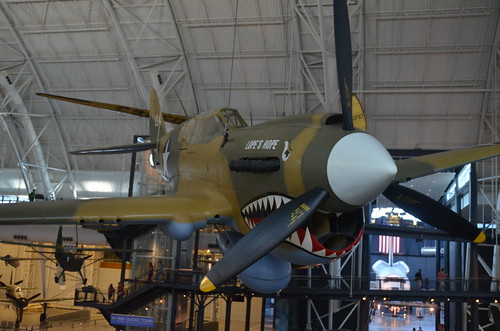

Image by Chris Devers
See a lot more pictures of this, and the Wikipedia article.


Specifics, quoting from Smithsonian National Air and Space Museum | Curtiss P-40E Warhawk (Kittyhawk IA):


No matter whether identified as the Warhawk, Tomahawk, or Kittyhawk, the Curtiss P-40 proved to be a effective, versatile fighter throughout the first half of Globe War II. The shark-mouthed Tomahawks that Gen. Claire Chennault’s &quotFlying Tigers&quot flew in China against the Japanese remain among the most well-known airplanes of the war. P-40E pilot Lt. Boyd D. Wagner became the 1st American ace of World War II when he shot down six Japanese aircraft in the Philippines in mid-December 1941.


Curtiss-Wright built this airplane as Model 87-A3 and delivered it to Canada as a Kittyhawk I in 1941. It served until 1946 in No. 111 Squadron, Royal Canadian Air Force. U.S. Air Force personnel at Andrews Air Force Base restored it in 1975 to represent an aircraft of the 75th Fighter Squadron, 23rd Fighter Group, 14th Air Force.


Donated by the Exchange Club in Memory of Kellis Forbes.


Manufacturer:
Curtiss Aircraft Firm


Date:

1939


Country of Origin:

United States of America


Dimensions:

All round: 330 x 970cm, 2686kg, 1140cm (10ft 9 15/16in. x 31ft 9 7/8in., 5921.6lb., 37ft four 13/16in.)


Supplies:

All-metal, semi-monocoque


Physical Description:

Single engine, single seat, fighter aircraft.


Long Description:

Whether or not it was the Tomahawk, Warhawk, or Kittyhawk, the Curtiss P-40 was a effective and versatile fighter aircraft for the duration of the 1st half of Globe War II. The shark-mouthed Tomahawks that General Claire Chennault led against the Japanese remain among the most well-known airplanes of the war. In the Phillipines, Lt. Boyd D. Wagner became the initial American ace of Planet War II whilst flying a P-40E when he shot down six Japanese aircraft in the course of mid-December 1941. P-40s had been first-line Army Air Corps fighters at the begin of the war but they quickly gave way to far more advanced styles such as the Republic P-47 Thunderbolt and the Lockheed P-38 Lightning (see NASM collection for each aircraft). The P-40 is not ranked amongst the very best all round fighters of the war but it was a rugged, effective style obtainable in big numbers early in the war when America and her allies urgently necessary them. The P-40 remained in production from 1939 to the end of 1944 and a total of 13, 737 have been built.


Design engineer Dr. Donovan R. Berlin layed the foundation for the P-40 in 1935 when he created the agile, but lightly-armed, P-36 fighter equipped with a radial, air-cooled engine. The Curtiss-Wright Corporation won a production contract for 210 P-36 airplanes in 1937-the biggest Army airplane contract awarded because World War I. Worldwide, fighter aircraft styles matured rapidly in the course of the late 1930s and it was soon apparent that the P-36 was no match for newer European designs. Higher altitude overall performance in particular became a priceless commodity. Berlin attempted to increase the P-36 by redesigning it in to accommodate a turbo-supercharged Allison V-1710-11 inline, liquid-cooled engine. The new aircraft was designated the XP-37 but proved unpopular with pilots. The turbo-supercharger was not trustworthy and Berlin had placed the cockpit as well far back on the fuselage, restricting the view to the front of the fighter. Nonetheless, when the engine was not giving difficulty, the more-streamlined XP-37 was a lot more quickly than the P-36.


Curtiss attempted once more in 1938. Berlin had modified yet another P-36 with a new Allison V-1710-19 engine. It was designated the XP-40 and very first flew on October 14, 1938. The XP-40 looked promising and Curtiss supplied it to Army Air Corps leaders who evaluated the airplane at Wright Field, Ohio, in 1939, along with numerous other fighter proposals. The P-40 won the competitors, soon after some modifications, and Curtiss received an order for 540. At this time, the armament package consisted of two .50 caliber machine guns in the fuselage and 4 .30 caliber machine guns in the wings.


After production began in March 1940, France ordered 140 P-40s but the British took delivery of these airplanes when Paris surrendered. The British named the aircraft Tomahawks but identified they performed poorly in higher-altitude combat over northern Europe and relegated them to low-altitude operations in North Africa. The Russians bought much more than 2,000 P-40s but information of their operational history stay obscure.


When the United States declared war, P-40s equipped numerous of the Army Air Corps’s front line fighter units. The plucky fighter ultimately saw combat in practically each and every theater of operations being the most powerful in the China-Burma-India (CBI) Theater. Of all the CBI groups that gained the most notoriety of the complete war, and remains to this day synonymous with the P-40, is the American Volunteer Group (AVG) or the Flying Tigers. The unit was organized right after the Chinese gave former U. S. Army Air Corps Captain Claire Lee Chennault virtually 9 million dollars in 1940 to buy aircraft and recruit pilots to fly against the Japanese. Chennault’s most critical assistance within the Chinese government came from Madam Chiang Kai-shek, a Lt. Colonel in the Chinese Air Force and for a time, the service’s overall commander.


The income from China diverted an order placed by the British Royal Air Force for one hundred Curtiss-Wright P-40B Tomahawks but getting airplanes was only one particular important step in making a fighting air unit. Educated pilots had been required, and rapidly, as tensions across the Pacific escalated. On April 15, 1941, President Franklin D. Roosevelt quietly signed an Executive Order permitting Chennault to recruit straight from the ranks of American military reserve pilots. Within a few months, 350 flyers joined from pursuit (fighter), bomber, and patrol squadrons. In all, about half the pilots in the Flying Tigers came from the U. S. Navy and Marine Corps even though the Army Air Corps supplied 1-third. Factory test pilots at Bell, Consolidated, and other firms, and commercial airline pilots, filled the remaining slots.


The Flying Tigers flew their 1st mission on December 20. The unit’s name was derived from the ferocious fangs and teeth painted on the nose of AVG P-40s at either side of the distinctive, large radiator air intake. The concept is mentioned to originate from images in a magazine that showed Royal Air Force Tomahawks of No. 112 Squadron, operating in the western desert of North Africa, adorned with fangs and teeth painted about their air intakes. The Flying Tigers had been the first genuine opposition the Japanese military encountered. In much less than 7 months of action, AVG pilots destroyed about 115 Japanese aircraft and lost only 11 planes in air-to-air combat. The AVG disbanded on July four, 1942, and its assets, which includes a few pilots, became a component of the U. S. Army Air Forces (AAF) 23rd Fighter Group in the newly activated 14th Air Force. Chennault, now a Brigadier Common, assumed command of the 14th AF and by war’s end, the 23rd was one of the highest-scoring Army fighter groups.


As wartime expertise in the P-40 mounted, Curtiss made several modifications. Engineers added armor plate, greater self-sealing fuel tanks, and far more potent engines. They modified the cockpit to enhance visibility and changed the armament package to six, wing-mounted, .50 caliber machine guns. The P-40E Kittyhawk was the very first model with this gun package and it entered service in time to serve in the AVG. The last model created in quantity was the P-40N, the lightest P-40 constructed in quantity, and significantly more quickly than preceding models. Curtiss constructed a single P-40Q. It was the quickest P-40 to fly (679 kph/422 mph) but it could not match the functionality of the P-47 Thunderbolt and the P-51 Mustang so Curtiss ended development of the P-40 series with this model. In addition to the AAF, several Allied nations purchased and flew P-40s like England, France, China, Russia, Australia, New Zealand, Canada, South Africa, and Turkey.


The Smithsonian P-40E did not serve in the U. S. military. Curtiss-Wright built it in Buffalo, New York, as Model 87-A3 and delivered it to Canada as a Kittyhawk IA on March 11, 1941. It served in No. 111 Squadron, Royal Canadian Air Force (RCAF). When the Japanese navy moved to attack Midway, they sent a diversionary battle group to menace the Aleutian Islands. Canada moved No. 111 Squadron to Alaska to assist defend the region. Right after the Japanese threat diminished, the unit returned to Canada and at some point transferred to England without having its P-40s. The RCAF declared the NASM Kittyhawk IA surplus on July 27, 1946, and the aircraft at some point returned to the United States. It had several owners prior to ending up with the Explorer Scouts youth group in Meridian, Mississippi. Throughout the early 1960s, the Smithsonian started looking for a P-40 with a documented history of service in the AVG but discovered none. In 1964, the Exchange Club in Meridian donated the Kittyhawk IA to the National Aeronautical Collection, in memory of Mr. Kellis Forbes, a local man devoted to Boys Club activities. A U. S. Air Force Reserve crew airlifted the fighter to Andrews Air Force Base, Maryland, on March 13, 1964. Andrews personnel restored the airplane in 1975 and painted it to represent an aircraft of the 75th Fighter Squadron, 23rd Fighter Group, 14th Air Force.


• • •


Quoting from Wikipedia | Curtiss P-40 Warhawk:


The Curtiss P-40 Warhawk was an American single-engine, single-seat, all-metal fighter and ground attack aircraft that 1st flew in 1938. It was employed by the air forces of 28 nations, such as these of most Allied powers in the course of World War II, and remained in front line service till the finish of the war. It was the third most-made American fighter, following the P-51 and P-47 by November 1944, when production of the P-40 ceased, 13,738 had been constructed, all at Curtiss-Wright Corporation‘s primary production facility at Buffalo, New York.


The P-40 design and style was a modification of the preceding Curtiss P-36 this lowered improvement time and enabled a speedy entry into production and operational service.


Warhawk was the name the United States Army Air Corps adopted for all models, generating it the official name in the United States for all P-40s. The British Commonwealth and Soviet air forces utilised the name Tomahawk for models equivalent to the P-40B and P-40C, and the name Kittyhawk for models equivalent to the P-40D and all later variants.


The P-40’s lack of a two-stage supercharger produced it inferior to Luftwaffe fighters such as the Messerschmitt Bf 109 or the Focke-Wulf Fw 190 in high-altitude combat and it was rarely utilized in operations in Northwest Europe. In between 1941 and 1944, however, the P-40 played a crucial role with Allied air forces in three main theaters: North Africa, the Southwest Pacific and China. It also had a considerable role in the Middle East, Southeast Asia, Eastern Europe, Alaska and Italy. The P-40’s functionality at high altitudes was not as crucial in those theaters, where it served as an air superiority fighter, bomber escort and fighter bomber.


P-40s 1st saw combat with the British Commonwealth squadrons of the Desert Air Force (DAF) in the Middle East and North African campaigns, in the course of June 1941. The Royal Air Force‘s No. 112 Squadron was amongst the first to operate Tomahawks, in North Africa, and the unit was the initial to feature the &quotshark mouth&quot logo, copying related markings on some Luftwaffe Messerschmitt Bf 110 twin-engine fighters. [N 1]


Even though it gained a post-war reputation as a mediocre design, appropriate only for close air assistance, much more current analysis like scrutiny of the records of individual Allied squadrons indicates that the P-40 performed surprisingly properly as an air superiority fighter, at instances suffering extreme losses, but also taking a extremely heavy toll on enemy aircraft. The P-40 supplied the further benefit of low cost, which kept it in production as a ground-attack fighter extended following it was obsolete in the air superiority function.


As of 2008, 19 P-40s were airworthy.


• • • • •


See far more pictures of this, and the Wikipedia write-up.


Information, quoting from Smithsonian National Air and Space Museum | Space Shuttle Enterprise:


Manufacturer:
Rockwell International Corporation


Country of Origin:

United States of America


Dimensions:

General: 57 ft. tall x 122 ft. lengthy x 78 ft. wing span, 150,000 lb.

(1737.36 x 3718.57 x 2377.44cm, 68039.6kg)


Materials:

Aluminum airframe and physique with some fiberglass characteristics payload bay doors are graphite epoxy composite thermal tiles are simulated (polyurethane foam) except for test samples of actual tiles and thermal blankets.


The 1st Space Shuttle orbiter, &quotEnterprise,&quot is a full-scale test automobile used for flights in the atmosphere and tests on the ground it is not equipped for spaceflight. Although the airframe and flight handle elements are like these of the Shuttles flown in space, this automobile has no propulsion system and only simulated thermal tiles due to the fact these attributes had been not necessary for atmospheric and ground tests. &quotEnterprise&quot was rolled out at Rockwell International’s assembly facility in Palmdale, California, in 1976. In 1977, it entered service for a nine-month-long strategy-and-landing test flight system. Thereafter it was employed for vibration tests and fit checks at NASA centers, and it also appeared in the 1983 Paris Air Show and the 1984 World’s Fair in New Orleans. In 1985, NASA transferred &quotEnterprise&quot to the Smithsonian Institution’s National Air and Space Museum.


Transferred from National Aeronautics and Space Administration


(Source from rapid prototyping from China blog)

Sunday, November 16, 2014

Latest Prototype Manufacturers In China News

Why SLM 3D Printing Has Substantial Positive aspects for the Automotive Market

No wonder that many automotive engineers use selective laser melting for producing functional prototypes for pre-series testing, but also attempt to incorporate it much more and more in the true manufacturing procedure. How Does the Automotive Business Advantage …
Read a lot more on 3DPrint.com


​CIA prototype of Osama bin Laden doll up for auction

According to the Washington Post, the CIA only made three of the dolls, and in right after the prototype was developed, it decided to scrap the idea. Spokesman Ryan Trapani told the Post that the CIA, &quothas no knowledge of these action figures getting …
Read more on CBS News


Methode Announces NP-100 Prototype and Improvement Printer for the Printed

The NP-one hundred improvement and prototype printer is a robust platform that provides consumers an expanded capability to work with a wider variety of substrates for development and prototype production. … Methode Electronics, Inc. ( NYSE : MEI) is a worldwide …
Study a lot more on Marketwired (press release)


(Source from rapid prototyping in China blog)

Monday, October 6, 2014

Latest Precision Turned Parts Manufacturers News

Schools&#39 wait lists named a drag on the economy

In New Bedford, where the 10.5 percent jobless price is almost double the state typical, the Higher New Bedford Regional Vocational Technical High College turned away a lot more than 500 students since of lack of capacity. In Springfield, exactly where unemployment …
Study more on Boston Globe


(Posted by an aluminium machining China Company and precision CNC machined parts China manufacturer)

Sunday, October 5, 2014

VMA manufacturers showcase draws record turnout

VMA companies showcase draws record turnout

… Aeronautical University, featured displays by manufacturers from all through the Volusia-Flagler location as well as a robotics competitors pitting six teams from region high schools and an art show of pieces designed with computerized precision machining …
Read far more on Daytona Beach News-Journal


Robot Transfer Unit Adds Flexibility to Machining Production

Methods Machine works with a variety of suppliers to make precision machines, tooling and fixtures. 1 supplier is … Recently, a big automotive supplier met with Approaches Machine Tools, hoping it could develop a fully automated machining line for castings.
Study far more on Assembly Magazine


(Posted by an aluminium machining China Company and precision CNC machined parts China manufacturer)

BRM Releases New Video Showing How to Automate Deburring and Surface Finishing with Flexible Hones Manufacturers Use Cylinder Honing Tools in Machine Centers


Los Angeles, CA (PRWEB) July 09, 2013


Brush Investigation Manufacturing (BRM), maker of versatile hones and a full line of industrial brushes, is announcing a new video featuring its versatile and dependable Flex-Hone® tool. BRM’s In-Machine Setup: Automated Deburring and Finishing video shows makers how to automate burr removal, edge blending, and surface finishing with flexible honing tools. By utilizing cylinder hones after machining, manufacturers can speed secondary operations and permit gear to run at optimum cycle occasions.


&#13


Burr Removal, Edge Blending, and Plateau Finishing


&#13


Cutting, turning, and drilling metal parts creates raised areas known as burrs that can impact dimensional tolerances, result in element misalignments, and limit the overall efficiency of machined elements. With cross-drilled holes, burrs can also impede the flow of cooling fluids, lubricants, and gases. Deburring is essential, of course, but manufacturers also want to impart a surface finish that increases bearing location, reduces friction and wear, and promotes lubrication.


&#13


As BRM’s new video shows, the Flex-Hone® tool solves these and other surface finishing challenges. Examples include cross-drilled holes in 7075 aluminum cylinders and radial slots in 6061 aluminum bores. Just 3 minutes and 32 seconds long, the new BRM video also shows how the Flex-Hone® reduces surface roughness and improves surface finish down to the single RA level. Close-ups of the crosshatch pattern that versatile honing imparts reveal a substantially flat or plateau finish on cylinder walls.


&#13


Deciding on and Using Flexible Honing Tools


&#13


BRM’s flexible hones are accessible in ten distinct abrasive sorts from 20 to 800 grit, and come in diameters ranging from four-mm to 36”. To automate secondary operations, companies can use the Flex-Hone® tool in a machining center to remove burrs uniformly, effectively, and expense-successfully while enhancing surface finish at the identical time. With CNC equipment, use a Jacobs style chuck directly on the brush tool’s stem wire. BRM plateau hones also mount in lathes, mills, drill presses, and electric hand drills to replace labor-intensive and time-consuming manual deburring operations.


&#13


Self-centering, self-aligning, and self-compensating for put on, the Flex-Hone® tool follows bore geometry and will not affect size, ovality, or concentricity. Versatile hones are mostly surface finishing and deburring tools, and are not created for heavy-duty or high-precision metal removal. As the In-Machine Setup: Automated Deburring and Finishing video explains, always use versatile hones with a honing oil or coolant for lubrication.


&#13


About Brush Study Manufacturing


&#13


Brush Investigation Manufacturing (BRM), makers of a complete line of flexible honing tools and industrial brushes, is positioned in Los Angeles, California. Because 1958, BRM has been solving difficult finishing troubles with brushing technology. Download the Flex-Hone® Resource Guide for a lot more data about how to pick and use flexible honing tools.


&#13


Media Contact:&#13

Heather Jones&#13

Director of Advertising &#13

Brush Research Manufacturing Co. Inc. &#13

4642 Floral Drive&#13

Los Angeles, CA 90022&#13

HJones(at)brushresearch(dot)com


&#13


For Instant Release:&#13

http://www.brushresearch.com/&#13

Ph: (323) 261-2193


&#13

&#13

&#13

&#13

&#13


(Posted by an aluminium machining China Company and precision CNC machined parts China manufacturer)

Thursday, October 2, 2014

Inspection Machine Manufacturers Ahmedabad | Textile Machinery Components Manufacturers


We Ambatex Engineers- www.ambatexengineers.com are Companies of Inspection Machine,Textile Machinery Components, Brushing Machine, Peach Emerazing Machine and so on…
Video Rating: / 5


(Posted by an aluminium machining China Company and precision CNC machined parts China manufacturer)

Wednesday, September 24, 2014

Newest Precision Turned Components Manufacturers News

LEGO-like Parts Make Creating 3-D Labs-on-a-chip a Snap

Creating a single device can typically need multiple iterations, each and every of which can take up to two weeks and many thousand dollars to manufacture. And the more complicated the system, the greater the number of iterations necessary. &quotYou test your device and …
Study far more on Laboratory Gear


(Posted by an aluminium machining China Company and precision CNC machined parts China manufacturer)

Monday, September 22, 2014

sheet metal components manufacturers China


make contact with Ray Chen at sales05@joinconn.com joinconn is a metal stampings manufacturer in China since 1998. Find out a lot more ,please pay a visit to www.joinconn.com.
Video Rating: / five


(Posted by an aluminium machining China Company and precision CNC machined parts China manufacturer)

Friday, September 12, 2014

CAD/CAM Manufacturers Are Trending Towards Open Architecture: U.S. Market place Led by Sirona, Align Technologies, and EnvisionTec

Vancouver, BC (PRWEB) September 11, 2014


According to a report series by iData Analysis, the leading global authority in health-related device, dental and pharmaceutical industry analysis, the total U.S. CAD/CAM technique market is anticipated to develop to more than $ 300 million by 2020. CAD/CAM systems marketplace involves complete in-lab, standalone scanners and chairside systems. Market place development will be driven by the improve in demand by each customers and dentists for all-ceramic restorations due to their superior aesthetic qualities, biocompatibility of ceramic materials and economical pricing.


Chairside systems are the fastest expanding market, as much more laboratories and dental offices are going digital, making use of CAD/CAM technologies, intra-oral digital impression-taking devices and rapid prototyping systems. This market place is expected to experience double digit development by 2020. “Chairside use is expected to enhance further due to the new entry of glass ceramics blocks to the marketplace and the reimbursement of resin supplies at the same rate as ceramics,” says Dr. Kamran Zamanian, CEO of iData.


CAD/CAM makers are trending towards open architecture, meaning that the application can be utilized in conjunction with any milling unit. Open architecture makes it possible for systems presented from various firms to inter-communicate. For example, 3Shape and Dental Wings only offer standalone scanner systems, but they are compatible with various milling systems such as Wieland Dental’s ZENOTEC™ and B&ampD Dental’s ORIGIN® for milling restorations. This trend is far more visible among lower priced CAD/CAM systems such as Schütz Dental’s Tizan™, which gives an open architecture to operate with other systems.


One particular of the major trends driving the technological developments is the demand for far more assortment offered by CAD/CAM systems, such as versatility in materials utilized allowing for the alternative of utilizing wax or composite material to mill a restoration. An additional driving trend is giving laboratories the alternative of choosing how they want the restoration prepared. DENTSPLY for instance, provides a quantity of techniques to mill a dental restoration making use of their CAD/CAM technologies.


Essential leading manufacturers in this industry are Sirona, Align Technologies, and EnvisionTec. Other respected competitors such as 3Shape, DENTSPLY, Nobel Biocare and Dental Wings, supply a diverse range of CAD/CAM items and related devices, such as CAD/CAM blocks and prosthetics.


For far more details


iData’s four-report series on the U.S., European, Asia-Pacific and Emerging “Markets for Dental Prosthetics and CAD/CAM Devices” covers Crowns and Bridges, Inlays and Onlays, Veneers, Dentures, CAD/CAM Systems, Intra-Oral Digital Impression-Taking Systems and Rapid Prototyping Systems.


The full reports supply a comprehensive analysis like procedure numbers, units sold, marketplace worth, forecasts, as nicely as a detailed competitive marketplace shares and evaluation of main players’ accomplishment techniques in each market and segment.


For a cost-free executive summary pay a visit to


http://www.idataresearch.com/u-s-dental-prosthetics-cadcam-devices-market place-2014/


About iData Analysis


iData Study (http://www.idataresearch.com) is an international market research and consulting group focused on supplying industry intelligence for health-related device and pharmaceutical organizations. iData covers analysis in: dental, orthopedics, imaging and more.


(Posted by an aluminium machining China Company and precision CNC machined parts China manufacturer)

Saturday, September 6, 2014

Nice Precision Turned Parts Manufacturers photos

A few nice precision turned parts manufacturers images I found:


Steven F. Udvar-Hazy Center: B-29 Superfortress “Enola Gay” panorama


Image by Chris Devers
See more photos of this, and the Wikipedia article.


Details, quoting from Smithsonian National Air and Space Museum | Lockheed P-38J-10-LO Lightning


In the P-38 Lockheed engineer Clarence "Kelly" Johnson and his team of designers created one of the most successful twin-engine fighters ever flown by any nation. From 1942 to 1945, U. S. Army Air Forces pilots flew P-38s over Europe, the Mediterranean, and the Pacific, and from the frozen Aleutian Islands to the sun-baked deserts of North Africa. Lightning pilots in the Pacific theater downed more Japanese aircraft than pilots flying any other Allied warplane.


Maj. Richard I. Bong, America’s leading fighter ace, flew this P-38J-10-LO on April 16, 1945, at Wright Field, Ohio, to evaluate an experimental method of interconnecting the movement of the throttle and propeller control levers. However, his right engine exploded in flight before he could conduct the experiment.


Transferred from the United States Air Force.


Manufacturer:
Lockheed Aircraft Company


Date:

1943


Country of Origin:

United States of America


Dimensions:

Overall: 390 x 1170cm, 6345kg, 1580cm (12ft 9 9/16in. x 38ft 4 5/8in., 13988.2lb., 51ft 10 1/16in.)


Materials:

All-metal


Physical Description:

Twin-tail boom and twin-engine fighter; tricycle landing gear.


Long Description:

From 1942 to 1945, the thunder of P-38 Lightnings was heard around the world. U. S. Army pilots flew the P-38 over Europe, the Mediterranean, and the Pacific; from the frozen Aleutian Islands to the sun-baked deserts of North Africa. Measured by success in combat, Lockheed engineer Clarence "Kelly" Johnson and a team of designers created the most successful twin-engine fighter ever flown by any nation. In the Pacific Theater, Lightning pilots downed more Japanese aircraft than pilots flying any other Army Air Forces warplane.


Johnson and his team conceived this twin-engine, single-pilot fighter airplane in 1936 and the Army Air Corps authorized the firm to build it in June 1937. Lockheed finished constructing the prototype XP-38 and delivered it to the Air Corps on New Year’s Day, 1939. Air Corps test pilot and P-38 project officer, Lt. Benjamin S. Kelsey, first flew the aircraft on January 27. Losing this prototype in a crash at Mitchel Field, New York, with Kelsey at the controls, did not deter the Air Corps from ordering 13 YP-38s for service testing on April 27. Kelsey survived the crash and remained an important part of the Lightning program. Before the airplane could be declared ready for combat, Lockheed had to block the effects of high-speed aerodynamic compressibility and tail buffeting, and solve other problems discovered during the service tests.


The most vexing difficulty was the loss of control in a dive caused by aerodynamic compressibility. During late spring 1941, Air Corps Major Signa A. Gilke encountered serious trouble while diving his Lightning at high-speed from an altitude of 9,120 m (30,000 ft). When he reached an indicated airspeed of about 515 kph (320 mph), the airplane’s tail began to shake violently and the nose dropped until the dive was almost vertical. Signa recovered and landed safely and the tail buffet problem was soon resolved after Lockheed installed new fillets to improve airflow where the cockpit gondola joined the wing center section. Seventeen months passed before engineers began to determine what caused the Lightning’s nose to drop. They tested a scale model P-38 in the Ames Laboratory wind tunnel operated by the NACA (National Advisory Committee for Aeronautics) and found that shock waves formed when airflow over the wing leading edges reached transonic speeds. The nose drop and loss of control was never fully remedied but Lockheed installed dive recovery flaps under each wing in 1944. These devices slowed the P-38 enough to allow the pilot to maintain control when diving at high-speed.


Just as the development of the North American P-51 Mustang, Republic P-47 Thunderbolt, and the Vought F4U Corsair (see NASM collection for these aircraft) pushed the limits of aircraft performance into unexplored territory, so too did P-38 development. The type of aircraft envisioned by the Lockheed design team and Air Corps strategists in 1937 did not appear until June 1944. This protracted shakedown period mirrors the tribulations suffered by Vought in sorting out the many technical problems that kept F4U Corsairs off U. S. Navy carrier decks until the end of 1944.


Lockheed’s efforts to trouble-shoot various problems with the design also delayed high-rate, mass production. When Japan attacked Pearl Harbor, the company had delivered only 69 Lightnings to the Army. Production steadily increased and at its peak in 1944, 22 sub-contractors built various Lightning components and shipped them to Burbank, California, for final assembly. Consolidated-Vultee (Convair) subcontracted to build the wing center section and the firm later became prime manufacturer for 2,000 P-38Ls but that company’s Nashville plant completed only 113 examples of this Lightning model before war’s end. Lockheed and Convair finished 10,038 P-38 aircraft including 500 photo-reconnaissance models. They built more L models, 3,923, than any other version.


To ease control and improve stability, particularly at low speeds, Lockheed equipped all Lightnings, except a batch ordered by Britain, with propellers that counter-rotated. The propeller to the pilot’s left turned counter-clockwise and the propeller to his right turned clockwise, so that one propeller countered the torque and airflow effects generated by the other. The airplane also performed well at high speeds and the definitive P-38L model could make better than 676 kph (420 mph) between 7,600 and 9,120 m (25,000 and 30,000 ft). The design was versatile enough to carry various combinations of bombs, air-to-ground rockets, and external fuel tanks. The multi-engine configuration reduced the Lightning loss-rate to anti-aircraft gunfire during ground attack missions. Single-engine airplanes equipped with power plants cooled by pressurized liquid, such as the North American P-51 Mustang (see NASM collection), were particularly vulnerable. Even a small nick in one coolant line could cause the engine to seize in a matter of minutes.


The first P-38s to reach the Pacific combat theater arrived on April 4, 1942, when a version of the Lightning that carried reconnaissance cameras (designated the F-4), joined the 8th Photographic Squadron based in Australia. This unit launched the first P-38 combat missions over New Guinea and New Britain during April. By May 29, the first 25 P-38s had arrived in Anchorage, Alaska. On August 9, pilots of the 343rd Fighter Group, Eleventh Air Force, flying the P-38E, shot down a pair of Japanese flying boats.


Back in the United States, Army Air Forces leaders tried to control a rumor that Lightnings killed their own pilots. On August 10, 1942, Col. Arthur I. Ennis, Chief of U. S. Army Air Forces Public Relations in Washington, told a fellow officer "… Here’s what the 4th Fighter [training] Command is up against… common rumor out there that the whole West Coast was filled with headless bodies of men who jumped out of P-38s and had their heads cut off by the propellers." Novice Lightning pilots unfamiliar with the correct bailout procedures actually had more to fear from the twin-boom tail, if an emergency dictated taking to the parachute but properly executed, Lightning bailouts were as safe as parachuting from any other high-performance fighter of the day. Misinformation and wild speculation about many new aircraft was rampant during the early War period.


Along with U. S. Navy Grumman F4F Wildcats (see NASM collection) and Curtiss P-40 Warhawks (see NASM collection), Lightnings were the first American fighter airplanes capable of consistently defeating Japanese fighter aircraft. On November 18, men of the 339th Fighter Squadron became the first Lightning pilots to attack Japanese fighters. Flying from Henderson Field on Guadalcanal, they claimed three during a mission to escort Boeing B-17 Flying Fortress bombers (see NASM collection).


On April 18, 1943, fourteen P-38 pilots from the 70th and the 339th Fighter Squadrons, 347th Fighter Group, accomplished one of the most important Lightning missions of the war. American ULTRA cryptanalysts had decoded Japanese messages that revealed the timetable for a visit to the front by the commander of the Imperial Japanese Navy, Admiral Isoroku Yamamoto. This charismatic leader had crafted the plan to attack Pearl Harbor and Allied strategists believed his loss would severely cripple Japanese morale. The P-38 pilots flew 700 km (435 miles) at heights from 3-15 m (10-50 feet) above the ocean to avoid detection. Over the coast of Bougainville, they intercepted a formation of two Mitsubishi G4M BETTY bombers (see NASM collection) carrying the Admiral and his staff, and six Mitsubishi A6M Zero fighters (see NASM collection) providing escort. The Lightning pilots downed both bombers but lost Lt. Ray Hine to a Zero.


In Europe, the first Americans to down a Luftwaffe aircraft were Lt. Elza E. Shahan flying a 27th Fighter Squadron P-38E, and Lt. J. K. Shaffer flying a Curtiss P-40 (see NASM collection) in the 33rd Fighter Squadron. The two flyers shared the destruction of a Focke-Wulf Fw 200C-3 Condor maritime strike aircraft over Iceland on August 14, 1942. Later that month, the 1st fighter group accepted Lightnings and began combat operations from bases in England but this unit soon moved to fight in North Africa. More than a year passed before the P-38 reappeared over Western Europe. While the Lightning was absent, U. S. Army Air Forces strategists had relearned a painful lesson: unescorted bombers cannot operate successfully in the face of determined opposition from enemy fighters. When P-38s returned to England, the primary mission had become long-range bomber escort at ranges of about 805 kms (500 miles) and at altitudes above 6,080 m (20,000 ft).


On October 15, 1943, P-38H pilots in the 55th Fighter Group flew their first combat mission over Europe at a time when the need for long-range escorts was acute. Just the day before, German fighter pilots had destroyed 60 of 291 Eighth Air Force B-17 Flying Fortresses (see NASM collection) during a mission to bomb five ball-bearing plants at Schweinfurt, Germany. No air force could sustain a loss-rate of nearly 20 percent for more than a few missions but these targets lay well beyond the range of available escort fighters (Republic P-47 Thunderbolt, see NASM collection). American war planners hoped the long-range capabilities of the P-38 Lightning could halt this deadly trend, but the very high and very cold environment peculiar to the European air war caused severe power plant and cockpit heating difficulties for the Lightning pilots. The long-range escort problem was not completely solved until the North American P-51 Mustang (see NASM collection) began to arrive in large numbers early in 1944.


Poor cockpit heating in the H and J model Lightnings made flying and fighting at altitudes that frequently approached 12,320 m (40,000 ft) nearly impossible. This was a fundamental design flaw that Kelly Johnson and his team never anticipated when they designed the airplane six years earlier. In his seminal work on the Allison V-1710 engine, Daniel Whitney analyzed in detail other factors that made the P-38 a disappointing airplane in combat over Western Europe.


• Many new and inexperienced pilots arrived in England during December 1943, along with the new J model P-38 Lightning.


• J model rated at 1,600 horsepower vs. 1,425 for earlier H model Lightnings. This power setting required better maintenance between flights. It appears this work was not done in many cases.


• During stateside training, Lightning pilots were taught to fly at high rpm settings and low engine manifold pressure during cruise flight. This was very hard on the engines, and not in keeping with technical directives issued by Allison and Lockheed.


• The quality of fuel in England may have been poor, TEL (tetraethyl lead) fuel additive appeared to condense inside engine induction manifolds, causing detonation (destructive explosion of fuel mixture rather than controlled burning).


• Improved turbo supercharger intercoolers appeared on the J model P-38. These devices greatly reduced manifold temperatures but this encouraged TEL condensation in manifolds during cruise flight and increased spark plug fouling.


Using water injection to minimize detonation might have reduced these engine problems. Both the Republic P-47 Thunderbolt and the North American P-51 Mustang (see NASM collection) were fitted with water injection systems but not the P-38. Lightning pilots continued to fly, despite these handicaps.


During November 1942, two all-Lightning fighter groups, the 1st and the 14th, began operating in North Africa. In the Mediterranean Theater, P-38 pilots flew more sorties than Allied pilots flying any other type of fighter. They claimed 608 enemy a/c destroyed in the air, 123 probably destroyed and 343 damaged, against the loss of 131 Lightnings.


In the war against Japan, the P-38 truly excelled. Combat rarely occurred above 6,080 m (20,000 ft) and the engine and cockpit comfort problems common in Europe never plagued pilots in the Pacific Theater. The Lightning’s excellent range was used to full advantage above the vast expanses of water. In early 1945, Lightning pilots of the 12th Fighter Squadron, 18th Fighter Group, flew a mission that lasted 10 ½ hours and covered more than 3,220 km (2,000 miles). In August, P-38 pilots established the world’s long-distance record for a World War II combat fighter when they flew from the Philippines to the Netherlands East Indies, a distance of 3,703 km (2,300 miles). During early 1944, Lightning pilots in the 475th Fighter Group began the ‘race of aces.’ By March, Lieutenant Colonel Thomas J. Lynch had scored 21 victories before he fell to antiaircraft gunfire while strafing enemy ships. Major Thomas B. McGuire downed 38 Japanese aircraft before he was killed when his P-38 crashed at low altitude in early January 1945. Major Richard I. Bong became America’s highest scoring fighter ace (40 victories) but died in the crash of a Lockheed P-80 (see NASM collection) on August 6, 1945.


Museum records show that Lockheed assigned the construction number 422-2273 to the National Air and Space Museum’s P-38. The Army Air Forces accepted this Lightning as a P-38J-l0-LO on November 6, 1943, and the service identified the airplane with the serial number 42-67762. Recent investigations conducted by a team of specialists at the Paul E. Garber Facility, and Herb Brownstein, a volunteer in the Aeronautics Division at the National Air and Space Museum, have revealed many hitherto unknown aspects to the history of this aircraft.


Brownstein examined NASM files and documents at the National Archives. He discovered that a few days after the Army Air Forces (AAF) accepted this airplane, the Engineering Division at Wright Field in Dayton, Ohio, granted Lockheed permission to convert this P-38 into a two-seat trainer. The firm added a seat behind the pilot to accommodate an instructor who would train civilian pilots in instrument flying techniques. Once trained, these test pilots evaluated new Lightnings fresh off the assembly line.


In a teletype sent by the Engineering Division on March 2, 1944, Brownstein also discovered that this P-38 was released to Colonel Benjamin S. Kelsey from March 3 to April 10, 1944, to conduct special tests. This action was confirmed the following day in a cable from the War Department. This same pilot, then a Lieutenant, flew the XP-38 across the United States in 1939 and survived the crash that destroyed this Lightning at Mitchel Field, New York. In early 1944, Kelsey was assigned to the Eighth Air Force in England and he apparently traveled to the Lockheed factory at Burbank to pick up the P-38. Further information about these tests and Kelsey’s involvement remain an intriguing question.


One of Brownstein’s most important discoveries was a small file rich with information about the NASM Lightning. This file contained a cryptic reference to a "Major Bong" who flew the NASM P-38 on April 16, 1945, at Wright Field. Bong had planned to fly for an hour to evaluate an experimental method of interconnecting the movement of the throttle and propeller control levers. His flight ended after twenty-minutes when "the right engine blew up before I had a chance [to conduct the test]." The curator at the Richard I. Bong Heritage Center confirmed that America’s highest scoring ace made this flight in the NASM P-38 Lightning.


Working in Building 10 at the Paul E. Garber Facility, Rob Mawhinney, Dave Wilson, Wil Lee, Bob Weihrauch, Jim Purton, and Heather Hutton spent several months during the spring and summer of 2001 carefully disassembling, inspecting, and cleaning the NASM Lightning. They found every hardware modification consistent with a model J-25 airplane, not the model J-10 painted in the data block beneath the artifact’s left nose. This fact dovetails perfectly with knowledge uncovered by Brownstein. On April 10, the Engineering Division again cabled Lockheed asking the company to prepare 42-67762 for transfer to Wright Field "in standard configuration." The standard P-38 configuration at that time was the P-38J-25. The work took several weeks and the fighter does not appear on Wright Field records until May 15, 1944. On June 9, the Flight Test Section at Wright Field released the fighter for flight trials aimed at collecting pilot comments on how the airplane handled.


Wright Field’s Aeromedical Laboratory was the next organization involved with this P-38. That unit installed a kit on July 26 that probably measured the force required to move the control wheel left and right to actuate the power-boosted ailerons installed in all Lightnings beginning with version J-25. From August 12-16, the Power Plant Laboratory carried out tests to measure the hydraulic pump temperatures on this Lightning. Then beginning September 16 and lasting about ten days, the Bombing Branch, Armament Laboratory, tested type R-3 fragmentation bomb racks. The work appears to have ended early in December. On June 20, 1945, the AAF Aircraft Distribution Office asked that the Air Technical Service Command transfer the Lightning from Wright Field to Altus Air Force Base, Oklahoma, a temporary holding area for Air Force museum aircraft. The P-38 arrived at the Oklahoma City Air Depot on June 27, 1945, and mechanics prepared the fighter for flyable storage.


Airplane Flight Reports for this Lightning also describe the following activities and movements:


6-21-45 Wright Field, Ohio, 5.15 hours of flying.

6-22-45Wright Field, Ohio, .35 minutes of flying by Lt. Col. Wendel [?] J. Kelley and P. Shannon.

6-25-45Altus, Oklahoma, .55 hours flown, pilot P. Shannon.

6-27-45Altus, Oklahoma, #2 engine changed, 1.05 hours flown by Air Corps F/O Ralph F. Coady.

10-5-45 OCATSC-GCAAF (Garden City Army Air Field, Garden City, Kansas), guns removed and ballast added.

10-8-45Adams Field, Little Rock, Arkansas.

10-9-45Nashville, Tennessee,

5-28-46Freeman Field, Indiana, maintenance check by Air Corps Capt. H. M. Chadhowere [sp]?

7-24-46Freeman Field, Indiana, 1 hour local flight by 1st Lt. Charles C. Heckel.

7-31-46 Freeman Field, Indiana, 4120th AAF Base Unit, ferry flight to Orchard Place [Illinois] by 1st Lt. Charles C. Heckel.


On August 5, 1946, the AAF moved the aircraft to another storage site at the former Consolidated B-24 bomber assembly plant at Park Ridge, Illinois. A short time later, the AAF transferred custody of the Lightning and more than sixty other World War II-era airplanes to the Smithsonian National Air Museum. During the early 1950s, the Air Force moved these airplanes from Park Ridge to the Smithsonian storage site at Suitland, Maryland.


• • •


Quoting from Wikipedia | Lockheed P-38 Lightning:


The Lockheed P-38 Lightning was a World War II American fighter aircraft built by Lockheed. Developed to a United States Army Air Corps requirement, the P-38 had distinctive twin booms and a single, central nacelle containing the cockpit and armament. Named "fork-tailed devil" by the Luftwaffe and "two planes, one pilot" by the Japanese, the P-38 was used in a number of roles, including dive bombing, level bombing, ground-attack, photo reconnaissance missions, and extensively as a long-range escort fighter when equipped with drop tanks under its wings.


The P-38 was used most successfully in the Pacific Theater of Operations and the China-Burma-India Theater of Operations as the mount of America’s top aces, Richard Bong (40 victories) and Thomas McGuire (38 victories). In the South West Pacific theater, the P-38 was the primary long-range fighter of United States Army Air Forces until the appearance of large numbers of P-51D Mustangs toward the end of the war. The P-38 was unusually quiet for a fighter, the exhaust muffled by the turbo-superchargers. It was extremely forgiving, and could be mishandled in many ways, but the rate of roll was too slow for it to excel as a dogfighter. The P-38 was the only American fighter aircraft in production throughout American involvement in the war, from Pearl Harbor to Victory over Japan Day.


Variants: Lightning in maturity: P-38J


The P-38J was introduced in August 1943. The turbo-supercharger intercooler system on previous variants had been housed in the leading edges of the wings and had proven vulnerable to combat damage and could burst if the wrong series of controls were mistakenly activated. In the P-38J model, the streamlined engine nacelles of previous Lightnings were changed to fit the intercooler radiator between the oil coolers, forming a "chin" that visually distinguished the J model from its predecessors. While the P-38J used the same V-1710-89/91 engines as the H model, the new core-type intercooler more efficiently lowered intake manifold temperatures and permitted a substantial increase in rated power. The leading edge of the outer wing was fitted with 55 gal (208 l) fuel tanks, filling the space formerly occupied by intercooler tunnels, but these were omitted on early P-38J blocks due to limited availability.


The final 210 J models, designated P-38J-25-LO, alleviated the compressibility problem through the addition of a set of electrically-actuated dive recovery flaps just outboard of the engines on the bottom centerline of the wings. With these improvements, a USAAF pilot reported a dive speed of almost 600 mph (970 km/h), although the indicated air speed was later corrected for compressibility error, and the actual dive speed was lower. Lockheed manufactured over 200 retrofit modification kits to be installed on P-38J-10-LO and J-20-LO already in Europe, but the USAAF C-54 carrying them was shot down by an RAF pilot who mistook the Douglas transport for a German Focke-Wulf Condor. Unfortunately the loss of the kits came during Lockheed test pilot Tony LeVier‘s four-month morale-boosting tour of P-38 bases. Flying a new Lightning named "Snafuperman" modified to full P-38J-25-LO specs at Lockheed’s modification center near Belfast, LeVier captured the pilots’ full attention by routinely performing maneuvers during March 1944 that common Eighth Air Force wisdom held to be suicidal. It proved too little too late because the decision had already been made to re-equip with Mustangs.


The P-38J-25-LO production block also introduced hydraulically-boosted ailerons, one of the first times such a system was fitted to a fighter. This significantly improved the Lightning’s rate of roll and reduced control forces for the pilot. This production block and the following P-38L model are considered the definitive Lightnings, and Lockheed ramped up production, working with subcontractors across the country to produce hundreds of Lightnings each month.


Noted P-38 pilots


Richard Bong and Thomas McGuire


The American ace of aces and his closest competitor both flew Lightnings as they tallied 40 and 38 victories respectively. Majors Richard I. "Dick" Bong and Thomas J. "Tommy" McGuire of the USAAF competed for the top position. Both men were awarded the Medal of Honor.


McGuire was killed in air combat in January 1945 over the Philippines, after racking up 38 confirmed kills, making him the second-ranking American ace. Bong was rotated back to the United States as America’s ace of aces, after making 40 kills, becoming a test pilot. He was killed on 6 August 1945, the day the atomic bomb was dropped on Japan, when his P-80 Shooting Star jet fighter flamed out on takeoff.


Charles Lindbergh


The famed aviator Charles Lindbergh toured the South Pacific as a civilian contractor for United Aircraft Corporation, comparing and evaluating performance of single- and twin-engined fighters for Vought. He worked to improve range and load limits of the F4U Corsair, flying both routine and combat strafing missions in Corsairs alongside Marine pilots. In Hollandia, he attached himself to the 475th FG flying P-38s so that he could investigate the twin-engine fighter. Though new to the machine, he was instrumental in extending the range of the P-38 through improved throttle settings, or engine-leaning techniques, notably by reducing engine speed to 1,600 rpm, setting the carburetors for auto-lean and flying at 185 mph (298 km/h) indicated airspeed which reduced fuel consumption to 70 gal/h, about 2.6 mpg. This combination of settings had been considered dangerous; it was thought it would upset the fuel mixture and cause an explosion. Everywhere Lindbergh went in the South Pacific, he was accorded the normal preferential treatment of a visiting colonel, though he had resigned his Air Corps Reserve colonel’s commission three years before. While with the 475th, he held training classes and took part in a number of Army Air Corps combat missions. On 28 July 1944, Lindbergh shot down a Mitsubishi Ki-51 "Sonia" flown expertly by the veteran commander of 73rd Independent Flying Chutai, Imperial Japanese Army Captain Saburo Shimada. In an extended, twisting dogfight in which many of the participants ran out of ammunition, Shimada turned his aircraft directly toward Lindbergh who was just approaching the combat area. Lindbergh fired in a defensive reaction brought on by Shimada’s apparent head-on ramming attack. Hit by cannon and machine gun fire, the "Sonia’s" propeller visibly slowed, but Shimada held his course. Lindbergh pulled up at the last moment to avoid collision as the damaged "Sonia" went into a steep dive, hit the ocean and sank. Lindbergh’s wingman, ace Joseph E. "Fishkiller" Miller, Jr., had also scored hits on the "Sonia" after it had begun its fatal dive, but Miller was certain the kill credit was Lindbergh’s. The unofficial kill was not entered in the 475th’s war record. On 12 August 1944 Lindbergh left Hollandia to return to the United States.


Charles MacDonald


The seventh-ranking American ace, Charles H. MacDonald, flew a Lightning against the Japanese, scoring 27 kills in his famous aircraft, the Putt Putt Maru.


Robin Olds


Main article: Robin Olds


Robin Olds was the last P-38 ace in the Eighth Air Force and the last in the ETO. Flying a P-38J, he downed five German fighters on two separate missions over France and Germany. He subsequently transitioned to P-51s to make seven more kills. After World War II, he flew F-4 Phantom IIs in Vietnam, ending his career as brigadier general with 16 kills.


Clay Tice


A P-38 piloted by Clay Tice was the first American aircraft to land in Japan after VJ-Day, when he and his wingman set down on Nitagahara because his wingman was low on fuel.


Antoine de Saint-Exupéry


Noted aviation pioneer and writer Antoine de Saint-Exupéry vanished in a F-5B-1-LO, 42-68223, c/n 2734, of Groupe de Chasse II/33, out of Borgo-Porreta, Bastia, Corsica, a reconnaissance variant of the P-38, while on a flight over the Mediterranean, from Corsica to mainland France, on 31 July 1944. His health, both physical and mental (he was said to be intermittently subject to depression), had been deteriorating and there had been talk of taking him off flight status. There have been suggestions (although no proof to date) that this was a suicide rather than an aircraft failure or combat loss. In 2000, a French scuba diver found the wreckage of a Lightning in the Mediterranean off the coast of Marseille, and it was confirmed in April 2004 as Saint-Exupéry’s F-5B. No evidence of air combat was found. In March 2008, a former Luftwaffe pilot, Horst Rippert from Jagdgruppe 200, claimed to have shot down Saint-Exupéry.


Adrian Warburton


The RAF’s legendary photo-recon "ace", Wing Commander Adrian Warburton DSO DFC, was the pilot of a Lockheed P-38 borrowed from the USAAF that took off on 12 April 1944 to photograph targets in Germany. W/C Warburton failed to arrive at the rendezvous point and was never seen again. In 2003, his remains were recovered in Germany from his wrecked USAAF P-38 Lightning.


• • • • •


Quoting Smithsonian National Air and Space Museum | Boeing B-29 Superfortress "Enola Gay":


Boeing’s B-29 Superfortress was the most sophisticated propeller-driven bomber of World War II and the first bomber to house its crew in pressurized compartments. Although designed to fight in the European theater, the B-29 found its niche on the other side of the globe. In the Pacific, B-29s delivered a variety of aerial weapons: conventional bombs, incendiary bombs, mines, and two nuclear weapons.


On August 6, 1945, this Martin-built B-29-45-MO dropped the first atomic weapon used in combat on Hiroshima, Japan. Three days later, Bockscar (on display at the U.S. Air Force Museum near Dayton, Ohio) dropped a second atomic bomb on Nagasaki, Japan. Enola Gay flew as the advance weather reconnaissance aircraft that day. A third B-29, The Great Artiste, flew as an observation aircraft on both missions.


Transferred from the United States Air Force.


Manufacturer:
Boeing Aircraft Co.
Martin Co., Omaha, Nebr.


Date:

1945


Country of Origin:

United States of America


Dimensions:

Overall: 900 x 3020cm, 32580kg, 4300cm (29ft 6 5/16in. x 99ft 1in., 71825.9lb., 141ft 15/16in.)


Materials:

Polished overall aluminum finish


Physical Description:

Four-engine heavy bomber with semi-monoqoque fuselage and high-aspect ratio wings. Polished aluminum finish overall, standard late-World War II Army Air Forces insignia on wings and aft fuselage and serial number on vertical fin; 509th Composite Group markings painted in black; "Enola Gay" in black, block letters on lower left nose.


(Posted by an aluminium machining China Company and precision CNC machined parts China manufacturer)

Wednesday, August 27, 2014

Most recent Cnc Machined Elements Manufacturers News

Standex International"s (SXI) CEO David Dunbar on Q4 2014 Final results – Earnings

This is just the latest example of the electronics group moving up the worth chain from becoming a element supplier to providing much more advanced and comprehensive sensor options. Our fiscal 2015 CapEx plan for electronics supports this strategy from both …
Read much more on In search of Alpha (registration)


Why Many Argue There"s Nonetheless A Fortune To Be Created In 3D Printing Stocks

As Marketwatch"s Ben Pimental not too long ago noted, Petra Schindler-Carter, Amazon"s director of marketplace sales, said the move “suggests the beginnings of a shift in on the web retail — that manufacturing can be more nimble to supply an immersive client …
Read much more on Business Insider


(Posted by an aluminium machining China Company and precision CNC machined parts China manufacturer)

Saturday, August 23, 2014

Nice Medical Component Manufacturers photos

Some cool medical component manufacturers images:


Capital Airlines de Havilland DH 4A Comet


Image by james_gordon_losangeles

CAPITAL AIRLINES PURCHASE COMETS’ was the headline in the Enterprise magazine – the internal magazine of the de Havilland Company. It referred to a (then) recent joint announcement by Capital and de Havilland which disclosed an order for 14 Comet aircraft.

Thus it appeared that de Havilland had done what every other non-American manufacturer needed to do, broken into the United States airliner market in the face of home competition. The argument went: with a foot hold in the U.S. market many more ‘knock on’ sales could be hoped for. So the announcement was of very great significance.

The agreement specified that the Comets would be powered by Rolls-Royce engines, and including spares, the cost was put at some £19 million/USD 7 million (year 2000 = £263/43). Deliveries were to commence in late 1958 with four Comet Mk.4s and late in 1959 with ten of the special variant the Mk.4A.

J.H. Slim Carmichael, who was President of Capital Airlines, said of the deal, The decision to purchase the Comet has been made after a most comprehensive and detailed study of all flight equipment either in production or projected, both in the United States and England. The economical and operating characteristics of the Comet 4A are ideally suited to the Capital system. The Comets will go into service on our major and most competitive routes.

Apparently the same basis for determining economic criteria were used when Capital purchased Viscounts. (ed note – The only financing Capital had available was through the Bank Of England and only for British built aircraft). Projections made before the Viscount purchase had proved accurate when it was introduced on Capital routes in 1955. The Comet order was placed because Capital now wanted a range of pure-jets to operate some 200 mph faster than anything else they then had in use. Capital was one of the biggest domestic carriers in the USA as was illustrated by figures for 1955 which showed that Capital carried 2½ million passengers over some 31 million miles!

Capital’s Mk.4As were to be furnished to accommodate 74 passengers in the utmost luxury by having 68 persons seated four abreast in two large cabins and six in a forward lounge. The expectation was that passengers would be carried in unprecedented smoothness and quietude, even surpassing the qualities of the earlier Comet models while the speed and economy also show a marked advance. The 4A was to be assembled at Chester as well as Hatfield, England.

The Mk.4A was launched in June 1956 as a short range version of the Comet. The fuselage was stretched and the wing span was reduced. Maximum takeoff weight was reduced to 152.5Klb. The Mk.4A died, when the launch customer Capital Airlines cancelled the order. As a result no Mk 4A was ever built.

Unfortunately Capital suffered sudden financial difficulties, a period of uncertainty and numerous fatal incidents, it was forced to give up some of its routes to rival carriers and was absorbed into United Airlines. The foothold into the US market was lost and the Mk.4A was never produced.

The de Havilland DH 106 Comet was the world’s first commercial jet airliner to reach production. Developed and manufactured by de Havilland at the Hatfield, Hertfordshire, United Kingdom headquarters, it first flew in 1949 and was a landmark in aeronautical design. It featured an extremely aerodynamically clean design with its four de Havilland Ghost turbojet engines buried into the wings, a low-noise pressurised cabin, and large windows; for the era, it was an exceptionally comfortable design for passengers and showed signs of being a major success in the first year upon launching.

However, a few years after introduction into commercial service, Comet airframes began suffering from catastrophic metal fatigue, which in combination with cabin pressurisation cycles, caused two well-publicised accidents where the aircraft tore apart in mid-flight. The Comet had to be withdrawn and extensively tested to discover the cause; the first incident had been incorrectly identified as having been caused by an onboard fire. Several contributory factors, such as window installation methodology, were also identified as exacerbating the problem. The Comet was extensively redesigned to eliminate this design flaw. Rival manufacturers meanwhile developed their own aircraft and heeded the lessons learned from the Comet.

Although sales never fully recovered, the redesigned Comet 4 series subsequently enjoyed a long and productive career of over 30 years. The Comet was adapted for a variety of military roles, such as surveillance, VIP, medical and passenger transport; the most extensive modification resulted in a specialised maritime patrol aircraft variant, the Hawker Siddeley Nimrod. Nimrods remained in service with the Royal Air Force (RAF) until they were retired in June 2011, over 60 years after the Comet’s first flight.

Development

Design studies for the DH 106 Comet 1944–1947

During the Second World War, the Brabazon Committee was formed on 11 March 1943 to determine Britain’s postwar airliner needs. One of the recommendations set a design target of a pressurised, transatlantic mailplane that could carry a ton of payload at a cruising speed of 400 mph (640 km/h).[8] Challenging the widely held scepticism of jet engines as too fuel-hungry and unreliable, committee member Sir Geoffrey de Havilland, head of the de Havilland company, used his influence and the company’s expertise with jets to specify a turbojet-powered design.[7] The committee accepted the proposal, calling it the "Type IV" (of five designs), and awarded the production contract to de Havilland’s Type 106. The first-phase designs focused on short and intermediate range mailplanes with a small passenger compartment and as few as six seats, later redefined as a long-range airliner with 24-seat capacity. Out of all the Brabazon designs, the DH 106 was seen as the riskiest in terms of both introducing untried design elements and for the financial commitment involved.[7] Nevertheless, British Overseas Airways Corporation (BOAC) found the Type IV’s specifications attractive, initially proposing a purchase of 25 aircraft and, in December 1945, when a "firm contract" was laid out, revising the number to 10.

A design team was formed in 1946 under the leadership of Chief Designer Ronald Bishop, who had been responsible for the Mosquito fighter-bomber. A number of unorthodox configurations were considered, all of which were subsequently rejected. The Ministry of Supply was interested in the most radical of the proposed designs and issued Operational Requirement OR207 to Specification E.18/45 for two experimental DH 108s ordered as proof-of-concept aircraft to test swept-wing configurations in both low-speed and high-speed flight.

Even before the DH 108s were completed, further requests from BOAC necessitated a redesign of the DH 106 from the original four-engined (Halford H.1 Goblin-powered) 24-seat airliner to a larger 36-seat version to specification 22/46 in September 1946. With no time to develop the technology required for the tailless configuration, Bishop opted for a more conventional 20˚ swept-wing design with unswept tail surfaces, married to an enlarged fuselage accommodating 36 passengers, arranged four abreast with a central aisle. Four new, more powerful Rolls-Royce Avons were to be incorporated in pairs buried in the wing roots, but Halford H.2 Ghost engines were eventually specified as an interim solution while the Avons cleared certification. The redesigned DH 106 was named the DH 106 Comet in December 1947. First revised orders for both BOAC and British South American Airways for a combined total of 14 aircraft had a projected delivery schedule set for 1952.

During 1947–1948, de Havilland undertook an extensive research and development phase, utilising a number of stress test rigs at Hatfield for small components and large assemblies. Sections of the pressurised fuselage were subjected to the conditions of a flight at altitude in the company’s decompression chamber. The DH 108s were also modified to test the DH 106′s power controls.

The first flight of the first prototype DH 106 Comet (carrying Class B markings G-5-1) took place on 27 July 1949 from Hatfield, and lasted 31 minutes. The pilot was de Havilland Chief Test Pilot John Cunningham, a famous wartime night-fighter pilot, who later commented, "I assumed that it would change aviation, and so it has proved. It was a bit like Concorde. Also on board were co-pilot Harold Tubby Waters, engineers John Wilson (electrics) and Frank Reynolds (hydraulics), along with flight test observer Tony Fairbrother. Fairbrother commented, The world changed as our wheels left the ground.

G-5-1 was publicly displayed at the 1949 Farnborough Airshow before beginning flight trials. A year later, the second prototype made its maiden flight. On 2 April 1951, this aircraft was delivered to the BOAC Comet Unit at Hurn under the registration G-ALZK and carried out 500 flying hours of crew training and route proving.[22] Both prototypes were distinguished by large main wheel units that were replaced by four-wheeled bogies on each main leg for the subsequent production series.

The British Government considered the development of the Comet a highly ideological matter, as high-ranking officials perceived the need to meet foreign competition and surpass them when there was the opportunity to do so:

During the next few years, the UK has an opportunity, which may not recur, of developing aircraft manufacture as one of our main export industries. On whether we grasp this opportunity and so establish firmly an industry of the utmost strategic and economic importance, our future as a great nation may depend.

—Duncan Sandys, Minister of Supply, 1952.

Design

The Comet is an all-metal low-wing cantilever monoplane powered by four jet engines, approximately the length of a Boeing 737, carrying fewer people in a significantly more spacious environment. The earliest Comets had 11 rows of seats with four seats to a row in the 1A configuration used by Air France; BOAC used an even roomier arrangement of 36 seats on 45-inch (1,100 mm) centres. The Comet’s four-place cockpit held two pilots, a flight engineer, and a navigator. The cabin was quieter than those of propeller-driven airliners. Amenities included a galley that could serve hot and cold food and drinks, a bar, and separate men’s and women’s washrooms. For emergencies, life rafts were stored in the wings near the engines and life vests were stowed under each seat bottom.

The clean, low-drag design featured many unique or innovative design elements, including a swept-wing leading edge, integral wing fuel tanks, and four-wheel bogie main undercarriage units designed by de Havilland. Two pairs of de Havilland Ghost 50 Mk1 turbojet engines were buried in the wings close to the fuselage. Chief Designer Bishop chose this configuration because it avoided the drag of podded engines and allowed a smaller fin and rudder, since the hazards of asymmetric thrust were reduced. The engines’ higher mounting in the wings also reduced the risk of ingestion damage (foreign object damage [FOD]), a major problem for turbine engines. These benefits were compromised by increased structural weight and general complexity, including armour for the engine cells (in case of an engine explosion) and a more complicated wing structure. This arrangement also carried higher risk of catastrophic wing failure in case of an engine fire, cited as the main reason the Boeing Aircraft Company chose podded engines in their subsequent jet bomber and airliner designs. The fuel system incorporated underwing pressure refuelling, developed by Flight Refuelling Ltd, which allowed much faster refilling of fuel tanks than was possible previously.

The Comet was originally intended to have two hydrogen peroxide-powered de Havilland Sprite booster rockets for takeoff under hot and high altitude conditions from airports such as Khartoum and Nairobi. These were tested on 30 flights, but the Ghosts were considered powerful enough without them, although Sprite fittings were kept on production aircraft. The later Comet 4 was highly rated for its takeoff performance from high altitude locations such as Mexico City. Newer and more powerful AJ.65 Avon engines replaced the Ghosts on the Comet 2. High engine performance combined with a low weight (compared to the Boeing 707 and Douglas DC-8), and exceptionally clean design all contributed to its high performance. Early-model Comets had the advantage of requiring low maintenance, the de Havilland Ghost engines being a key contributing factor. Mounting the engines in a low-wing position combined with numerous service panels allowed for "easy" and efficient maintenance.

The Comet’s thin metal skin was composed of advanced new alloys (Directorate of Technical Development 564/L.73 and DTD 746C/L90) and was both chemically bonded using the adhesive Redux and riveted, which saved weight and reduced the risk of fatigue cracks spreading from the rivets. When it went into service with BOAC on 2 May 1952, the Comet was the most exhaustively tested airliner in history. After the Comet entered production, for safety reasons, and to limit the damage to the specimens, a water tank was used instead of the decompression chamber. The entire forward fuselage section was tested for metal fatigue by repeatedly pressurising to 2.75 pounds per square inch (19.0 kPa) overpressure and depressurising through more than 16,000 cycles, equivalent to about 40,000 hours of airline service. The windows were tested under a pressure of 12 psi (83 kPa), 4.75 psi (32.8 kPa) above the normal service ceiling of 36,000 ft (11,000 m). One window frame survived a massive 100 psi (690 kPa), about 1,250% over the maximum pressure it would encounter in service.

In 1953, Sud-Est’s design bureau, while working on the Sud Aviation Caravelle, licensed several design features from de Havilland, a company Sud had previously collaborated with on earlier licenced designs, including the DH 100 Vampire. [N 12] The entire nose and cockpit layout from the Comet 1 was grafted onto the Caravelle.

Operational history

Introduction

The first production aircraft (G-ALYP) flew on 9 January 1951 and subsequently was on loan to BOAC for development flying by the Comet Unit. On 22 January 1952, G-ALYS was the first Comet to receive a Certificate of Airworthiness, six months ahead of schedule. As part of the BOAC route proving trials, on 2 May, G-ALYP took off on the world’s first jetliner flight with fare-paying passengers, beginning scheduled service to Johannesburg. The last Comet from the initial order (G-ALYZ) began flying in September 1952, carrying cargo along South American routes while simulating passenger schedules.

The Comet was a hit with passengers including Queen Elizabeth, the Queen Mother and Princess Margaret, who were guests on a special flight on 30 June 1953 hosted by Sir Geoffrey and Lady de Havilland, and thus became the first members of the British Royal Family to fly by jet.[48] A total of 30,000 passengers was carried during the first year of service. For the travelling public, the Comet offered flights about 50% faster than advanced piston-engined types such as the Douglas DC-6 (490 mph for the Comet compared to 315 mph for the DC-6B), and its rate of climb was also far higher, which could cut flight times in half. In August 1953 BOAC scheduled the Comet London to Tokyo in 35 hours, compared to 85 hr 35 min for their Argonaut; Pan Am’s DC-6B flight 2 was scheduled 46 hr 45 min. Smooth, quiet jet flight was a new experience for passengers used to piston-engined airliners (although passengers of today would consider it noisy, particularly when seated aft of the wing). BOAC’s Comets featured the BOAC-designed slumberseat; a comfortable, reclining design, allowing for greater leg room in front and behind. The large picture window view and accommodations for a table setting for a row of passengers afforded a feel of comfort and luxury atypical of airliners of the period. One of the most striking aspects of flight on the Comet was the quiet, vibration-free flying touted by BOAC.

Commercial success was widely expected, with a profitable passenger load factor as low as 43%. The Ghost engine was smooth, relatively simple, fuel-efficient above 30,000 ft (9,144 m),[N had low maintenance costs, and enabled operations above weather the competition had to fly through. At the height of Comet"s early flying career, the BOAC Comet 1 fleet flew routes such as London-Singapore, London-Tokyo, and London-Johannesburg several times a week.

Early accidents and incidents

On 26 October 1952, a BOAC flight departing from Ciampino airport near Rome failed to become airborne and ran into rough ground at the end of the runway. Two passengers sustained only minor injuries, but the aircraft was a total loss. On 3 March 1953, a new Canadian Pacific Airlines Comet 1A (CF-CUN), known as "Empress of Hawaii," being delivered to Australia, also failed to become airborne on takeoff from Karachi, Pakistan. The aircraft plunged into a dry drainage canal and collided with an embankment, killing all five crew and six passengers on board, the first fatal crash of a passenger jet airliner.

Both of these accidents were originally attributed to pilot error as over-rotation had led to a loss of lift from the leading edge of the aircraft"s wing. It was later determined the wing profile led to a loss of lift at high angle of attack, and the engine inlets suffered from a lack of pressure recovery in these conditions as well. The wing leading edge was re-profiled with a pronounced droop and a wing fence was added to control spanwise flow. A fictionalised investigation into these takeoff accidents was the subject of the 1959 novel, Cone of Silence by Arthur David Beaty, a former BOAC captain. Cone of Silence was made into a film in 1960, and Beaty also recounted the story of the Comet"s takeoff accidents in a chapter of his 1984 non-fiction work, Strange Encounters: Mysteries of the Air.

The next fatal accident involving passengers was on 2 May 1953, when a BOAC Comet 1 (G-ALYV) crashed in a severe tropical storm six minutes after taking off from Calcutta/Dum Dum (now Netaji Subhash Chandra Bose International Airport), India, killing all 43 on board. The crash was attributed to structural failure of the airframe with witnesses observing the wingless Comet on fire plunging into the Indian Ocean.

India Court of Inquiry

A court of inquiry was convened by the Central Government of India to examine the cause of the accident.[N 17] The conclusions of the inquiry focused on the extreme negative G forces encountered in the thundersquall. A large proportion of the aircraft was recovered and reassembled at Farnborough.[59] The break-up was found to have begun with a left-hand elevator spar failure in the stabiliser. The immediate focus was on the severe turbulence encountered that induced down-loading, which subsequently precipitated the loss of the wings. Examination of the cockpit controls led to a belief that the pilot may have inadvertently overstressed the aircraft when pulling out of a steep dive by over-manipulation of the fully powered flight controls.

Recommendations from the court revolved around the enforcement of stricter rough air speed limits. The tragedy led to two significant developments: all Comets were equipped with "weather radar" and the introduction of Q feel, a system that ensured that control column forces (invariably called "stick forces") would be proportional to control loads. The artificial feel was the first of its kind to be introduced in any aircraft. The Comet 1 and 1A had been criticised for a lack of feel in their controls, although test pilot John Cunningham contended, it flew extremely smoothly and responded to the controls in the best way de Havilland aircraft usually did.

DH.106 Comet 1 of BOAC at London Heathrow on 2 June 1953

[edit] Comet disasters of 1954

Main articles: BOAC Flight 781 and South African Airways Flight 201

Rome’s Ciampino airport, the site of the first Comet hull loss, was again the origin of more disastrous Comet flights just over a year later. On 10 January 1954, 20 minutes after taking off from Ciampino, Comet G-ALYP ("Yoke Peter"), BOAC Flight 781, broke up in flight and crashed into the Mediterranean off the Italian island of Elba, with the loss of all 35 on board. With no witnesses to the disaster and only "sketchy" and incomplete radio transmissions left behind, there appeared to be no obvious reason for the crash. Engineers at de Havilland immediately recommended 60 modifications aimed at any possible design flaw while the Abell Committee met to determine potential causes of the crash.

Abell Committee Court of Inquiry

Media attention centred upon sabotage; other speculation ranged from "clear-sky" turbulence to an explosion of vapour in an empty fuel tank. The committee soon focused on six potential aerodynamic and mechanical causes: control flutter (which had led to the loss of the de Havilland DH 108 Swallow prototypes), structural failure due to high loads or metal fatigue of the wing structure, failure of the powered flight controls, failure of the window panels leading to explosive decompression, or fire and other engine problems. The committee concluded fire was the most likely cause of the problem, and a number of changes were made to the aircraft to protect the engines and wings from damage which might lead to another fire.

The cost of solving the Comet mystery must be reckoned neither in money nor in manpower.

During this investigation, the Royal Navy conducted recovery operations. The first wreckage was discovered on 12 January and the search continued until August, by which time, 70% of the main structure, 80% of the power section and 50% of the aircraft systems/equipment had been recovered. The forensic reconstruction effort was only lately underway when the Abell Committee reported their findings. On 4 April, Lord Brabazon wrote to the Minister of Transport, "Although no definite reason for the accident has been established, modifications are being embodied to cover every possibility that imagination has suggested as a likely cause of the disaster. When these modifications are completed and have been satisfactorily flight tested, the Board sees no reason why passenger services should not be resumed." Comet flights resumed on 23 March 1954.

On 8 April 1954, Comet G-ALYY ("Yoke Yoke"), on charter to South African Airways, was on a leg from Rome to Cairo (of a longer flight from London to Johannesburg), when it crashed in the waters near Naples. The fleet was immediately grounded once again and a large investigation board was formed under the direction of the Royal Aircraft Establishment (RAE). Prime Minister Winston Churchill tasked the Royal Navy with helping locate and retrieve the wreckage so that the cause of the accident could be found.[69] The type’s Certificate of Airworthiness was revoked and line production suspended at Hatfield while the BOAC fleet was grounded.

[edit] Cohen Committee Court of Inquiry

An illustration showing the recovered (shaded) parts of the wreckage of the de Havilland Comet 1 G-ALYP "Yoke Peter" and the forward ADF aerial window in the cabin roof where the initial fatigue failure occurred – after an illustration in Air Disasters (1989).

On 19 October 1954, a court of inquiry was set up under the chairmanship of Lord Cohen to examine the causes of the Comet crashes.[70] Investigators under the leadership of Sir Arnold Hall, Director of the RAE at Farnborough, began considering fatigue as the most likely cause of both accidents and initiated further research into measurable strain on the skin. With the recovery of large sections of G-ALYP from the Elba crash and G-ALYU, an extensive "water torture" test eventually provided conclusive results. Stress around the window corners was found to be much higher than expected, and stresses on the skin were generally more than previously expected or tested. This was due to stress concentration, a consequence of the windows’ square shape, the levels of stress at these corners could be two or three times that across the rest of the fuselage.

Before the Elba accident, G-ALYP had made 1,290 pressurised flights and at the time of the Naples accident, G-ALYY had made 900 pressurised flights. Dr. P.B. Walker, Head of the Structures Department (RAE) said he was not surprised by this, noting that the difference was about 3 to 1, and previous experience with metal fatigue suggested a total range of 9 to 1 between experiment and outcome in the field could result in failure. Thus, if the tank test result was "typical", aircraft failures could be expected at anywhere from 1,000 to 9,000 cycles. Engineers subjected an identical airframe, G-ALYU, to repeated re-pressurisation and over-pressurisation, and on 24 June 1954, after 3,057 flight cycles (1,221 actual and 1,836 simulated), G-ALYU burst open. Hall, Geoffrey de Havilland and Bishop were immediately called to the scene, where the water tank was drained to reveal the fuselage had ripped open at a corner of the forward port-side escape hatch cutout. A further test reproduced the same results. By then, the RAE had reconstructed about ⅔ of G-ALYP at Farnborough and found fatigue crack growth from a rivet hole at the low-drag fibreglass forward "window" around the Automatic Direction Finder, had caused a catastrophic breakup of the aircraft in high altitude flight.

The rivet problem was exacerbated by the punch rivet construction technique employed. The windows had been engineered to be glued and riveted, but had been punch riveted only. Unlike drill riveting, the imperfect nature of the hole created by punch riveting may cause the start of fatigue cracks around the rivet. Hall, the principal investigator, concluded, "In the light of known properties of the aluminium alloy D.T.D. 546 or 746 of which the skin was made and in accordance with the advice I received from my Assessors, I accept the conclusion of RAE that this is a sufficient explanation of the failure of the cabin skin of Yoke Uncle by fatigue after a small number, namely, 3,060 cycles of pressurisation.

The Cohen Court closed on 24 November 1954. Although the court found that the basic design of the Comet was sound, nonetheless, de Havilland began a refit programme that involved strengthening the fuselage and wing structure, employing thicker gauge skin and replacing all square windows and panels with rounded ones.

As is often the case in aeronautical engineering, other aircraft manufacturers learned from, and profited by, de Havilland’s hard-learned lessons. Although the Comet had been subjected to the most rigorous testing of any contemporary airliner, the "dynamic stresses" of pressurisation were not well known, and the Comet had pushed ‘the state-of-the-art’ beyond its limits. According to John Cunningham, representatives from American manufacturers such as Boeing and Douglas (privately) "admitted that if it hadn’t been for our [de Havilland"s] problems, it would have happened to one of them.

Resumption of service

The Comet did not resume commercial airline service until 1958.[78] Following the structural problems of the early series, all remaining Comets were withdrawn from service, with de Havilland launching a major effort to build a new version that would be both larger and stronger. The square windows of the Comet 1 were replaced by the oval versions used on the Comet 2, which first flew in 1953, and the skin sheeting was thickened slightly. The remaining Comet 1s and 1As were either scrapped or modified with oval window rip-stop doublers (a thick, structurally strong ring of material that prevents a crack from spreading further), but a program to produce a Comet 2 with more powerful Avons was delayed. All production Comet 2s were modified to alleviate the fatigue problems and most of these served with the RAF as the Comet C2. Development flying and route proving with the Comet 3 allowed BOAC to accelerate the certification of what was destined to be the most successful variant of the type. On 24 September 1958, the Comet 4 received a Certificate of Air Worthiness and, the next day, BOAC took delivery of its first two Comet 4s.

The Comet 4 enabled BOAC to inaugurate the first regular jet-powered transatlantic services to begin that same year, albeit the westward North Atlantic crossing still required a fuel stop at Gander International Airport, Newfoundland. BOAC got publicity by being the first across the Atlantic with the London to New York crossing on 4 October 1958, but by the end of the month Pan Am was flying the Boeing 707 along the same route and in 1959-60 the Douglas DC-8 would be ready. The American jets were larger, faster, longer-ranged, and more cost-effective to operate than the Comet. In analysing the route structure the Comet could fly effectively, BOAC reluctantly cast about for a successor and, by 1958, had entered into an agreement with Boeing to purchase the 707.

In 1959 BOAC began shifting its Comet operations from the Atlantic run to other routes and releasing the Comet to the associate companies, the moves resulting in the Comet 4′s ascendancy as a premier airliner being relatively brief. Besides the 707/DC-8 duo, the imminent introduction of the Vickers VC10 meant the Comet’s competitors assumed more of the role initially pioneered by the Comet, that of high-speed, long-range passenger service.[82] Orders from other air carriers were gradually falling off in the 1960s with a total of 76 of the Comet 4 family delivered from 1958 to 1964. BOAC retired its Comet 4s from revenue service in 1965, but other operators continued flying Comets in commercial passenger service until 1981. Dan-Air played a significant role in the fleet’s later history and, at one time, owned all 48 remaining airworthy civil Comets. On 14 March 1997, a Comet 4C (XS235) which had been acquired by the British Ministry of Technology and used for radio, radar and avionics trials, made the last documented Comet flight.

Variants

Comet 1

DH106 Comet 1 preserved in the colours of BOAC G-APAS, this aircraft also served with the RAF as XM823, now at RAF Cosford

The square-windowed Comet 1 was the first model produced, a total of 12 aircraft in service and test. Following closely the design features of the two prototypes, the only noticeable change was the adoption of four-wheel bogie main undercarriage units, replacing the single main wheels. Four 5,050 lbf (22.5 kN) Ghost 50 Mk 1 (later 5,700 lbf (25 kN) Ghost DGT3 series) engines were fitted. The span was 115 ft (35.05 m), length 93 ft (28.35 m), Maximum Takeoff Weight 105,000 lb (47.628 kg) with 36–48 passenger configurations.

An updated Comet 1A was offered with higher allowed weight and water-methanol injection; 10 were produced. In the wake of the 1954 disasters, all Comet 1s and 1As were brought back to Hatfield, first placed in a protective "cocoon" and retained for testing.[85] All were substantially damaged in stress testing or were scrapped entirely.

Comet 1X: Two RCAF Comet 1As were rebuilt with heavier-gauge skins to a Comet 2 standard for the fuselage, and renamed Comet 1X.

Comet 1XB: Four Comet 1As were upgraded to a 1XB standard with a reinforced fuselage structure and oval windows. Both 1X series were limited in number of pressurisation cycles.[86]

DH 111 Comet Bomber

Originally proposed in 1948 as the "PR Comet", a "high-level photo reconnaissance" adaptation of the Comet 1, de Havilland further developed a bomber variant to Air Ministry specification B35/46 as the DH 111 Comet Bomber with a submission to the Air Ministry on 27 May 1948. The substantially altered airframe powered by four 5,700 lbf (25 kN) Ghost DGT3 engines, was designed around the special bomb, and featured a narrowed fuselage along with a bulbous nose to accommodate the H2S Mk IX radar; the crew of four would be housed in a pressurised cockpit under a large bubble canopy. Additional fuel tanks carrying 2,400 imperial gallons (11,000 L) were built into the fuselage to attain a range of 3,350 miles (5,390 km). The DH 111 proposal was evaluated by the Royal Aircraft Establishment but serious concerns regarding weapons storage led to a negative RAE review. The capability of the proposed V bomber trio also made the DH 111 redundant and further development work at de Havilland was abandoned on 22 October 1948.

Comet 2

The Comet 2 had a slightly larger wing, higher fuel capacity and more powerful Rolls-Royce Avon engines, which all improved the aircraft’s range and performance; some of these changes had been made to make the aircraft more suitable for transatlantic operations.[88] Following the Comet 1 disasters, these models were rebuilt with heavier gauge skin and rounded windows, and the Avon engines featuring larger air intakes and "outward-curving" jet tailpipes.[N 21]

[89] A total of 12 of the 44-seat Comet 2s were ordered by BOAC for the South Atlantic route.[90] The first production aircraft (G-AMXA) flew on 27 August 1953. Although these aircraft performed well on test flights on the South Atlantic, their range was still not suitable for the North Atlantic. All but four Comet 2s were allocated to the RAF with deliveries beginning in 1955. Modifications to the interiors allowed the Comet 2s to be used in a number of different roles. For VIP transport, the seating and accommodations were altered while provisions for carrying medical equipment including iron lungs was incorporated. Specialised ELINT and electronic survelillance capability was later added to some airframes.

Comet 2X: Limited to a single Comet Mk 1 powered by four Rolls-Royce Avon 502 turbojet engines and used as a development aircraft for the Comet 2.

Comet 2E: Two Comet 2 airliners were fitted with Avon 504s in the inner nacelles and Avon 524s in the outer ones. These aircraft were used by BOAC for proving flights during 1957–1958.

Comet T2: The first two of 10 Comet 2s for the RAF were fitted out as crew trainers, with the first aircraft (XK669) flying for the first time on 9 December 1955.

Comet C2: Eight Comet 2s originally destined for the civil market were completed for the RAF and assigned to No. 216 Squadron.

Comet 2R: Three Comet 2s were modified for use in radar and electronic systems development, initially assigned to No. 90 Group (later Signals Command) for the RAF. In service with No. 192 and No. 51 Squadrons, the 2R series were equipped to monitor Warsaw Pact signal traffic and operated in this role from 1958.

Comet 3

The Comet 3, which flew for the first time on 19 July 1954, was a lengthened Comet 2 powered by Avon M502 engines developing 10,000 lbf (44 kN) with greater capacity and range, including the addition of wing pinion tanks. The Comet 3 was destined to remain a development series since it did not incorporate the fuselage-strengthening modifications of the later series aircraft, and was not able to be fully pressurised.[95] Only two Comet 3s were constructed with G-ANLO, the only "flying" Comet 3, demonstrated at the Farnborough SBAC Show in September 1954. The other Comet 3 airframe was not completed to production standard and was used primarily for ground-based structural and technology testing during development of the similarly sized Comet 4. Nine additional Comet 3 airframes were not completed and their construction was abandoned at Hatfield.[96] In BOAC colours, G-ANLO was flown by John Cunningham in a marathon round-the-world promotional tour in December 1955. As a flying testbed, it was later modified with Avon RA29 engines fitted, as well as replacing the original long-span wings with reduced span wings as the Comet 3B and demonstrated in British European Airways (BEA) livery at the Farnborough Airshow in September 1958. Assigned in 1961 to the Blind Landing Experimental Unit (BLEU) at RAE Bedford, the final testbed role played by G–ANLO was in "autoland" experiments. When retired in 1973, the airframe was used for foam arrester trials before the fuselage was salvaged at BAE Woodford, to serve as the mock-up for the Nimrod.

Comet 4

The Comet 4 was a further improvement on the stretched Comet 3 with even greater fuel capacity. The design had progressed significantly from the original Comet 1, growing by 18 ft 6 in (5.64 m) and typically seating 74 to 81 passengers compared to the Comet 1′s 36 to 44. The Comet 4 was considered the definitive series, having a longer range, higher cruising speed and higher maximum takeoff weight. These improvements were possible largely because of Avon engines with twice the thrust of the Comet 1′s Ghosts.

BOAC ordered 19 Comet 4s in March 1955, with G-APDA first flying on 27 April 1958. Deliveries to the airline began on 30 September 1958 with two 48-seat aircraft.[99] BOAC’s G-APDC initiated transatlantic Comet 4 service and the first scheduled transatlantic passenger jet service in history, flying from London to New York with a stopover at Gander, Newfoundland on 4 October 1958. Rival Pan Am’s inaugural Boeing 707 service began later that month.

BEA’s Comets received a welcome response from crews and passengers but they were not so well liked by the baggage handlers. The baggage/cargo holds had doors directly underneath the aircraft, so each item of baggage or cargo had to be loaded upwards from the top of the cab of the baggage truck, through the little hole, then slid along the hold floor to be stacked inside. Likewise, the individual pieces of luggage and cargo had to be retrieved slowly with great effort on arrival.

American operator Capital Airlines ordered 14 Comet 4s in July 1956.[103] The Comet 4A was designed for short-range operations and had a stretched fuselage with short wings (lacking the pinion (outboard wing) fuel tanks of the Comet 4). This order was cancelled but the aircraft were built for BEA as the Comet 4B, with a further fuselage stretch of 38 in (97 cm) and seating for 99 passengers. The first Comet 4B (G-APMA) flew on 27 June 1959 and BEA aircraft G-APMB began Tel Aviv to London-Heathrow service on 1 April 1960.

The last Comet 4 variant was the Comet 4C with the same longer fuselage as the Comet 4B coupled with the longer wings and extra fuel tanks of the original Comet 4, which gave it a longer range than the 4B. The first Comet 4C flew on 31 October 1959 and Mexicana began scheduled Comet 4C flights in 1960. The last two Comet 4C fuselages were used to build prototypes of the Hawker Siddeley Nimrod maritime patrol aircraft. Comet 4C (SA-R-7) was ordered by Saudi Arabian Airlines with eventual disposition to the Saudi Royal Flight for the exclusive use of King Saud bin Abdul Aziz. Extensively modified at the factory, the aircraft included a VIP front cabin, a bed, special toilets with gold fittings and was distinguished by a resplendent green, gold and white colour scheme with polished wings and lower fuselage that was commissioned from aviation artist John Stroud. Following its first flight, the special order Comet 4C was described as "the world’s first executive jet.

Comet 5 design

The Comet 5 was proposed as an improvement over previous models, including a wider fuselage with five-abreast seating, a wing with greater sweep and podded Rolls-Royce Conway engines. Without support from the Ministry of Transport, the proposal languished as a "paper project" only.

Hawker Siddeley Nimrod

Main article: Hawker Siddeley Nimrod.

The last two Comet 4 fuselages produced were modified as prototypes to meet a British requirement for a maritime patrol aircraft for the Royal Air Force, designated Type HS 801. This variant became the Hawker Siddeley Nimrod and was built at the Hawker Siddeley factory at Woodford Aerodrome. Entering service in 1969, five Nimrod variants were produced. The final Nimrod aircraft were retired in June 2011.

Capital Airlines ordered the Comet 4 in July 1956 which were to be supplemented by 10 Comet 4As, a variant modified for Capital. Following financial problems and the takeover by United Airlines, the order was cancelled.