Check out these china prototyping images:
Fast prototyping Protei 011 “Optimist”
Image by cesarharada.com
(Source from rapid prototyping from China blog)
Check out these china prototyping images:
Fast prototyping Protei 011 “Optimist”
Image by cesarharada.com
Touch International Adds 3D Printing and Improve Laser Etching for Rapid …
New 3D printing and laser etching capacity helps Touch International quickly create full touch screen display solutions through fast prototyping, shortening product development lifecycles, increased quality manage, and an optimized provide chain.
Study much more on Robotics Tomorrow (press release)
US widens anti-ISIS choices USAF shrinks bomber-cost estimates Navy plans …
Speaking to the Senate Armed Solutions Committee Tuesday, Ashton Carter described a path for Washington's counter-ISIS fight, couching it in his 3 Rs: Raqqa, Ramadi and raids. There is …. Frank Kelley, a retired Marine Corps brigadier common …
Read much more on Defense A single
Is innovation in India Inc undergoing a radical shift?
It's a trend in which folks or groups converge and fabricate goods in maker spaces — a platform for tinkerers — which are equipped with CNC machines, CAD, 3-D printers enabling for sharing of capabilities and rapid prototyping. Items crafted …
Study much more on Economic Times
Freeport-McMoRan Is A Falling Knife
FCX has appreciated rapidly in the past two months, but investors should not get carried away by the rally as the copper market's fundamentals are weak. China accounts for 40% of worldwide copper demand, but an financial slowdown in the country has …
Read a lot more on Searching for Alpha
The Weekly Gold Digger!
China has typically been accumulating the metal whilst decreased the purchases of US debt instruments. Chinese net Gold imports from Hong Kong may be 59.9 tons year over …. The Fed Balance Sheet Level for the week of October 28th was $ four.489 trillion …
Read more on Inside Futures
Cambridge University creates 'ultimate' battery
Researchers at the University of Cambridge have revealed a new "super battery" that could replace the present lithium-ion battery discovered in most electric and plug-in cars. The energy of this new battery is its higher power density, and could be the …
Read much more on SMN Weekly (blog)
A couple of nice precision engineering china photos I found:
The Future of Overall health: Overview
Image by World Economic Forum
DAVOS/SWITZERLAND, 23JAN13 – (FLTR) Victor J. Dzau, President and Chief Executive Officer, Duke University Healthcare Center and Overall health Program, Duke University, USA Worldwide Agenda Council on Customized & Precision Medicine, Margaret A. Hamburg, Commissioner, US Food and Drug Administration, USA Worldwide Agenda Council on Customized & Precision Medicine, Peer M. Schatz, Chief Executive Officer, QIAGEN, Germany Global Agenda Council on Customized & Precision Medicine, David B. Agus, Professor of Medicine and Engineering, USC Center for Applied Molecular Medicine, USA International Agenda Council on Customized & Precision Medicine, Karin Johansson, State Secretary, Ministry of Wellness and Social Affairs of Sweden Global Agenda Council on Digital Overall health and Liu Jiren, Chairman and Chief Executive Officer, Neusoft Corporation, People’s Republic of China International Agenda Council on Emerging Multinationals are observed throughout the interactive session ‘The Future of Health -Strengthening Individual Resilience’ at the Annual Meeting 2013 of the Planet Economic Forum in Davos, Switzerland, January 23, 2013..
.
Copyright by World Economic Forum.
.
swiss-image.ch/Photo Remy Steinegger
The Future of Overall health: Overview
Image by World Financial Forum
DAVOS/SWITZERLAND, 23JAN13 – (FLTR) Victor J. Dzau, President and Chief Executive Officer, Duke University Health-related Center and Overall health Program, Duke University, USA Global Agenda Council on Customized & Precision Medicine, Margaret A. Hamburg, Commissioner, US Food and Drug Administration, USA Worldwide Agenda Council on Customized & Precision Medicine, Peer M. Schatz, Chief Executive Officer, QIAGEN, Germany International Agenda Council on Personalized & Precision Medicine, David B. Agus, Professor of Medicine and Engineering, USC Center for Applied Molecular Medicine, USA International Agenda Council on Personalized & Precision Medicine, Karin Johansson, State Secretary, Ministry of Wellness and Social Affairs of Sweden International Agenda Council on Digital Well being and Liu Jiren, Chairman and Chief Executive Officer, Neusoft Corporation, People’s Republic of China Worldwide Agenda Council on Emerging Multinationals are noticed throughout the interactive session ‘The Future of Well being -Strengthening Individual Resilience’ at the Annual Meeting 2013 of the World Financial Forum in Davos, Switzerland, January 23, 2013..
.
Copyright by Planet Financial Forum.
.
swiss-image.ch/Photo Remy Steinegger
mong kok, materials
Image by cesarharada.com
Trans-Pacific Partnership divides auto components market
Massive Canadian components makers with international operations are acquiring tariff-free access to new markets, but the Canadian auto parts sector also involves a lot of metal stampers and makers of plastic components who are reliant on North American sales. "The bigger …
Study far more on CBC.ca
NN Shares Up 3.7% (NNBR)
It has 25 manufacturing plants in the usa, Eastern Europe, Western Europe, South America and China. The Metal Bearing Parts section produces and supplies bearing components, composed of spheres, cylindrical rollers, tapered metal retainers and rollers.
Read more on DC Progressive
Asia Pacific Industry: Stocks fall on Fed rate hike woes
The BOJ held off on expanding its huge stimulus programme on Friday, preferring to preserve its dwindling policy possibilities in the hope that the economy can overcome the drag from China's slowdown without having extra monetary support. The Federal …
Read far more on Enterprise Standard
Some cool sheet metal china pictures:
Image from web page 100 of “An American engineer in China” (1900)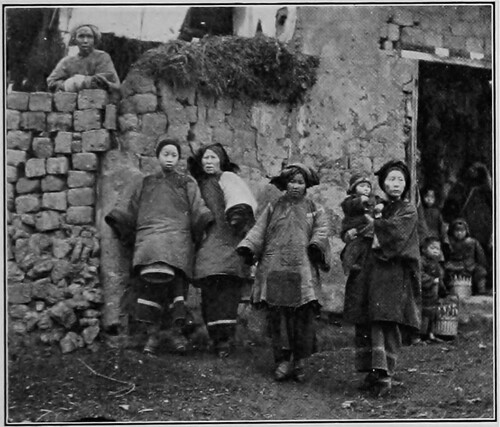
Image by World wide web Archive Book Photos
Identifier: cu31924023226081
Title: An American engineer in China
Year: 1900 (1900s)
Authors: Parsons, William Barclay, 1859-1932
Subjects: Parsons, William Barclay, 1859-1932 Railroads
Publisher: New York, McClure, Phillips & co.
Contributing Library: Cornell University Library
Digitizing Sponsor: MSN
View Book Page: Book Viewer
About This Book: Catalog Entry
View All Pictures: All Photos From Book
Click here to view book on the web to see this illustration in context in a browseable online version of this book.
Text Appearing Ahead of Image:
set, I donot know, but the last we saw of that man he washugging his rind like a ti-easure. Before we hadseen the last of his horse, nonetheless, we felt that ifthe pumaloe rind had constituted the complete ofthe acquire-cost we still need to have been thelosers. It is surprising how closely the men and women in onesection of the country pattern after those else-where, when one particular remembers the lack, almostabsolute lack, of intercommunication. But inspite of the basic sameness, which perhapsappears higher than it is on account of the uni-formity in physiognomy of the men and women, with theMongolian coloring and jet-black hair, there weremany pecuHar customs which appeared to belocalized, as numerous of them were found only in Chapter III: Hu-nan, the Closed Province 95 tiny districts, and travelled Chinese who accom-panied me, stated that they had in no way prior to seensimilar things elsewhere in the empire. Of thesethe most singular was the carrying of tiny bam-boo baskets lined with sheet metal and filled with
Text Appearing Soon after Image:
A Peculiar Custom by Chinese Women of Wearing Heat-ing-Baskets hot wood-ashes. Such baskets the girls in onelocality suspend from a belt beneath their shortblouses. Occasionally the baskets are worn infront, often behind, and occasionally in bothplaces, according, apparently, to the fancy of thewearer. Youngsters also produced use of the heating 96 An American Engineer in China apparatus, but men only seldom. No matter howworn, the effect in all situations was both extraordi-nary and comical. To get a photograph of Chi-nese ladies is almost as hard as to photographa herd of wild deer. Girls are supposed tokeep away from any man, and of course a foreignman is specially terrible. The picture of thewomen and their baskets was obtained by cau-tious stalking behind some Chinese, even though theirattention was attracted by 1 of the members ofmy employees. The immediate after the shutter droppedthe group had scattered. In farming strategies the Chinaman in the inte-rior is, of course, centuries behind. His gra
Note About Images
Please note that these images are extracted from scanned page photos that may possibly have been digitally enhanced for readability – coloration and look of these illustrations may not completely resemble the original work.
Image from web page 142 of “The art of lead burning a practical treatise explaining the apparatus and processes” (1905)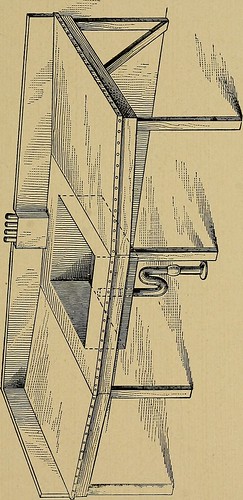
Image by Internet Archive Book Images
Identifier: artofleadburning00fayc
Title: The art of lead burning a practical treatise explaining the apparatus and processes
Year: 1905 (1900s)
Authors: Fay, C. H
Subjects: Lead burning
Publisher: New York, D. Williams company
Contributing Library: The Library of Congress
Digitizing Sponsor: The Library of Congress
View Book Page: Book Viewer
About This Book: Catalog Entry
View All Pictures: All Photos From Book
Click right here to view book on the internet to see this illustration in context in a browseable on-line version of this book.
Text Appearing Ahead of Image:
d just as forlead. Britannia metal is fast becoming the favoritelining for splash and drip boards on butlers pan-attempt sinks, as also for lining the function benches insaloons. It is soft enough to enable the most deli-cate china to be laid on it with no danger of chip-ping, and is also quite straightforward to preserve clean. It takesa high polish and constantly looks well. The methodof cutting the metal for a butlers pantry sink isshown in Fig. 51, the dotted lines showing theactual dimensions of the write-up to be covered,although the complete lines show the laps required tocover the edges of the board. This metal isharder than lead, and will not dress smooth withthe dresser. Any uneven spots have to be presseddown with a hot flatiron. The approach of turn-ing the edges is shown at a. The bending iron isheated and rubbed over the edge, progressively turn- THE ART OF LEAD BURNING. 139 ing the edges till they are at their suitable posi-tion. The iron must be constantly heated to in-positive the ideal final results, and if appropriately carried out no
Text Appearing Soon after Image:
cq CQ 1 140 THE ART OF LEAD BURNING. wrinkles will seem. A lined perform bench isalso shown in Fig, 52, which shows the methodof placing in the bar washer. The sheet metalmust be cut and fitted to its place and all theseams feasible ought to be soldered before placingthe metal in position. The edges must be tackedon the beneath side of the function, when practicable,with copper tacks. Sooner or later the blow pipe solderer will becalled upon to make repairs on Britannia metal,and will be shocked to discover that it will be impos-sible to solder the metal, owing to the excess ofmoisture beneath it. The greatest way to overcomethis, which is practically the only difficulty thatoccurs, is to reduce out a little square patch. Theedge can be cleaned and a patch of new metalcarefully fitted into the hole. When prepared to be-gin soldering, a piece of blotting paper ought to beinserted amongst the patch and board. Thispaper will absorb all the moisture and let theseam to be neatly soldered. The man who makeshimself
Note About Images
Please note that these images are extracted from scanned web page pictures that might have been digitally enhanced for readability – coloration and appearance of these illustrations could not perfectly resemble the original work.
Image from web page 620 of “Mechanical Contracting & Plumbing January-December 1912” (1912)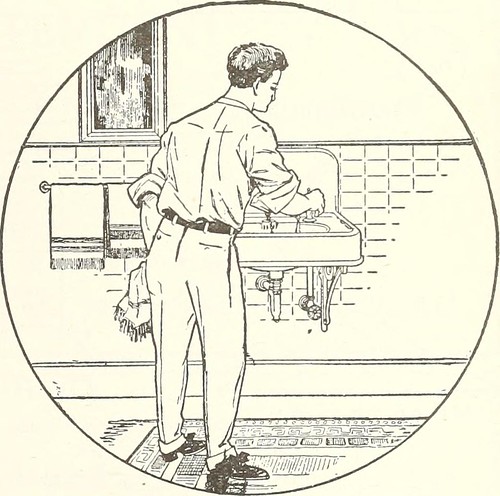
Image by Net Archive Book Images
Identifier: mechcontract1912toro
Title: Mechanical Contracting & Plumbing January-December 1912
Year: 1912 (1910s)
Authors:
Subjects: Air conditioning Refrigeration and refrigerating machinery Heating Plumbing
Publisher: Toronto : Maclean-Hunter Pub. Co.
Contributing Library: Fisher – University of Toronto
Digitizing Sponsor: University of Toronto
View Book Page: Book Viewer
About This Book: Catalog Entry
View All Photos: All Pictures From Book
Click right here to view book on-line to see this illustration in context in a browseable on-line version of this book.
Text Appearing Just before Image:
-■•mum We Can FurnishYour Requirements in All PLUMBING GOODS We handle a total line of Enameled Baths Enameled LavatoriesSinks and Laundry Tubs
Text Appearing Soon after Image:
Write us about ourVictorian China Lavatories. The James Morrison Brass Mfg.Company, Ltd. Producers and dealers in a completeline of Plumbing and Heating Supplies 93-97 Adelaide Street West TORONTO 19 Complete Course in Sheet Metal Work In prob. 23, plate 21, fig. 1 representsa pail, of which A-B is a boss, or rein-forcement on the deal with. The pattern is just a circle havingthe identical curve as the deal with, and iscut out to shape shown by fig. two, thenformed to shape by fig. three, and solderedto deal with. In prob. 24, fig. 1, is a strainer pail,the brest B is developed the exact same as thebrest on the watering pail, prob. 18,plate 20. To develop the spout A, continue theline C- any distance, and parallel to By L. W. KOSER this carry a line from the point V, asV-7. Draw a cross section of the spout fig.2, then divide it into equal spaces andcarry lines from exact same till they cut thelines O-V and C-V. Lay out a stretchout at correct anglesto C-O, as fig. three, and carry lines fromthe distinct points o
Note About Photos
Please note that these photos are extracted from scanned web page photos that could have been digitally enhanced for readability – coloration and look of these illustrations may not perfectly resemble the original operate.
Sakti3's quest for a greater battery: Hype, funding, promises, and then a …
The prospect for advances in manufacturing method, as opposed to battery technology, is largely what has led Musk to forecast a 50% drop in battery costs with the construction of Tesla's future lithium-ion “gigafactory” outside Reno, Nevada. Regardless of …
Read a lot more on Quartz
Calling All Startups: Highway1 Hardware Accelerator is Open for Applications …
… design, advertising and marketing and company staff alongside a 1000 square foot hardware prototyping lab. The plan incorporates a trip to Shenzhen, China to see 1st hand the worldwide manufacturing and provide chain management of scaling a hardware business.
Read far more on Crowdfund Insider
How Upkar Sharma envisions CREA to be a international force in brand merchandising space
We have, more than the years, invested in setting up manufacturing units in India, sourcing workplace in China and sales office in the Middle East (Dubai). But the greatest investment or utilisation of money has been travel. Over the last 5 years, since the …
Read a lot more on Entrepreneur
Some cool china fast prototyping images:
Protei 011 “Optimist” Kit
Image by cesarharada.com
scoutbots.com/
protei.org
Greenyield turns to furnishings amid weak commodities
“We are currently in the prototyping phase [for the garden furniture]. If effective, we aim to … We aim to develop sales in other nations, like but not restricted to Australia [which is catching up with the US and Europe], Japan, China and Malaysia …
Study more on The Edge Markets
Ōura – Tiny packs a punch
Finnish Ouraring, a start-up focused on developing technology for the – undeniably developing – IoT & wearable device market place. But how can you stick out from the masses in a industry overflowing with bracelets? With a ring and an app. The firm started a …
Study much more on evertiq.com
A few nice sheet metal china pictures I identified:
Image from web page one hundred of “An American engineer in China” (1900)
Image by Net Archive Book Photos
Identifier: cu31924023226081
Title: An American engineer in China
Year: 1900 (1900s)
Authors: Parsons, William Barclay, 1859-1932
Subjects: Parsons, William Barclay, 1859-1932 Railroads
Publisher: New York, McClure, Phillips & co.
Contributing Library: Cornell University Library
Digitizing Sponsor: MSN
View Book Page: Book Viewer
About This Book: Catalog Entry
View All Photos: All Pictures From Book
Click right here to view book on the internet to see this illustration in context in a browseable on-line version of this book.
Text Appearing Before Image:
set, I donot know, but the last we saw of that man he washugging his rind like a ti-easure. Just before we hadseen the last of his horse, however, we felt that ifthe pumaloe rind had constituted the complete ofthe purchase-price tag we still should have been thelosers. It is surprising how closely the men and women in onesection of the country pattern after these else-where, when one remembers the lack, almostabsolute lack, of intercommunication. But inspite of the basic sameness, which perhapsappears greater than it is on account of the uni-formity in physiognomy of the individuals, with theMongolian coloring and jet-black hair, there weremany pecuHar customs which appeared to belocalized, as a lot of of them were located only in Chapter III: Hu-nan, the Closed Province 95 little districts, and travelled Chinese who accom-panied me, stated that they had in no way prior to seensimilar factors elsewhere in the empire. Of thesethe most singular was the carrying of small bam-boo baskets lined with sheet metal and filled with
Text Appearing Soon after Image:
A Peculiar Custom by Chinese Women of Wearing Heat-ing-Baskets hot wood-ashes. Such baskets the ladies in onelocality suspend from a belt beneath their shortblouses. Often the baskets are worn infront, occasionally behind, and occasionally in bothplaces, according, apparently, to the fancy of thewearer. Kids also created use of the heating 96 An American Engineer in China apparatus, but guys only rarely. No matter howworn, the impact in all circumstances was each extraordi-nary and comical. To get a photograph of Chi-nese females is almost as hard as to photographa herd of wild deer. Ladies are supposed tokeep away from any man, and of course a foreignman is specially terrible. The picture of thewomen and their baskets was obtained by cau-tious stalking behind some Chinese, although theirattention was attracted by a single of the members ofmy staff. The instant soon after the shutter droppedthe group had scattered. In farming techniques the Chinaman in the inte-rior is, of course, centuries behind. His gra
Note About Photos
Please note that these pictures are extracted from scanned web page images that could have been digitally enhanced for readability – coloration and appearance of these illustrations might not completely resemble the original operate.
Image from page 142 of “The art of lead burning a sensible treatise explaining the apparatus and processes” (1905)
Image by Web Archive Book Photos
Identifier: artofleadburning00fayc
Title: The art of lead burning a practical treatise explaining the apparatus and processes
Year: 1905 (1900s)
Authors: Fay, C. H
Subjects: Lead burning
Publisher: New York, D. Williams company
Contributing Library: The Library of Congress
Digitizing Sponsor: The Library of Congress
View Book Web page: Book Viewer
About This Book: Catalog Entry
View All Photos: All Photos From Book
Click right here to view book online to see this illustration in context in a browseable on the internet version of this book.
Text Appearing Just before Image:
d just as forlead. Britannia metal is quick becoming the favoritelining for splash and drip boards on butlers pan-attempt sinks, as also for lining the operate benches insaloons. It is soft sufficient to permit the most deli-cate china to be laid on it without danger of chip-ping, and is also quite easy to maintain clean. It takesa higher polish and usually appears properly. The methodof cutting the metal for a butlers pantry sink isshown in Fig. 51, the dotted lines displaying theactual dimensions of the post to be covered,although the complete lines show the laps essential tocover the edges of the board. This metal isharder than lead, and will not dress smooth withthe dresser. Any uneven spots should be presseddown with a hot flatiron. The strategy of turn-ing the edges is shown at a. The bending iron isheated and rubbed over the edge, progressively turn- THE ART OF LEAD BURNING. 139 ing the edges till they are at their suitable posi-tion. The iron have to be continually heated to in-certain the very best final results, and if appropriately completed no
Text Appearing After Image:
cq CQ 1 140 THE ART OF LEAD BURNING. wrinkles will appear. A lined function bench isalso shown in Fig, 52, which shows the methodof putting in the bar washer. The sheet metalmust be reduce and fitted to its spot and all theseams feasible must be soldered ahead of placingthe metal in position. The edges ought to be tackedon the under side of the function, when practicable,with copper tacks. Sooner or later the blow pipe solderer will becalled upon to make repairs on Britannia metal,and will be surprised to locate that it will be impos-sible to solder the metal, owing to the excess ofmoisture beneath it. The best way to overcomethis, which is virtually the only trouble thatoccurs, is to cut out a tiny square patch. Theedge can be cleaned and a patch of new metalcarefully fitted into the hole. When ready to be-gin soldering, a piece of blotting paper must beinserted amongst the patch and board. Thispaper will absorb all the moisture and allow theseam to be neatly soldered. The man who makeshimself
Note About Photos
Please note that these images are extracted from scanned page photos that may have been digitally enhanced for readability – coloration and look of these illustrations may not completely resemble the original work.
Image from web page 620 of “Mechanical Contracting & Plumbing January-December 1912” (1912)
Image by Web Archive Book Images
Identifier: mechcontract1912toro
Title: Mechanical Contracting & Plumbing January-December 1912
Year: 1912 (1910s)
Authors:
Subjects: Air conditioning Refrigeration and refrigerating machinery Heating Plumbing
Publisher: Toronto : Maclean-Hunter Pub. Co.
Contributing Library: Fisher – University of Toronto
Digitizing Sponsor: University of Toronto
View Book Page: Book Viewer
About This Book: Catalog Entry
View All Pictures: All Pictures From Book
Click right here to view book on-line to see this illustration in context in a browseable online version of this book.
Text Appearing Prior to Image:
-■•mum We Can FurnishYour Requirements in All PLUMBING GOODS We deal with a full line of Enameled Baths Enameled LavatoriesSinks and Laundry Tubs
Text Appearing After Image:
Create us about ourVictorian China Lavatories. The James Morrison Brass Mfg.Firm, Ltd. Manufacturers and dealers in a completeline of Plumbing and Heating Supplies 93-97 Adelaide Street West TORONTO 19 Comprehensive Course in Sheet Metal Operate In prob. 23, plate 21, fig. 1 representsa pail, of which A-B is a boss, or rein-forcement on the manage. The pattern is simply a circle havingthe exact same curve as the handle, and iscut out to shape shown by fig. 2, thenformed to shape by fig. 3, and solderedto deal with. In prob. 24, fig. 1, is a strainer pail,the brest B is created the identical as thebrest on the watering pail, prob. 18,plate 20. To develop the spout A, continue theline C- any distance, and parallel to By L. W. KOSER this carry a line from the point V, asV-7. Draw a cross section of the spout fig.2, then divide it into equal spaces andcarry lines from exact same till they reduce thelines O-V and C-V. Lay out a stretchout at proper anglesto C-O, as fig. three, and carry lines fromthe different points o
Note About Images
Please note that these images are extracted from scanned web page images that could have been digitally enhanced for readability – coloration and appearance of these illustrations may possibly not completely resemble the original work.
This Desktop Robotic Arm Can Make Virtually Anything, Which includes New Parts For Itself
And then enlisted Dragon Innovation to support tweak the industrial style and set up manufacturing offers in China, as properly as helping with supply chains for components. But that … "It actually, truly speeds up the prototyping procedure for a lot of various …
Read far more on Chicago Inno
CIPSA CIRCUITS Installs Orbotech Fusion AOI and Sprint 120 Inkjet Systems
ORBOTECH LTD announced today that CIPSA CIRCUITS, a European PCB manufacturer and long-time client of Orbotech, has completed integration of two Orbotech Fusion AOI systems and one Orbotech Sprint 120 inkjet technique, purchased in the initial half of …
Read much more on I-Connect007
Check out these prototype china images:
Ubco Assembly
Image by locusresearch
Close up shot of 2×2 in the course of assembly
Ubco components
Image by locusresearch
Close up shot of 2×2 for the duration of assembly
Ubco parts
Image by locusresearch
Close up shot of 2×2 during assembly
A few good china prototype manufacturing photos I located:
Steven F. Udvar-Hazy Center: Photomontage of SR-71 on the port side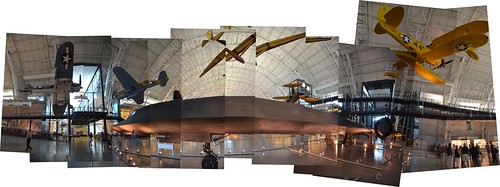
Image by Chris Devers
Posted by means of e-mail to ☛ HoloChromaCinePhotoRamaScope‽: cdevers.posterous.com/panoramas-of-the-sr-71-blackbird-at…. See the full gallery on Posterous …
• • • • •
See far more pictures of this, and the Wikipedia report.
Specifics, quoting from Smithsonian National Air and Space Museum | Lockheed SR-71 Blackbird:
No reconnaissance aircraft in history has operated globally in a lot more hostile airspace or with such complete impunity than the SR-71, the world’s fastest jet-propelled aircraft. The Blackbird’s efficiency and operational achievements placed it at the pinnacle of aviation technologies developments throughout the Cold War.
This Blackbird accrued about two,800 hours of flight time in the course of 24 years of active service with the U.S. Air Force. On its final flight, March six, 1990, Lt. Col. Ed Yielding and Lt. Col. Joseph Vida set a speed record by flying from Los Angeles to Washington, D.C., in 1 hour, 4 minutes, and 20 seconds, averaging three,418 kilometers (two,124 miles) per hour. At the flight’s conclusion, they landed at Washington-Dulles International Airport and turned the airplane more than to the Smithsonian.
Transferred from the United States Air Force.
Manufacturer:
Lockheed Aircraft Corporation
Designer:
Clarence L. "Kelly" Johnson
Date:
1964
Nation of Origin:
United States of America
Dimensions:
Overall: 18ft 5 15/16in. x 55ft 7in. x 107ft 5in., 169998.5lb. (5.638m x 16.942m x 32.741m, 77110.8kg)
Other: 18ft 5 15/16in. x 107ft 5in. x 55ft 7in. (5.638m x 32.741m x 16.942m)
Components:
Titanium
Physical Description:
Twin-engine, two-seat, supersonic strategic reconnaissance aircraft airframe constructed largley of titanium and its alloys vertical tail fins are constructed of a composite (laminated plastic-kind material) to minimize radar cross-section Pratt and Whitney J58 (JT11D-20B) turbojet engines feature massive inlet shock cones.
Long Description:
No reconnaissance aircraft in history has operated in a lot more hostile airspace or with such total impunity than the SR-71 Blackbird. It is the quickest aircraft propelled by air-breathing engines. The Blackbird’s overall performance and operational achievements placed it at the pinnacle of aviation technologies developments in the course of the Cold War. The airplane was conceived when tensions with communist Eastern Europe reached levels approaching a full-blown crisis in the mid-1950s. U.S. military commanders desperately needed correct assessments of Soviet worldwide military deployments, especially close to the Iron Curtain. Lockheed Aircraft Corporation’s subsonic U-two (see NASM collection) reconnaissance aircraft was an in a position platform but the U. S. Air Force recognized that this comparatively slow aircraft was currently vulnerable to Soviet interceptors. They also understood that the speedy development of surface-to-air missile systems could put U-2 pilots at grave risk. The danger proved reality when a U-2 was shot down by a surface to air missile more than the Soviet Union in 1960.
Lockheed’s 1st proposal for a new high speed, higher altitude, reconnaissance aircraft, to be capable of avoiding interceptors and missiles, centered on a design and style propelled by liquid hydrogen. This proved to be impracticable since of considerable fuel consumption. Lockheed then reconfigured the style for conventional fuels. This was feasible and the Central Intelligence Agency (CIA), already flying the Lockheed U-2, issued a production contract for an aircraft designated the A-12. Lockheed’s clandestine ‘Skunk Works’ division (headed by the gifted style engineer Clarence L. "Kelly" Johnson) created the A-12 to cruise at Mach 3.2 and fly well above 18,288 m (60,000 feet). To meet these challenging requirements, Lockheed engineers overcame a lot of daunting technical challenges. Flying far more than three occasions the speed of sound generates 316° C (600° F) temperatures on external aircraft surfaces, which are sufficient to melt traditional aluminum airframes. The design group chose to make the jet’s external skin of titanium alloy to which shielded the internal aluminum airframe. Two conventional, but very effective, afterburning turbine engines propelled this remarkable aircraft. These power plants had to operate across a enormous speed envelope in flight, from a takeoff speed of 334 kph (207 mph) to far more than three,540 kph (2,200 mph). To prevent supersonic shock waves from moving inside the engine intake causing flameouts, Johnson’s group had to style a complex air intake and bypass program for the engines.
Skunk Performs engineers also optimized the A-12 cross-section style to exhibit a low radar profile. Lockheed hoped to achieve this by meticulously shaping the airframe to reflect as little transmitted radar energy (radio waves) as attainable, and by application of specific paint made to absorb, rather than reflect, those waves. This treatment became one of the very first applications of stealth technology, but it never ever completely met the design ambitions.
Test pilot Lou Schalk flew the single-seat A-12 on April 24, 1962, soon after he became airborne accidentally for the duration of higher-speed taxi trials. The airplane showed wonderful guarantee but it needed considerable technical refinement just before the CIA could fly the very first operational sortie on May 31, 1967 – a surveillance flight over North Vietnam. A-12s, flown by CIA pilots, operated as component of the Air Force’s 1129th Unique Activities Squadron beneath the "Oxcart" program. While Lockheed continued to refine the A-12, the U. S. Air Force ordered an interceptor version of the aircraft designated the YF-12A. The Skunk Operates, nonetheless, proposed a "specific mission" version configured to conduct post-nuclear strike reconnaissance. This program evolved into the USAF’s familiar SR-71.
Lockheed built fifteen A-12s, which includes a specific two-seat trainer version. Two A-12s had been modified to carry a unique reconnaissance drone, designated D-21. The modified A-12s have been redesignated M-21s. These have been developed to take off with the D-21 drone, powered by a Marquart ramjet engine mounted on a pylon amongst the rudders. The M-21 then hauled the drone aloft and launched it at speeds high adequate to ignite the drone’s ramjet motor. Lockheed also built 3 YF-12As but this type never ever went into production. Two of the YF-12As crashed for the duration of testing. Only a single survives and is on display at the USAF Museum in Dayton, Ohio. The aft section of a single of the "written off" YF-12As which was later utilised along with an SR-71A static test airframe to manufacture the sole SR-71C trainer. One SR-71 was lent to NASA and designated YF-12C. Including the SR-71C and two SR-71B pilot trainers, Lockheed constructed thirty-two Blackbirds. The 1st SR-71 flew on December 22, 1964. Simply because of extreme operational charges, military strategists decided that the much more capable USAF SR-71s need to replace the CIA’s A-12s. These had been retired in 1968 soon after only one year of operational missions, largely over southeast Asia. The Air Force’s 1st Strategic Reconnaissance Squadron (part of the 9th Strategic Reconnaissance Wing) took more than the missions, flying the SR-71 starting in the spring of 1968.
Following the Air Force began to operate the SR-71, it acquired the official name Blackbird– for the unique black paint that covered the airplane. This paint was formulated to absorb radar signals, to radiate some of the tremendous airframe heat generated by air friction, and to camouflage the aircraft against the dark sky at higher altitudes.
Experience gained from the A-12 program convinced the Air Force that flying the SR-71 safely required two crew members, a pilot and a Reconnaissance Systems Officer (RSO). The RSO operated with the wide array of monitoring and defensive systems installed on the airplane. This equipment incorporated a sophisticated Electronic Counter Measures (ECM) program that could jam most acquisition and targeting radar. In addition to an array of sophisticated, higher-resolution cameras, the aircraft could also carry equipment designed to record the strength, frequency, and wavelength of signals emitted by communications and sensor devices such as radar. The SR-71 was created to fly deep into hostile territory, avoiding interception with its tremendous speed and higher altitude. It could operate safely at a maximum speed of Mach three.3 at an altitude more than sixteen miles, or 25,908 m (85,000 ft), above the earth. The crew had to put on pressure suits comparable to those worn by astronauts. These suits have been needed to safeguard the crew in the event of sudden cabin stress loss even though at operating altitudes.
To climb and cruise at supersonic speeds, the Blackbird’s Pratt & Whitney J-58 engines have been made to operate continuously in afterburner. While this would seem to dictate higher fuel flows, the Blackbird really accomplished its greatest "gas mileage," in terms of air nautical miles per pound of fuel burned, in the course of the Mach three+ cruise. A typical Blackbird reconnaissance flight might require a number of aerial refueling operations from an airborne tanker. Every single time the SR-71 refueled, the crew had to descend to the tanker’s altitude, typically about six,000 m to 9,000 m (20,000 to 30,000 ft), and slow the airplane to subsonic speeds. As velocity decreased, so did frictional heat. This cooling effect triggered the aircraft’s skin panels to shrink significantly, and those covering the fuel tanks contracted so a lot that fuel leaked, forming a distinctive vapor trail as the tanker topped off the Blackbird. As quickly as the tanks were filled, the jet’s crew disconnected from the tanker, relit the afterburners, and again climbed to high altitude.
Air Force pilots flew the SR-71 from Kadena AB, Japan, throughout its operational profession but other bases hosted Blackbird operations, too. The 9th SRW occasionally deployed from Beale AFB, California, to other places to carryout operational missions. Cuban missions have been flown directly from Beale. The SR-71 did not commence to operate in Europe until 1974, and then only temporarily. In 1982, when the U.S. Air Force based two aircraft at Royal Air Force Base Mildenhall to fly monitoring mission in Eastern Europe.
When the SR-71 became operational, orbiting reconnaissance satellites had already replaced manned aircraft to collect intelligence from sites deep inside Soviet territory. Satellites could not cover each and every geopolitical hotspot so the Blackbird remained a essential tool for worldwide intelligence gathering. On several occasions, pilots and RSOs flying the SR-71 offered information that proved important in formulating productive U. S. foreign policy. Blackbird crews offered critical intelligence about the 1973 Yom Kippur War, the Israeli invasion of Lebanon and its aftermath, and pre- and post-strike imagery of the 1986 raid carried out by American air forces on Libya. In 1987, Kadena-primarily based SR-71 crews flew a number of missions over the Persian Gulf, revealing Iranian Silkworm missile batteries that threatened industrial shipping and American escort vessels.
As the overall performance of space-based surveillance systems grew, along with the effectiveness of ground-primarily based air defense networks, the Air Force started to drop enthusiasm for the costly program and the 9th SRW ceased SR-71 operations in January 1990. In spite of protests by military leaders, Congress revived the plan in 1995. Continued wrangling more than operating budgets, even so, quickly led to final termination. The National Aeronautics and Space Administration retained two SR-71As and the one particular SR-71B for high-speed research projects and flew these airplanes till 1999.
On March six, 1990, the service profession of 1 Lockheed SR-71A Blackbird ended with a record-setting flight. This special airplane bore Air Force serial quantity 64-17972. Lt. Col. Ed Yeilding and his RSO, Lieutenant Colonel Joseph Vida, flew this aircraft from Los Angeles to Washington D.C. in 1 hour, 4 minutes, and 20 seconds, averaging a speed of 3,418 kph (2,124 mph). At the conclusion of the flight, ‘972 landed at Dulles International Airport and taxied into the custody of the Smithsonian’s National Air and Space Museum. At that time, Lt. Col. Vida had logged 1,392.7 hours of flight time in Blackbirds, more than that of any other crewman.
This particular SR-71 was also flown by Tom Alison, a former National Air and Space Museum’s Chief of Collections Management. Flying with Detachment 1 at Kadena Air Force Base, Okinawa, Alison logged a lot more than a dozen ‘972 operational sorties. The aircraft spent twenty-4 years in active Air Force service and accrued a total of 2,801.1 hours of flight time.
Wingspan: 55’7"
Length: 107’5"
Height: 18’6"
Weight: 170,000 Lbs
Reference and Further Reading:
Crickmore, Paul F. Lockheed SR-71: The Secret Missions Exposed. Oxford: Osprey Publishing, 1996.
Francillon, Rene J. Lockheed Aircraft Given that 1913. Annapolis, Md.: Naval Institute Press, 1987.
Johnson, Clarence L. Kelly: Far more Than My Share of It All. Washington D.C.: Smithsonian Institution Press, 1985.
Miller, Jay. Lockheed Martin’s Skunk Works. Leicester, U.K.: Midland Counties Publishing Ltd., 1995.
Lockheed SR-71 Blackbird curatorial file, Aeronautics Division, National Air and Space Museum.
DAD, 11-11-01
A handful of good china speedy prototyping photos I found:
Protei 011 “Optimist” Kit
Image by cesarharada.com
scoutbots.com/
protei.org
Taiwan: An Island in a Sea of Volatility
Investors have a tendency to treat Taiwan and South Korea as proxies both for international technologies demand and, much more not too long ago, as moons orbiting a giant Chinese Jupiter. Taiwan's stock market has hence been hit fairly hard by the Fed's hesitance, as investors fear it …
Read more on Barron’s
Venture capitalist Lee's investment suggestions in China: precision engineering and …
“China reinvents itself each and every ten years and you can see this in their policies – from the migration from low-expense labour to computer software-based IT personnel in 2000-05, to now precision manufacturing and automation,” stated Lee, who worked briefly as a banker …
Read far more on South China Morning Post (subscription)
ASE's legal action won't affect marketplace: Taiwan FSC head
Tseng Ming-chung, chair of Taiwan's Monetary Supervisory Commission (FSC), stated Tuesday that a legal maneuver by IC packager Sophisticated Semiconductor Engineering (ASE) against a rival is unlikely to influence the country's broader equity marketplace.
Read a lot more on WantChinaTimes
Millesimal fineness is a technique of denoting the purity of platinum, gold and silver alloys by components per thousand of pure metal by mass in the alloy. For example, an alloy containing 75% gold is denoted as “750”. Many European nations use the percentage hallmark stamps (i.e. ‘585’, ‘750’, and so forth) rather than ’14K’, ’18K’, and so on., which is utilized in the United States.
It is an extension of the older carat (karat in North American spelling) technique of denoting the purity of gold by fractions of 24, such as “18 carat” for an alloy with 75% (18 parts per 24) pure gold by mass.
The millesimal fineness is usually rounded to a three figure quantity, especially where utilized as a hallmark, and the fineness could vary slightly from the standard versions of purity.
The most typical millesimal finenesses used for valuable metals:
999 (also known as 3 nines fine)
995 (what most dealer would acquire your platinum at if it is 100% pure)
950 (the most widespread purity for platinum jewellery)
900 (also identified as one nine fine)
999.99 (The purest variety of Gold in the marketplace)
999 (Fine gold equivalent to 24 carat, also recognized as 3 nines fine)
990 also known as two nines fine
916 (equivalent to 22 carat)
833 (equivalent to 20 carat)
750 (equivalent to 18 carat)
625 (equivalent to 15 carat)
585 (equivalent to 14 carat)
417 (equivalent to ten carat)
375 (equivalent to 9 carat)
333 (equivalent to 8 carat minimum regular for gold in Germany after 1884)
999.9 (Ultra-fine silver used by Royal Canadian Mint in the Canadian Silver Maple Leaf)
999 (Fine silver used in bullion bars, also identified as three nines fine)
980 (frequent common used in Mexico ca.1930 – 1945)
958 (equivalent to Britannia silver)
950 (equivalent to “French 1st Regular”)
925 (equivalent to Sterling silver)
900 (equivalent to “Coin silver” in the USA, also recognized as one particular nine fine)
875 (could be discovered in former USSR and in Switzerland)
833 (typical regular used in continental silver specifically among the Dutch, Swedish, and Germans)
830 (widespread normal utilised in older Scandinavian silver)
835 (a regular predominantly employed in Germany soon after 1884)
800 (minimum standard for silver in Germany after 1884 Egyptian silver Canadian silver circulating coinage)
750 (uncommon silver common discovered in older German, Swiss and Austro-Hungarian silver)
Gold as an investment
Silver as an investment
Anklet Belt buckle Belly chain Bracelet Brooch Chatelaine Crown Cufflink Earring lapel pin Necklace Pendant Ring Tiara Tie clip Watch (pocket)
Bench jeweler Goldsmith Jewelry designer Lapidary Watchmaker
Casting (centrifugal, lost-wax, vacuum) Enameling Engraving Filigree Metal clay Plating Polishing Repouss and chasing Soldering Stonesetting Wire wrapping
Draw plate File Hammer Mandrel Pliers
Gold Palladium Platinum Rhodium Silver
Britannia silver Colored gold Crown gold Electrum Platinum sterling Shakudo Shibuichi Sterling silver Tumbaga
Brass Bronze Copper Kuromido Pewter Stainless steel Titanium
Aventurine Agate Alexandrite Amethyst Aquamarine Carnelian Citrine Diamond Emerald Garnet Jade Jasper Malachite Lapis lazuli Moonstone Obsidian Onyx Opal Peridot Quartz Ruby Sapphire Sodalite Sunstone Tanzanite Tiger’s Eye Topaz Tourmaline
Amber Copal Coral Jet Pearl Abalone
Carat (unit) Carat (purity) Discovering Millesimal fineness
Associated topics: Body piercing Fashion Gemology Metalworking Wearable art
We are higher high quality suppliers, our merchandise such as prototype circuit boards , China printed circuit assemblies for oversee purchaser. To know far more, please visits gerber pcb.
Far more Cnc Prototype China Articles
3D Sidekick Direct Pellet Printhead Provides Affordability in Components, Hooks …
… not only returned to Kickstarter with his 3D Sidekick Direct Pellet Printhead, but he's returned with a new and enhanced version for rapid prototyping and machining all rolled into a single, with the capability to use recycled polymers and low-cost pellets …
Read far more on 3DPrint.com
Why Is The Future All About 3D Printed Super Cars?
More than the last two decades, several automotive makers have started to use the technology for rapid prototyping of complicated models and other production tools. Big names, like Lamborghini, Formula 1 and Honda, which dominate the automotive market …
Study much more on 3DPrint.com
Some cool metal parts china photos:
mong kok, supplies
Image by cesarharada.com
mong kok, supplies
Image by cesarharada.com
A few nice china prototype manufacturing images I found:
Steven F. Udvar-Hazy Center: Photomontage of SR-71 on the port side
Image by Chris Devers
Posted by means of e-mail to ☛ HoloChromaCinePhotoRamaScope‽: cdevers.posterous.com/panoramas-of-the-sr-71-blackbird-at…. See the complete gallery on Posterous …
• • • • •
See more photos of this, and the Wikipedia post.
Specifics, quoting from Smithsonian National Air and Space Museum | Lockheed SR-71 Blackbird:
No reconnaissance aircraft in history has operated globally in more hostile airspace or with such full impunity than the SR-71, the world’s quickest jet-propelled aircraft. The Blackbird’s efficiency and operational achievements placed it at the pinnacle of aviation technologies developments during the Cold War.
This Blackbird accrued about two,800 hours of flight time throughout 24 years of active service with the U.S. Air Force. On its final flight, March 6, 1990, Lt. Col. Ed Yielding and Lt. Col. Joseph Vida set a speed record by flying from Los Angeles to Washington, D.C., in 1 hour, four minutes, and 20 seconds, averaging three,418 kilometers (two,124 miles) per hour. At the flight’s conclusion, they landed at Washington-Dulles International Airport and turned the airplane over to the Smithsonian.
Transferred from the United States Air Force.
Manufacturer:
Lockheed Aircraft Corporation
Designer:
Clarence L. "Kelly" Johnson
Date:
1964
Nation of Origin:
United States of America
Dimensions:
Overall: 18ft five 15/16in. x 55ft 7in. x 107ft 5in., 169998.5lb. (five.638m x 16.942m x 32.741m, 77110.8kg)
Other: 18ft 5 15/16in. x 107ft 5in. x 55ft 7in. (five.638m x 32.741m x 16.942m)
Components:
Titanium
Physical Description:
Twin-engine, two-seat, supersonic strategic reconnaissance aircraft airframe constructed largley of titanium and its alloys vertical tail fins are constructed of a composite (laminated plastic-type material) to reduce radar cross-section Pratt and Whitney J58 (JT11D-20B) turbojet engines feature huge inlet shock cones.
Long Description:
No reconnaissance aircraft in history has operated in more hostile airspace or with such complete impunity than the SR-71 Blackbird. It is the quickest aircraft propelled by air-breathing engines. The Blackbird’s functionality and operational achievements placed it at the pinnacle of aviation technology developments during the Cold War. The airplane was conceived when tensions with communist Eastern Europe reached levels approaching a complete-blown crisis in the mid-1950s. U.S. military commanders desperately needed correct assessments of Soviet worldwide military deployments, especially close to the Iron Curtain. Lockheed Aircraft Corporation’s subsonic U-two (see NASM collection) reconnaissance aircraft was an able platform but the U. S. Air Force recognized that this comparatively slow aircraft was already vulnerable to Soviet interceptors. They also understood that the speedy development of surface-to-air missile systems could place U-2 pilots at grave threat. The danger proved reality when a U-2 was shot down by a surface to air missile more than the Soviet Union in 1960.
Lockheed’s very first proposal for a new high speed, higher altitude, reconnaissance aircraft, to be capable of avoiding interceptors and missiles, centered on a style propelled by liquid hydrogen. This proved to be impracticable simply because of considerable fuel consumption. Lockheed then reconfigured the design for traditional fuels. This was feasible and the Central Intelligence Agency (CIA), already flying the Lockheed U-two, issued a production contract for an aircraft designated the A-12. Lockheed’s clandestine ‘Skunk Works’ division (headed by the gifted design and style engineer Clarence L. "Kelly" Johnson) created the A-12 to cruise at Mach 3.two and fly effectively above 18,288 m (60,000 feet). To meet these difficult specifications, Lockheed engineers overcame many daunting technical challenges. Flying a lot more than three times the speed of sound generates 316° C (600° F) temperatures on external aircraft surfaces, which are sufficient to melt standard aluminum airframes. The design team chose to make the jet’s external skin of titanium alloy to which shielded the internal aluminum airframe. Two standard, but very powerful, afterburning turbine engines propelled this exceptional aircraft. These power plants had to operate across a huge speed envelope in flight, from a takeoff speed of 334 kph (207 mph) to far more than three,540 kph (2,200 mph). To avoid supersonic shock waves from moving inside the engine intake causing flameouts, Johnson’s team had to design and style a complicated air intake and bypass system for the engines.
Skunk Functions engineers also optimized the A-12 cross-section design and style to exhibit a low radar profile. Lockheed hoped to attain this by very carefully shaping the airframe to reflect as small transmitted radar power (radio waves) as possible, and by application of special paint developed to absorb, rather than reflect, those waves. This therapy became one particular of the 1st applications of stealth technologies, but it never ever totally met the design and style objectives.
Test pilot Lou Schalk flew the single-seat A-12 on April 24, 1962, after he became airborne accidentally in the course of higher-speed taxi trials. The airplane showed great promise but it needed considerable technical refinement ahead of the CIA could fly the initial operational sortie on May 31, 1967 – a surveillance flight more than North Vietnam. A-12s, flown by CIA pilots, operated as portion of the Air Force’s 1129th Particular Activities Squadron under the "Oxcart" system. Although Lockheed continued to refine the A-12, the U. S. Air Force ordered an interceptor version of the aircraft designated the YF-12A. The Skunk Functions, however, proposed a "specific mission" version configured to conduct post-nuclear strike reconnaissance. This method evolved into the USAF’s familiar SR-71.
Lockheed built fifteen A-12s, such as a unique two-seat trainer version. Two A-12s have been modified to carry a unique reconnaissance drone, designated D-21. The modified A-12s have been redesignated M-21s. These have been created to take off with the D-21 drone, powered by a Marquart ramjet engine mounted on a pylon in between the rudders. The M-21 then hauled the drone aloft and launched it at speeds high sufficient to ignite the drone’s ramjet motor. Lockheed also built three YF-12As but this kind in no way went into production. Two of the YF-12As crashed during testing. Only a single survives and is on display at the USAF Museum in Dayton, Ohio. The aft section of one of the "written off" YF-12As which was later employed along with an SR-71A static test airframe to manufacture the sole SR-71C trainer. One particular SR-71 was lent to NASA and designated YF-12C. Which includes the SR-71C and two SR-71B pilot trainers, Lockheed constructed thirty-two Blackbirds. The first SR-71 flew on December 22, 1964. Because of intense operational expenses, military strategists decided that the more capable USAF SR-71s ought to replace the CIA’s A-12s. These have been retired in 1968 following only 1 year of operational missions, mainly more than southeast Asia. The Air Force’s 1st Strategic Reconnaissance Squadron (portion of the 9th Strategic Reconnaissance Wing) took over the missions, flying the SR-71 beginning in the spring of 1968.
Soon after the Air Force began to operate the SR-71, it acquired the official name Blackbird– for the specific black paint that covered the airplane. This paint was formulated to absorb radar signals, to radiate some of the tremendous airframe heat generated by air friction, and to camouflage the aircraft against the dark sky at high altitudes.
Experience gained from the A-12 plan convinced the Air Force that flying the SR-71 safely essential two crew members, a pilot and a Reconnaissance Systems Officer (RSO). The RSO operated with the wide array of monitoring and defensive systems installed on the airplane. This gear integrated a sophisticated Electronic Counter Measures (ECM) program that could jam most acquisition and targeting radar. In addition to an array of advanced, high-resolution cameras, the aircraft could also carry gear developed to record the strength, frequency, and wavelength of signals emitted by communications and sensor devices such as radar. The SR-71 was made to fly deep into hostile territory, avoiding interception with its tremendous speed and higher altitude. It could operate safely at a maximum speed of Mach three.three at an altitude a lot more than sixteen miles, or 25,908 m (85,000 ft), above the earth. The crew had to put on stress suits related to those worn by astronauts. These suits were essential to shield the crew in the event of sudden cabin pressure loss whilst at operating altitudes.
To climb and cruise at supersonic speeds, the Blackbird’s Pratt & Whitney J-58 engines were developed to operate continuously in afterburner. Whilst this would seem to dictate high fuel flows, the Blackbird really achieved its ideal "gas mileage," in terms of air nautical miles per pound of fuel burned, during the Mach three+ cruise. A typical Blackbird reconnaissance flight may well call for several aerial refueling operations from an airborne tanker. Every time the SR-71 refueled, the crew had to descend to the tanker’s altitude, usually about 6,000 m to 9,000 m (20,000 to 30,000 ft), and slow the airplane to subsonic speeds. As velocity decreased, so did frictional heat. This cooling impact caused the aircraft’s skin panels to shrink significantly, and those covering the fuel tanks contracted so considerably that fuel leaked, forming a distinctive vapor trail as the tanker topped off the Blackbird. As quickly as the tanks had been filled, the jet’s crew disconnected from the tanker, relit the afterburners, and once more climbed to high altitude.
Air Force pilots flew the SR-71 from Kadena AB, Japan, throughout its operational career but other bases hosted Blackbird operations, also. The 9th SRW sometimes deployed from Beale AFB, California, to other areas to carryout operational missions. Cuban missions had been flown straight from Beale. The SR-71 did not start to operate in Europe until 1974, and then only temporarily. In 1982, when the U.S. Air Force primarily based two aircraft at Royal Air Force Base Mildenhall to fly monitoring mission in Eastern Europe.
When the SR-71 became operational, orbiting reconnaissance satellites had currently replaced manned aircraft to collect intelligence from web sites deep inside Soviet territory. Satellites could not cover each and every geopolitical hotspot so the Blackbird remained a crucial tool for global intelligence gathering. On numerous occasions, pilots and RSOs flying the SR-71 provided data that proved vital in formulating profitable U. S. foreign policy. Blackbird crews supplied crucial intelligence about the 1973 Yom Kippur War, the Israeli invasion of Lebanon and its aftermath, and pre- and post-strike imagery of the 1986 raid performed by American air forces on Libya. In 1987, Kadena-primarily based SR-71 crews flew a number of missions over the Persian Gulf, revealing Iranian Silkworm missile batteries that threatened industrial shipping and American escort vessels.
As the overall performance of space-primarily based surveillance systems grew, along with the effectiveness of ground-based air defense networks, the Air Force began to drop enthusiasm for the high-priced system and the 9th SRW ceased SR-71 operations in January 1990. Despite protests by military leaders, Congress revived the system in 1995. Continued wrangling over operating budgets, even so, soon led to final termination. The National Aeronautics and Space Administration retained two SR-71As and the one particular SR-71B for higher-speed analysis projects and flew these airplanes till 1999.
On March 6, 1990, the service profession of a single Lockheed SR-71A Blackbird ended with a record-setting flight. This particular airplane bore Air Force serial quantity 64-17972. Lt. Col. Ed Yeilding and his RSO, Lieutenant Colonel Joseph Vida, flew this aircraft from Los Angeles to Washington D.C. in 1 hour, 4 minutes, and 20 seconds, averaging a speed of 3,418 kph (two,124 mph). At the conclusion of the flight, ‘972 landed at Dulles International Airport and taxied into the custody of the Smithsonian’s National Air and Space Museum. At that time, Lt. Col. Vida had logged 1,392.7 hours of flight time in Blackbirds, much more than that of any other crewman.
This certain SR-71 was also flown by Tom Alison, a former National Air and Space Museum’s Chief of Collections Management. Flying with Detachment 1 at Kadena Air Force Base, Okinawa, Alison logged a lot more than a dozen ‘972 operational sorties. The aircraft spent twenty-four years in active Air Force service and accrued a total of two,801.1 hours of flight time.
Wingspan: 55’7"
Length: 107’5"
Height: 18’6"
Weight: 170,000 Lbs
Reference and Additional Reading:
Crickmore, Paul F. Lockheed SR-71: The Secret Missions Exposed. Oxford: Osprey Publishing, 1996.
Francillon, Rene J. Lockheed Aircraft Considering that 1913. Annapolis, Md.: Naval Institute Press, 1987.
Johnson, Clarence L. Kelly: More Than My Share of It All. Washington D.C.: Smithsonian Institution Press, 1985.
Miller, Jay. Lockheed Martin’s Skunk Operates. Leicester, U.K.: Midland Counties Publishing Ltd., 1995.
Lockheed SR-71 Blackbird curatorial file, Aeronautics Division, National Air and Space Museum.
DAD, 11-11-01
China’s plastics machinery manufacturing sector 50 years from the 20th century made the very first solution considering that, following practically half a century, specifically the speedy development considering that the reform and opening up, and now have constructed a full range, the main technical and financial indices, or reached the international sophisticated level, supporting internationalized production progressively specialized, comprehensive with large-scale industrial program, the solution fundamentally meet the domestic demand, speedy increase in export capacity. I. Existing Predicament of China plastic machinery manufacturing market at present engaged in manufacturing plastics machinery and connected enterprises, about 600 units, of which plastic molding gear can provide about 250. China’s plastics machinery business has a considerable scale, at present, China’s leading plastic machinery production capacity far more than ten million sets, which, out of more than 8,000 sets of equipment, 30,000 sets of injection molding machines, blow molding gear, more than 3,000 sets of plastic machinery annual turnover of eight. billion ~ ten billion yuan. Plastic items from the marketplace analysis, combined with our existing plastic machinery production capacity into full play, from 2001 to 2010, China’s domestic market capacity of plastic machinery goods the average annual growth of about 6%. 2000, 2005 had been 80 billion yuan, 11 billion yuan, is expected to reach 14.5 billion by 2010. With the improvement in the top quality of our items and range increase, plastic machinery merchandise in the domestic marketplace share will enhance as anticipated have been 70%, 75% and 80% plastic machinery products have been five.6 billion total industrial output value , 8.25 billion yuan and 11.6 billion yuan. With the improve of China’s exports in 2010, China’s industrial output worth of plastic machinery products reached 140 billion yuan, 2.33 times in 2000, the annual typical growth price of about 9% in 2001 and 2005 annual development rate of 10% 2006 to 2010 annual growth rate of eight%. Plastic machinery goods from the quantitative analysis, 2000, 2005, were five.five million, 7.five million units in 2010 to 10 million units, of which about 35% of the injection molding machine, extruder, 25%, about Blow Molding Machine five%, 35% of other presses. Second, China’s exports of plastic machinery manufacturing market of plastic equipment for basic use in addition to meet the domestic demand, equipment exports also improved year by year. three years, China’s plastics machinery exports in the period of quickest development in history. Lengthy, exports have been about 50 million U.S. dollars in 1998, a lot more than 100 million U.S. dollars in 2001 to 238 million U.S. dollars, up 31.09 % more than 2000. Specialists think that the future of China’s exports of plastic machinery injection molding machine will be primarily based. From the quantitative evaluation of the export is expected to share all types of aircraft have been: 60.four% of injection molding machines, extruders 6.8%, 11.7% blow molding machine, the other presses 21.1%. From the amount of plastic machinery merchandise export point of view, 74.1% of injection molding machines, extruders, eight.1%, blow molding machine, eight%, other plastic machinery products accounted for 9.eight%. In 2002, total exports of plastic machinery market than in 2001. Robust export momentum in 2002 the enterprises of Ningbo Haitian Co., Ltd. and Zhejiang Shengda Plastic Machinery Co., Ltd., respectively, compared with an boost of three.6% in 2001 and three.39%. three, mold export In addition, the rise of China Mould exports momentum. In 2002, China exported 19,500 tons mold, to 252 million U.S. dollars. Amongst them, the plastic or rubber mold to 467,800 units, about 172 million U.S. dollars, accounting for 68.3% of total exports of the mold. Major sources of exports of plastic molds to Guangdong, Zhejiang, Shanghai and Fujian, have been abrasive exports accounted for 57%, 13.9%, 11% and five.2%. The main export markets are Hong Kong, China, Japan, China Taiwan Province, United States and Singapore, followed by Vietnam, Thailand, Malaysia, South Korea, India, Indonesia and Mexico. Though the origin of China’s plastic mold all more than the country but mostly concentrated in the southeast coastal provinces and cities, especially in the Pearl River Delta and Yangtze River Delta location where the concentration. By provinces, the Guangdong Province and Zhejiang Province, the most developed. The two provinces generate plastic mold mold production accounts for about two / three. , Dongguan, Shenzhen, Shunde, Guangdong Province, the most sophisticated plastic mold parts and Ningbo, Taizhou, Zhejiang Province, is the most sophisticated producer. Plastic injection mold plastic mold of the important products, primarily serves the automotive, motorcycle and electrical industries.
I am an professional from cnc-machiningparts.com, although we offers the quality solution, such as China Sheet Metal cabinet , Hydraulic Couplings, machining components supplier,and far more.
Find More China Sheet Metal Articles

