Verify out these prototype producers in china photos:
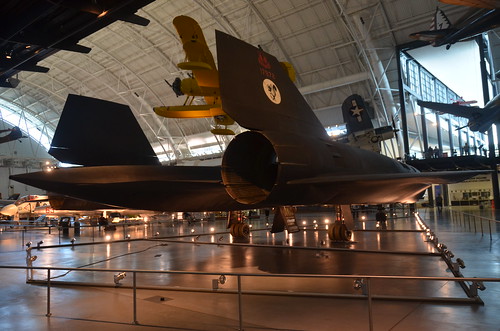
Steven F. Udvar-Hazy Center: South hangar panorama, like Vought OS2U-three Kingfisher seaplane, B-29 Enola Gay, among other people

Image by Chris Devers
Quoting Smithsonian National Air and Space Museum | Vought OS2U-3 Kingfisher:
The Kingfisher was the U.S. Navy’s principal ship-primarily based, scout and observation aircraft during Globe War II. Revolutionary spot welding methods gave it a smooth, non-buckling fuselage structure. Deflector plate flaps that hung from the wing’s trailing edge and spoiler-augmented ailerons functioned like further flaps to enable slower landing speeds. Most OS2Us operated in the Pacific, where they rescued a lot of downed airmen, like World War I ace Eddie Rickenbacker and the crew of his B-17 Flying Fortress.
In March 1942, this airplane was assigned to the battleship USS Indiana. It later underwent a six-month overhaul in California, returned to Pearl Harbor, and rejoined the Indiana in March 1944. Lt. j.g. Rollin M. Batten Jr. was awarded the Navy Cross for creating a daring rescue in this airplane below heavy enemy fire on July four, 1944.
Transferred from the United States Navy.
Manufacturer:
Vought-Sikorsky Aircraft Division
Date:
1937
Country of Origin:
United States of America
Dimensions:
Overall: 15ft 1 1/8in. x 33ft 9 1/2in., 4122.6lb., 36ft 1 1/16in. (460 x 1030cm, 1870kg, 1100cm)
Materials:
Wings covered with fabric aft of the main spar
Physical Description:
Two-seat monoplane, deflector plate flaps hung from the trailing edge of the wing, ailerons drooped at low airspeeds to function like further flaps, spoilers.
Steven F. Udvar-Hazy Center: P-40 Warhawk with “sharktooth” nose
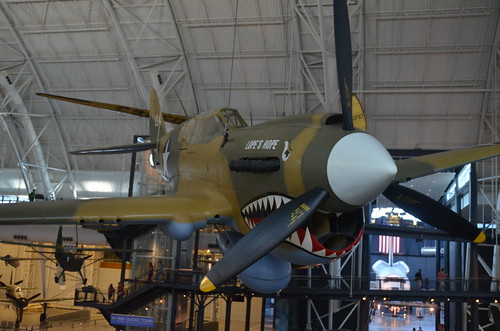
Image by Chris Devers
See a lot more pictures of this, and the Wikipedia article.
Specifics, quoting from Smithsonian National Air and Space Museum | Curtiss P-40E Warhawk (Kittyhawk IA):
No matter whether identified as the Warhawk, Tomahawk, or Kittyhawk, the Curtiss P-40 proved to be a effective, versatile fighter throughout the first half of Globe War II. The shark-mouthed Tomahawks that Gen. Claire Chennault’s "Flying Tigers" flew in China against the Japanese remain among the most well-known airplanes of the war. P-40E pilot Lt. Boyd D. Wagner became the 1st American ace of World War II when he shot down six Japanese aircraft in the Philippines in mid-December 1941.
Curtiss-Wright built this airplane as Model 87-A3 and delivered it to Canada as a Kittyhawk I in 1941. It served until 1946 in No. 111 Squadron, Royal Canadian Air Force. U.S. Air Force personnel at Andrews Air Force Base restored it in 1975 to represent an aircraft of the 75th Fighter Squadron, 23rd Fighter Group, 14th Air Force.
Donated by the Exchange Club in Memory of Kellis Forbes.
Manufacturer:
Curtiss Aircraft Firm
Date:
1939
Country of Origin:
United States of America
Dimensions:
All round: 330 x 970cm, 2686kg, 1140cm (10ft 9 15/16in. x 31ft 9 7/8in., 5921.6lb., 37ft four 13/16in.)
Supplies:
All-metal, semi-monocoque
Physical Description:
Single engine, single seat, fighter aircraft.
Long Description:
Whether or not it was the Tomahawk, Warhawk, or Kittyhawk, the Curtiss P-40 was a effective and versatile fighter aircraft for the duration of the 1st half of Globe War II. The shark-mouthed Tomahawks that General Claire Chennault led against the Japanese remain among the most well-known airplanes of the war. In the Phillipines, Lt. Boyd D. Wagner became the initial American ace of Planet War II whilst flying a P-40E when he shot down six Japanese aircraft in the course of mid-December 1941. P-40s had been first-line Army Air Corps fighters at the begin of the war but they quickly gave way to far more advanced styles such as the Republic P-47 Thunderbolt and the Lockheed P-38 Lightning (see NASM collection for each aircraft). The P-40 is not ranked amongst the very best all round fighters of the war but it was a rugged, effective style obtainable in big numbers early in the war when America and her allies urgently necessary them. The P-40 remained in production from 1939 to the end of 1944 and a total of 13, 737 have been built.
Design engineer Dr. Donovan R. Berlin layed the foundation for the P-40 in 1935 when he created the agile, but lightly-armed, P-36 fighter equipped with a radial, air-cooled engine. The Curtiss-Wright Corporation won a production contract for 210 P-36 airplanes in 1937-the biggest Army airplane contract awarded because World War I. Worldwide, fighter aircraft styles matured rapidly in the course of the late 1930s and it was soon apparent that the P-36 was no match for newer European designs. Higher altitude overall performance in particular became a priceless commodity. Berlin attempted to increase the P-36 by redesigning it in to accommodate a turbo-supercharged Allison V-1710-11 inline, liquid-cooled engine. The new aircraft was designated the XP-37 but proved unpopular with pilots. The turbo-supercharger was not trustworthy and Berlin had placed the cockpit as well far back on the fuselage, restricting the view to the front of the fighter. Nonetheless, when the engine was not giving difficulty, the more-streamlined XP-37 was a lot more quickly than the P-36.
Curtiss attempted once more in 1938. Berlin had modified yet another P-36 with a new Allison V-1710-19 engine. It was designated the XP-40 and very first flew on October 14, 1938. The XP-40 looked promising and Curtiss supplied it to Army Air Corps leaders who evaluated the airplane at Wright Field, Ohio, in 1939, along with numerous other fighter proposals. The P-40 won the competitors, soon after some modifications, and Curtiss received an order for 540. At this time, the armament package consisted of two .50 caliber machine guns in the fuselage and 4 .30 caliber machine guns in the wings.
After production began in March 1940, France ordered 140 P-40s but the British took delivery of these airplanes when Paris surrendered. The British named the aircraft Tomahawks but identified they performed poorly in higher-altitude combat over northern Europe and relegated them to low-altitude operations in North Africa. The Russians bought much more than 2,000 P-40s but information of their operational history stay obscure.
When the United States declared war, P-40s equipped numerous of the Army Air Corps’s front line fighter units. The plucky fighter ultimately saw combat in practically each and every theater of operations being the most powerful in the China-Burma-India (CBI) Theater. Of all the CBI groups that gained the most notoriety of the complete war, and remains to this day synonymous with the P-40, is the American Volunteer Group (AVG) or the Flying Tigers. The unit was organized right after the Chinese gave former U. S. Army Air Corps Captain Claire Lee Chennault virtually 9 million dollars in 1940 to buy aircraft and recruit pilots to fly against the Japanese. Chennault’s most critical assistance within the Chinese government came from Madam Chiang Kai-shek, a Lt. Colonel in the Chinese Air Force and for a time, the service’s overall commander.
The income from China diverted an order placed by the British Royal Air Force for one hundred Curtiss-Wright P-40B Tomahawks but getting airplanes was only one particular important step in making a fighting air unit. Educated pilots had been required, and rapidly, as tensions across the Pacific escalated. On April 15, 1941, President Franklin D. Roosevelt quietly signed an Executive Order permitting Chennault to recruit straight from the ranks of American military reserve pilots. Within a few months, 350 flyers joined from pursuit (fighter), bomber, and patrol squadrons. In all, about half the pilots in the Flying Tigers came from the U. S. Navy and Marine Corps even though the Army Air Corps supplied 1-third. Factory test pilots at Bell, Consolidated, and other firms, and commercial airline pilots, filled the remaining slots.
The Flying Tigers flew their 1st mission on December 20. The unit’s name was derived from the ferocious fangs and teeth painted on the nose of AVG P-40s at either side of the distinctive, large radiator air intake. The concept is mentioned to originate from images in a magazine that showed Royal Air Force Tomahawks of No. 112 Squadron, operating in the western desert of North Africa, adorned with fangs and teeth painted about their air intakes. The Flying Tigers had been the first genuine opposition the Japanese military encountered. In much less than 7 months of action, AVG pilots destroyed about 115 Japanese aircraft and lost only 11 planes in air-to-air combat. The AVG disbanded on July four, 1942, and its assets, which includes a few pilots, became a component of the U. S. Army Air Forces (AAF) 23rd Fighter Group in the newly activated 14th Air Force. Chennault, now a Brigadier Common, assumed command of the 14th AF and by war’s end, the 23rd was one of the highest-scoring Army fighter groups.
As wartime expertise in the P-40 mounted, Curtiss made several modifications. Engineers added armor plate, greater self-sealing fuel tanks, and far more potent engines. They modified the cockpit to enhance visibility and changed the armament package to six, wing-mounted, .50 caliber machine guns. The P-40E Kittyhawk was the very first model with this gun package and it entered service in time to serve in the AVG. The last model created in quantity was the P-40N, the lightest P-40 constructed in quantity, and significantly more quickly than preceding models. Curtiss constructed a single P-40Q. It was the quickest P-40 to fly (679 kph/422 mph) but it could not match the functionality of the P-47 Thunderbolt and the P-51 Mustang so Curtiss ended development of the P-40 series with this model. In addition to the AAF, several Allied nations purchased and flew P-40s like England, France, China, Russia, Australia, New Zealand, Canada, South Africa, and Turkey.
The Smithsonian P-40E did not serve in the U. S. military. Curtiss-Wright built it in Buffalo, New York, as Model 87-A3 and delivered it to Canada as a Kittyhawk IA on March 11, 1941. It served in No. 111 Squadron, Royal Canadian Air Force (RCAF). When the Japanese navy moved to attack Midway, they sent a diversionary battle group to menace the Aleutian Islands. Canada moved No. 111 Squadron to Alaska to assist defend the region. Right after the Japanese threat diminished, the unit returned to Canada and at some point transferred to England without having its P-40s. The RCAF declared the NASM Kittyhawk IA surplus on July 27, 1946, and the aircraft at some point returned to the United States. It had several owners prior to ending up with the Explorer Scouts youth group in Meridian, Mississippi. Throughout the early 1960s, the Smithsonian started looking for a P-40 with a documented history of service in the AVG but discovered none. In 1964, the Exchange Club in Meridian donated the Kittyhawk IA to the National Aeronautical Collection, in memory of Mr. Kellis Forbes, a local man devoted to Boys Club activities. A U. S. Air Force Reserve crew airlifted the fighter to Andrews Air Force Base, Maryland, on March 13, 1964. Andrews personnel restored the airplane in 1975 and painted it to represent an aircraft of the 75th Fighter Squadron, 23rd Fighter Group, 14th Air Force.
• • •
Quoting from Wikipedia | Curtiss P-40 Warhawk:
The Curtiss P-40 Warhawk was an American single-engine, single-seat, all-metal fighter and ground attack aircraft that 1st flew in 1938. It was employed by the air forces of 28 nations, such as these of most Allied powers in the course of World War II, and remained in front line service till the finish of the war. It was the third most-made American fighter, following the P-51 and P-47 by November 1944, when production of the P-40 ceased, 13,738 had been constructed, all at Curtiss-Wright Corporation‘s primary production facility at Buffalo, New York.
The P-40 design and style was a modification of the preceding Curtiss P-36 this lowered improvement time and enabled a speedy entry into production and operational service.
Warhawk was the name the United States Army Air Corps adopted for all models, generating it the official name in the United States for all P-40s. The British Commonwealth and Soviet air forces utilised the name Tomahawk for models equivalent to the P-40B and P-40C, and the name Kittyhawk for models equivalent to the P-40D and all later variants.
The P-40’s lack of a two-stage supercharger produced it inferior to Luftwaffe fighters such as the Messerschmitt Bf 109 or the Focke-Wulf Fw 190 in high-altitude combat and it was rarely utilized in operations in Northwest Europe. In between 1941 and 1944, however, the P-40 played a crucial role with Allied air forces in three main theaters: North Africa, the Southwest Pacific and China. It also had a considerable role in the Middle East, Southeast Asia, Eastern Europe, Alaska and Italy. The P-40’s functionality at high altitudes was not as crucial in those theaters, where it served as an air superiority fighter, bomber escort and fighter bomber.
P-40s 1st saw combat with the British Commonwealth squadrons of the Desert Air Force (DAF) in the Middle East and North African campaigns, in the course of June 1941. The Royal Air Force‘s No. 112 Squadron was amongst the first to operate Tomahawks, in North Africa, and the unit was the initial to feature the "shark mouth" logo, copying related markings on some Luftwaffe Messerschmitt Bf 110 twin-engine fighters. [N 1]
Even though it gained a post-war reputation as a mediocre design, appropriate only for close air assistance, much more current analysis like scrutiny of the records of individual Allied squadrons indicates that the P-40 performed surprisingly properly as an air superiority fighter, at instances suffering extreme losses, but also taking a extremely heavy toll on enemy aircraft. The P-40 supplied the further benefit of low cost, which kept it in production as a ground-attack fighter extended following it was obsolete in the air superiority function.
As of 2008, 19 P-40s were airworthy.
• • • • •
See far more pictures of this, and the Wikipedia write-up.
Information, quoting from Smithsonian National Air and Space Museum | Space Shuttle Enterprise:
Manufacturer:
Rockwell International Corporation
Country of Origin:
United States of America
Dimensions:
General: 57 ft. tall x 122 ft. lengthy x 78 ft. wing span, 150,000 lb.
(1737.36 x 3718.57 x 2377.44cm, 68039.6kg)
Materials:
Aluminum airframe and physique with some fiberglass characteristics payload bay doors are graphite epoxy composite thermal tiles are simulated (polyurethane foam) except for test samples of actual tiles and thermal blankets.
The 1st Space Shuttle orbiter, "Enterprise," is a full-scale test automobile used for flights in the atmosphere and tests on the ground it is not equipped for spaceflight. Although the airframe and flight handle elements are like these of the Shuttles flown in space, this automobile has no propulsion system and only simulated thermal tiles due to the fact these attributes had been not necessary for atmospheric and ground tests. "Enterprise" was rolled out at Rockwell International’s assembly facility in Palmdale, California, in 1976. In 1977, it entered service for a nine-month-long strategy-and-landing test flight system. Thereafter it was employed for vibration tests and fit checks at NASA centers, and it also appeared in the 1983 Paris Air Show and the 1984 World’s Fair in New Orleans. In 1985, NASA transferred "Enterprise" to the Smithsonian Institution’s National Air and Space Museum.
Transferred from National Aeronautics and Space Administration
(Source from
rapid prototyping from China blog)