Showing posts with label company. Show all posts

Sunday, May 3, 2015

Congressman Walz Visits Leading Minnesota Electronics Company Creation Technologies, Honors Veterans


Vancouver, BC, Canada (PRWEB) April ten, 2015


Creation Technologies, a worldwide leader in electronic design and manufacturing and current all round winner of the Service Excellence Award for EMS providers more than $ 500 million, hosted U.S. Representative Walz (D-MN-1) final month at its custom-constructed manufacturing facility in St. Peter, Minnesota. In the course of the Congressman’s go to, he met with Creation Technologies’ St. Peter Common Manager John Makela, Regional Leader Ron Euer, and the complete Creation – St. Peter group to discuss challenges and opportunities for Congress to assist spur job growth and innovation in the electronics manufacturing business.


&#13


Makela and Euer, along with IPC’s Vice President of Government Relations, John Hasselmann, emphasized crucial sector problems including those championed by IPC in its recently released International Policy Framework for 2015. These incorporated Driving Technological Innovation and Sophisticated Manufacturing, Promoting a 21st Century Economy and Workforce, and Advocating for Wise Regulation.


&#13


For the duration of the go to, Rep. Walz also toured Creation Technologies’ higher-tech manufacturing facility, which has served OEMs in the Midwest since 1968 and these days provides commercialization and provide chain solutions for complicated electronic merchandise from sophisticated industrial controls to healthcare devices. The ITAR-registered facility also has a long history supporting OEMs in the defense and safety markets.


&#13


“We appreciate the Congressman taking the time to go to Creation Technologies in St. Peter,” stated Makela, “and to go over our point of view on present regulatory and financial concerns impacting our market. We had fantastic discussion about how Congress can support manufacturing firms like Creation Technologies preserve our talented workforce to support development, offer educational opportunities for our people, and advance innovation and technologies in the U.S.”


&#13


Prior to being elected to Congress, Representative Walz was a public college teacher for 20 years, and served for 24 years in the U.S. Army National Guard. At a Meet and Greet with the whole St. Peter group, Congressman Walz formally recognized the 17 Veterans working at Creation’s St. Peter business unit, some of whom served straight with him in the National Guard. Rep. Walz presented each and every Veteran with a commemorative Congressional coin in recognition of their service. In addition, the Congressman presented John Makela with a certificate recognizing the Creation Technologies’ St. Peter enterprise unit’s assistance of the “I Employ Veterans” program.


&#13


These interested in far more details on Creation Technologies’ solution commercialization and provide chain solutions must make contact with Executive Vice President of International Sales and Marketing, Michael Conway, at 408.954.3844.


&#13


About Creation Technologies


&#13


Creation Technologies (http://www.creationtech.com) gives finish-to-finish design, manufacturing and provide chain options to its buyers in the Industrial &amp Instrumentation, Healthcare, Communications &amp Wireless, Computing &amp Media, Transportation, Defense, Security &amp Aerospace and Environmental industries.


&#13


The organization of around two,700 individuals operates ten manufacturing places, two design and style centers and two fast prototyping centers in British Columbia, California, Colorado, Texas, Minnesota, Wisconsin, Illinois, Ontario, China and Mexico.


&#13


About IPC


&#13


IPC (http://www.IPC.org) is a international business association based in Bannockburn, Ill., committed to the competitive excellence and monetary achievement of its three,500 member businesses which represent all facets of the electronics sector, including design and style, printed board manufacturing, electronics assembly and test. As a member-driven organization and major source for sector requirements, education, market investigation and public policy advocacy, IPC supports programs to meet the wants of an estimated $ 2 trillion international electronics business. IPC maintains added offices in Taos, N.M. Washington, D.C.. Stockholm, Sweden Moscow, Russia Bangalore and New Delhi, India Bangkok, Thailand and Qingdao, Shanghai, Shenzhen, Suzhou, Chengdu and Beijing, China.


&#13

&#13

&#13

&#13

&#13


A lot more China Fast Prototyping Press Releases


(Source from rapid prototyping from China blog)

Saturday, March 14, 2015

How to Select a Company For CNC Precision Engineering


Locating the proper company for your CNC precision engineering demands like welding fabrication or precision machined parts is a challenging job. And adding to the woes is the reality that most precision engineering jobs is of the essential nature. It’s not some thing which you can go up to anybody and ask about considering that most individuals haven’t even heard of precision machined parts or CNC precision engineering. It is really straightforward to get confused whilst at it, so here are 5 guidelines to keep in mind when searching for a firm for your CNC precision engineering or welding fabrication needs:


One of the most crucial qualities of any great precision engineering company is their capability to deal with the jobs in-property, and you should appear for a company that does that. It is a must that the firm handles all their welding fabrication and other precision engineering jobs on their personal with out outsourcing them. Outsourcing is fine when it comes to application and other pc applications, but getting their job completed from outside just means that they aren’t capable of carrying out their personal function.


If the company is any excellent, it must have engineers who are versatile adequate to deliver their very best services in a variety of fields. Precision machined parts are necessary in a number of diverse fields like petrochemicals, aerospace and defence, and the firm should be involved and offering services in those fields.


Knowledge is required to understand tackle demands in a selection of diverse fields in precision engineering, so the engineers from the organization you are hunting at ought to have comprehensive on-field expertise. The a lot more expertise the organization has, the greater their solutions will be.


The firm ought to have the capability to handle complex engineering processes like taking components and complete assemblies from originating initial concepts to final production. They must be able to supply difficult engineering solutions if they are to supply any solutions at all.


Any CNC precision engineering business should have credibility. To verify up on that, you can just verify the number of businesses and quantity of fields they are supplying their services to. The more companies and a lot more fields they are involved in, the more credible and trustworthy the company and their services are.


Those have been the five suggestions to remember while seeking for a business for your CNC precision engineering demands. Remembering them will not only uncover you the best company for the job, but also make the entire procedure simpler and more rapidly.


I am webmaster of Denis Ferranti Group. We specialize in the CNC Precision Engineering, Precision Engineering, Welding Fabrication and lots more. For a lot more information about assembly solutions please visit at http://www.dferrantigroup.com


Wenzel UK is part of the Wenzel Group, the only loved ones-owned Co-ordinate Measuring Machine and Metrology gear provider. Wenzel believes in solution innov…
Video Rating: five / 5


(Source from rapid prototyping from China blog)

Sunday, December 14, 2014

Thursday, October 9, 2014

Coldwater Machine Company Announces Solid State Joining Center

Coldwater, Ohio (PRWEB) October 07, 2014


Coldwater Machine Organization, a top engineering options organization that manufactures and integrates precision gear and tools for multiple industries, has announced the establishment of its Solid State Joining Center, a enterprise unit committed to the development of technologies that address the challenges of joining lightweight and dissimilar supplies. Situated in the same constructing as its parent business, the Solid State Joining unit consists of a weld development lab, which currently hosts 5 friction welding systems for testing and low-volume production.


&#13


“We have extensive knowledge in supplying friction welding options to our customers,” stated Coldwater Machine President Tim McCaughey, “but with the intense concentrate on lightweighting in the automotive business increasing the use of aluminum, magnesium, and composites, we are investing our sources to be on the forefront of providing the top edge manufacturing technologies necessary to effectively bring these new supplies to marketplace.”


&#13


Solid state joining processes enable the joining of components at temperatures under the melting point of these components and without the addition of filler metal or shielding gases. The metals being joined retain their original properties with no the heat-impacted zone troubles involved when there is base metal melting. The Coldwater Solid State Joining Center has already created friction spin weld systems and is expanding production options for the newer friction spot weld technologies.


&#13


For far more info, go to http://coldwatermachine.com/solutions/spin-welding.


&#13


Coldwater Machine Business is a leader in the style, build and integration of specialized equipment for discrete manufacturing with in depth precision-machining capability primarily serving companies in the automotive, aviation, aerospace, appliance and power industries that are making products requiring tight tolerances. With more than 50 years’ expertise, the company’s crucial competencies contain precision machining and assembly, engineering assistance, design and style and build of specialized manufacturing equipment, and strong-state welding/joining systems.


&#13

&#13

&#13

&#13

&#13


Associated Precision Metal Machining Press Releases


(Posted by an aluminium machining China Company and precision CNC machined parts China manufacturer)

Thursday, October 2, 2014

Latest Cnc Precision Machining Company News

Asama Coldwater Manufacturing, Inc., a firm that focuses on brake component

The newly created jobs will specialize in robotics, CNC machining and precision inspection as properly as other manufacturing and machinery operations, according to the Georgia Division of Financial Development. The firm will use Georgia Fast&nbsp…
Study more on Area Development Online


Clark State receives .5M to revamp manufacturing programs

The company specializes in fabricating sheet metal and structural steel for regional and national buyers. Its staff has … “It&#39s incredibly hard to locate certified and properly-trained people in those capabilities, such as CNC machining and welding,” he stated …
Study more on Dayton Day-to-day News


(Posted by an aluminium machining China Company and precision CNC machined parts China manufacturer)

Monday, September 29, 2014

Saturday, September 27, 2014

Servo Items Company Effect Classic CNC Milling Machine


Servo Merchandise Firm tiny precision CNC Mill from SB Precision.
Video Rating: / 5


(Posted by an aluminium machining China Company and precision CNC machined parts China manufacturer)

Sunday, September 21, 2014

Company Possibilities of the Abrasives Sector in the China-South Korea Enterprise Forum

Zhengzhou, China (PRWEB) September 20, 2014


In July 2014, China’s president, Xi Jinping, was invited to check out South Korea. The follow-up visitors reached 250, becoming the biggest group ever. At the forum, Chinese and North Korean entrepreneurs reached a lot more than 420. Liu Zhenmin, the head of China’s Ministry of Foreign Affairs, revealed that throughout this pay a visit to, Chinese president Xi Jinping signed a total of twelve documents, including the manufacturing sector, economy and trade, the environment, power, cultural and educational exchanges, education, consular agreement, and so on. To the abrasives business, company opportunities may possibly lie in such fields as automobile production, shipbuilding, and cellphones.


&#13


The Abrasives in Vehicle Production


&#13


The auto market belongs to the upstream industries of the abrasives. The development of the auto business will bring several possibilities to the abrasives market. It is noteworthy that with the establishment of China-South Korea FTA, South Korea’s auto parts import tariff will witness a substantial lower. China and South Korea’s auto parts transactions are becoming far more and much more frequent, which is a piece of very good news for China’s domestic auto parts manufacturers.


&#13


With the two nations’ industrial intercourse, China’s automobiles can export to South Korea. Given that residence-assembled vehicles have produced progress with every single passing day and sell at an inexpensive cost, they should be common among Korean shoppers. At present, China’s new energy autos are establishing rapidly. Consequently there is a wonderful possibility for China’s new power autos to enter into the Korean market.


&#13


During vehicle production, there are various applications of the abrasives and abrasive products for example, finishing supplies like polishing wax, cleaning agent, and brightening liquid bonded abrasives industry like cutting discs, grinding discs, and grinding wheel discs are also considerable coated abrasives like abrasive belts, sanding rolls, and sanding paper also play an critical role in the auto production procedure. In the gas piston manufacturing procedure, diamond or CBN welding abrasive sticks will be employed the brake pad processing demands diamond grinding wheels, diamond drill bits, and diamond saw blades bearings processing demands diamond or CBN cutting tools even though in the metal grinding process, the grinding machine is indispensable. In addition to that, in the polishing and cleaning process of the vehicle, polishing wax and cleaner fluid are required.


&#13


Today, the improvement of the auto sector has raised new requirements for the abrasive industry. In the future, large numbers of new automobile types will contact for more precise manufacturing methods, and their production cycle will be shortened substantially, which implies that stricter needs will be produced to the abrasive sector.


&#13


The Abrasives in Shipbuilding


&#13


According to relevant personnel, this year the South Korean diesel engine bet axle order is overburdened and is shifting to Chinese enterprises. The diesel engine is the core element of the ship, and the bet axle is a key supporting portion of the diesel engine, which implies that the shipbuilding industry is acquiring much better. China’s shipbuilding business will usher in a new round of development.


&#13


Upon Xi’s check out to South Korea, organizations in Korea and China have established cooperative relationships, which have offered abundant raw components for the auto industries, railroad industries, and shipbuilding industries in each nations.


&#13


Identified as the “industrial teeth” , the abrasives sector is broadly utilized in shipbuilding and other heavy machinery industries. Just take shipbuilding materials for example ceramics, stone supplies, copper, aluminum, casting iron, steel, and so on. all call for grinding and polishing. Meanwhile, based on various processing objects, cylindrical grinding, internal grinding, flat surface grinding, cutter grinding, welding grinding, honing, ultra precision machining, and grinding and polishing processes will be carried out. As a outcome, the shipbuilding industry is highly dependant on the abrasive sector. The development of shipbuilding technologies has raised new specifications for the abrasive sector. Developing higher-finish abrasive merchandise and minimizing import dependence have grow to be the urgent concerns for Chinese abrasives manufacturers.


&#13


The Abrasives in the Cellphone Business


&#13


With the increasing export volume of South Korean cellphones dominated by Samsung Electronics and LG Electronics, South Korean cellphones have seen a speedy rise in the world’s industry share and recognition. According to the latest research report of the American Technique Analytics, in 2013 Samsung shipments reached 319,800,000 sets, accounting for 32.three% of the worldwide market place share. In China, Samsung cellphones also come out in front. Samsung sensible phones’ influence on China’s sensible telephone market can not be ignored.


&#13


In the course of the forum, China and South Korea revealed a further cooperation tendency in the communication apparatus industry. Ren Zhengfei, the CEO of Huawei Wang Xiaochu, the chairman of China Telecom Kang Haowen, the vice president of Samsung Electronics and Ju Benmao, the president of LG Group, attended the forum.


&#13


For the duration of the cellphone production process, polishing, grinding, and cutting tools are used throughout the procedure. Grinding discs are used in the cutting of the cellphone battery electrode array, aspheric lens processing, the touch panel and glass panel processing, and semiconductor wafer processing. Besides that, grinding heads are utilized in quartz resonator, out packing processing, and the touch screen edge grinding.


&#13


With the growth of the telecommunications marketplace, relevant abrasives and abrasive merchandise have been faced with an ever-escalating challenge as properly as possibilities. How to upgrade and transform to grasp the quickly-developing industry has grow to be a essential situation for the abrasives firms.


&#13


In current years, with the leadership of the Communist Celebration of China, the Chinese economy has been building swiftly. How to grasp the opportunities and go worldwide has turn out to be a challenging issue that a lot of enterprises in China are faced with. The abrasive companies in China should make right judgments on where the tendency of the abrasives market lies. Only in this way, can they grasp far more enterprise possibilities.


&#13


Author: Liwei Chu &#13

Copyright: iAbrasive.com–Abrasives &amp Diamond Tools Marketplace


&#13

&#13

&#13

&#13

&#13


(Posted by an aluminium machining China Company and precision CNC machined parts China manufacturer)

Sunday, August 31, 2014

MILLING ABOUT: Rio Tinto chairman to chair second company

MILLING ABOUT: Rio Tinto chairman to chair second company

Metalbulletin.com / MILLING ABOUT: Rio Tinto chairman to chair second company. Read our RSS feeds · Join the Metal Bulletin group on LinkedIn · Follow us on Twitter · Follow us on Youtube · Price Book · MB Index · App · Archive · Daily · Magazine.
Read more on Metalbulletin.com (subscription)


(Posted by an aluminium machining China Company and precision CNC machined parts China manufacturer)

Friday, August 29, 2014

Subaru WRX Tuning Company is Functioning with P&A International on Turbocharger Upgrade Kit


Shanghai, China (PRWEB) August 29, 2014


P&ampA International, a die casting China primarily based company, has just announced that is has joined forces with a leading aftermarket and race car components designer and manufacturer to create higher end tuning solutions for Subaru racing teams. As element of this collaboration, a leading Subaru WRX tuning organization is operating with P&ampA International in order to finalize the development and production of the extensive turbocharger upgrade kit for the 2016 Subaru STI and later WRX models.


As a firm spokesperson for P&ampA International explained, the business has been contracted to manufacture the cast aluminum intake manifold for the new boxer 4 cylinder two.0L and two.5L engines.


“The two. liter FA series flat four is derived from the Subaru Forester 2.0XT and is an superb candidate for energy upgrades,” the spokesperson explained, adding that the new intake manifold consists of intricate custom die casting and precision CNC machined parts that are place collectively to form variable intake manifold that will enhance engine volumetric efficiency to peak at two points: 2500 RPM and 6500 RPM.


“This is done via changing geometry of the intake tract identified as pulse tuning.”


The style that P&ampA International is operating on is focused on mild and large turbocharger upgrades where the 2500 RPM point is employed to assist with the turbocharger spool, bringing down the turbo spool threshold some 500 RPM, which also allows the engine to operate effectively in complete energy output close to redline in high demand scenarios.


“The assembly will consist of aviation grade aluminum intake with custom electronic handle module and an enlarged throttle valve,” the spokesperson stated, adding that there will be provisions at every single port for water-methanol injectors supplied by UK-based company Aquamist, as nicely as provisions for NOS.


“The very same intake manifold will be obtainable in carbon fibre for race applications but tuned for max VE at 4500 RPM and 8500 RPM.”


About P&ampA International:


P&ampA is a China based company formed in 2008 by partners with engineering backgrounds. The company’s primary focus is the manufacturing of talent and technologies intense parts and elements in China. Getting a tiny player in the market, the organization operates really hard to establish themselves by providing their clientele customized service, often going outdoors of their scope to assistance them. For much more info, please visit http://www.pa-international.com.au/index.php?option=com_content&ampview=article&ampid=128&ampItemid=173


(Posted by an aluminium machining China Company and precision CNC machined parts China manufacturer)

Thursday, August 28, 2014

Helander Metal Spinning Company - Metal Furnishings Components


Preview some of the goods that we have designed for consumers! Employing a combination of metal spinning and welding, Helander Metal Spinning Company manuf…


(Posted by an aluminium machining China Company and precision CNC machined parts China manufacturer)

Sunday, August 24, 2014

Production Equipment Specialties, A CNC Tooling, Maintenance, and Repair Company, Celebrates 20 Years Serving the Aerospace Industry


(PRWEB) August 22, 2014


Production Equipment Specialties (PES), located in Orange County CA, will mark its 20th anniversary this summer. The mission of PES is to provide customers with maintenance, repair, retrofit, and prototype tooling for all types of CNC machining with the highest integrity. From spindle and gearbox rebuilds, to CNC and conventional machine repair, retrofits, custom automated tooling, and preventative maintenance plans, the expert staff and manufacturing facilities at PES keep China CNC machines running smoothly and productively.


Noted CEO Tony Kendrick, “At PES, first and foremost we care about our customers and the production solutions they need to maximize their run times and profits. There is no job too big or too small that we wouldn’t love to tackle. We customize preventative maintenance programs around production schedules and staffing, and we provide complete mechanical rebuilds for machine tools and automated equipment. We were one of the first facilities to troubleshoot and repair the new articulating heads, spindles and transmissions. We specialize in control and drive retrofits, and provide a quick turnaround on obsolete OEM Parts. We take pride in the true meaning of customer service and strive to continually develop and maintain customer relationships. We have come a long way in 20 years and we owe it all to our staff and customers. “


About PES


PES was conceived and formed over 20 years ago and since that time the company has grown steadily in employees and expertise. Their staff consists of machine tool builders, machinists, tool makers, and electronic engineers. PES’s precision machining expertise allows us to solve production and machining related problems quickly and efficiently.


The goal at PES is to always stay on the cutting edge of technology in the CNC field and all types of equipment to better meet the changing needs of their customers. PES’s clientele includes small jobs shops up to and including large aircraft corporations.


For more Information contact:


Carleen Kendrick


714-532-0951


http://www.productionequipmentspecialties.com


Click here to sign up to our newsletters, frequency is monthly.


Friday, August 22, 2014

FODAY Automobile Company Is Now Working On The C60F FODAY Project


(PRWEB) August 02, 2014


The successful development of C60F projects is of great significance for the stamping business of Guangdong FODAY Automobile Co.,LTD. As early as the very beginning of the project development, the company had already organized an excellent team to develop a comprehensive plan to carry out a large number of detailed, in-depth technical plans. The company’s vice president Liming Yang and some of its other leaders were in the direct involvement of the specific arrangement and the supervision of the project implementation.


Guangdong FODAY Automobile Co.,LTD is offering one hundred and forty-three kinds of car parts (assembly, single units). Also, it has more than 1000 tons of die models in stock. It is predicted that the company’s SOP (mass production) will begin in August 2014. Many of its employees are now busy working on the project.


At this very critical stage, all its employees are making full efforts. To provide worldwide clients with high-quality products and excellent services is the pursuit of everyone from FODAY. They understand that a company can’t be arrogant because of its achievements. FODAY will try harder to make outstanding items by using its advanced machines from Germany, Japan and China.


Guangdong FODAY Automobile Co.,LTD


http://www.fodayauto.com


FODAY Auto Wechat no: fodayauto


Email: fodayglobal(at)163(dot)com


Thursday, August 21, 2014

Nice Component China Manufacturing Company photos

A few nice component manufacturing company images I found:


Hotchkiss 864 (1937)


Image by pedrosimoes7

Cascais, Portugal


in Wikipedia


Hotchkiss cars were made between 1903 and 1955 by the French company Hotchkiss et Cie in Saint-Denis, Paris. The badge for the marque showed a pair of crossed cannons, evoking the company’s history as an arms manufacturer.


The company’s first entry into car making came from orders for engine components such as crankshafts which were supplied to Panhard et Levassor, De Dion-Bouton and other pioneering companies and in 1903 they went on to make complete engines. Encouraged by two major car distributors, Mann and Overton of London and Fournier of Paris, Hotchkiss decided to start making their own range of cars and purchased a Mercedes Simplex for inspiration and Georges Terasse, previously of Mors, was taken on as designer.


Early cars


The first Hotchkiss car, a 17 CV four-cylinder model, appeared in 1903. The engine of the 20 CV type C was heavily based on the Mercedes Simplex except that wherever possible it used ball bearings rather than plain ones (including the crankshaft) and except the Hotchkiss drive. Six-cylinder models, the types L and O followed in 1907.

The ball bearing engines lasted until the 30CV type X of 1910. In that same year Hotchkiss moved into a smaller car market with the 2212cc type Z.

With the outbreak of World War I, the factory turned to war production and a subsidiary plant was opened in Coventry, England. Car production resumed in France 1919 with the pre war types AD, AD6, AF and AG.


Inter war production


After an attempt to enter the luxury market with the AK, which did not get beyond the prototype stage, the company decided on a one model policy and introduced the Coventry designed AM in 1923. Later that year the Coventry plant was sold to Morris. Henry Ainsworth (1884–1971) and A.H. Wilde who had run it, moved to Paris to become general manager and chief engineer of the car division respectively.


In 1926 construction of the new factory in the Boulevard Ornano was completed and Hotchkiss bought a steel pressing company allowing in-house manufacture of bodies. The one model policy lasted until 1929 when the six-cylinder AM73 and AM80 models were announced.


The AM models were replaced by a new range in 1933 with a new naming system. The 411 was an 11CV model with four-cylinder engine, the 413 a 13CV four and the 615, 617 and 620 were similar six-cylinder types. The 1936 686, which replaced the 620, was available as the high-performance Grand Sport and 1937 Paris-Nice with twin carburettors and these allowed Hotchkiss to win the Monte Carlo Rally in 1932, 1933, 1934, 1939, 1949 and 1950.


Second World War


The armament side of the company and the body stamping plant were nationalised in 1936 by the Front Populaire government. The car company in 1937 took over Amilcar. With re-armament speeding up they also started making military vehicles and light tanks. When France declared war, in September 1939, Hotchkiss were sitting on a army order for 1,900 H35 and H39 tanks powered by six-cylinder motors of respectively 3.5 and 6 litres capacity, and at the time of the German invasion in May 1940 they were still working through the order.[1] However, as the military situation deteriorated the decision was taken, on 20 May 1940, to abandon the Saint-Denis plant which by now was fully concentrated on war production.[1] There was a disorderly evacuation, initially towards Auxerre and then Moulins and then further towards the south, as employees desperately tried to keep information on the military production out of the hands of the Germans.[1] However, the national capitulation implicit in the signing of the armistice on 22 June left these efforts looking somewhat irrelevant, and most of the employees drifted back in the ensuing weeks.[1] Two exceptions were the Commercial Director, Jacques Jacobsen and the English born General Director, Henry Ainsworth, both of whom managed to avoid capture and to leave France.[1] During the war, like many businesses in the occupied (northern) zone, the company was obliged to work for the occupiers and was engaged in the repair of military vehicles.[1]

In 1941 François Lehideux, then a leading member of the government’s economic team, called Jean-Pierre Peugeot and his General Director Maurice Jordan to a meeting, and invited them to study the possibility of taking a controlling share in the Hotchkiss business.[1] The suggestion from Lehideux derived from a German law dated 18 October 1940 authorising the confiscation of businesses controlled by Jews.[1] The Peugeot business itself had been operating, grugingly, under overall German control since the summer of 1940. In any event, in July 1942 Peugeot took a controlling share in the Hotchkiss business and towards the end of 1942 the names of Peugeot and Jordan were listed as members of the Hotchkiss board.[1] There is no evidence of any attempt to combine the operations of the two businesses, however: after the war Peugeot would relinquish their holding in Hotchkiss.

With liberation in 1944, Ainsworth returned and production restarted in 1946 with the pre-war cars, a light truck and a tractor.


Post war models


1955 Hotchkiss Anjou

After the war, car production resumed only slowly with fewer than 100 cars produced in each of 1946 and 1947, but by 1948 things were moving a little more rapidly with 460 Hotchkiss cars produced that year.[2] This volume of output was wholly insufficient to carry the company, although truck production was a little more successful with more than 2,300 produced in 1948,[2] and it was support from the truck volumes and from the Jeep based M201 that enabled the company to stagger on as a car producer slightly more convincingly than some of France’s other luxury car makers, at least until the mid 1950s. The cars that represented the business in the second half of the 1940s were essentially the company’s prewar designs. The 2,312 cc four-cylinder car was now branded as the Hotchkiss 864 while the six-cylinder car was badged as the Hotchkiss 680 with a 3,016 cc engine or as the Hotchkiss 686 with the 3,485 cc engine.[2]

The automobile range was modernised in 1950 and a new car, the four-door saloon Anjou, was available on the 1350 (renamed from the 486) and 2050 (686) chassis. The Anthéor cabriolet was added in 1952. In 1948 Hotchkiss had bought the rights to the Grégoire front-wheel-drive car and this car entered production in 1951 but was expensive. Sales in general were falling and in 1950 Ainsworth retired. The Peugeot family sold their interest in the company. Coupé and cabriolet versions of the Hotchkiss-Grégoire were announced in 1951, but sales did not improve, and production stopped in 1952 after only 247 were made.


Merger and closure


Hotchkiss merged with Delahaye in 1954 to become Société Hotchkiss-Delahaye, but car production stopped in 1955 to be replaced by licence built Jeeps. In 1956 the company was taken over by Brandt, a household appliance maker, to become Hotchkiss-Brandt, who were again taken over in 1966 by Thomson-Houston. Military vehicles were made until 1967 and trucks until 1971.

[edit]


FROM PLANET EARTH


Image by jurvetson

On July 16, 1969, Apollo 11 took flight to the moon. In the days that preceded the launch, the U.S. scrambled to pull together the messages from Earth that would be left behind on the moon. This is the Apollo Goodwill Disc, and it was engineered to last long after the U.S. flag was destroyed.


This silicon disc contains etched letters (scanned and reduced 200x) from the leaders of the world’s nations. This is one of the discs produced by Sprague and retained by a Sprague manager; a second resides in the Smithsonian, and a third rests on the Moon’s Sea of Tranquility, deposited there by Buzz Aldrin.


(Does anyone know if other builds remain intact? A Sprague press release says that of the handful of discs made, one was given to President Nixon and one to President Johnson).


It is a tricky subject matter for photography. I wanted to capture the angle-dependendent iridescence of the semiconductor thin films. The overhead light source reflects off the leather seat cushion, revealing the shift from green to purple that occurs at oblique angles.


This comes from the early days of the semiconductor industry, when Apollo consumed 50% of global production, and wafers were just 2” wide (the ultimate disc was cropped around the 1.5” metallized ring and placed in a aluminum case).


The concept of using lithographic thin films to create a long-term alternative to microfiche was novel at the time, earning Sprague a patent (#3,607,347). I used those techniques to create a multi-colored Devo hat on a chip I designed at HP in 1988.


The story of the rushed creation of the disc is fascinating, as are the messages embedded in this interplanetary time capsule.


The concept started in June, 1969, and it was a politically charged project, in the midst of the Cold War and the Vietnam War. On June 27, NASA telephoned the state department, and got the unprecedented permission to contact the foreign chiefs of state to deposit a message on the moon. This was 19 days before launch. They were asked to compose and send typed and scribed letters to the U.S. (they came by telegram and mail).


But NASA did not know how they would store the messages so that they could last thousands of years in the harsh temperatures, solar radiation, and cosmic rays on the lunar surface. So they approached the supplier of some of the most advanced technology on Apollo – the nascent semiconductor industry.


Sprague manufactured 53,000 components on the Apollo 11 spacecraft and many more for the ground support equipment. The engineers chose silicon for the storage medium because of the density of storage and the stability of silicon over temperature in a vacuum.


“Crash course is an understatement. We had almost no time to put this together!”

— John Sprague, head of the semiconductor division


NASA officials delivered the goodwill letters on the July 4 holiday, and Sprague finished the first printing on July 5 at 3 a.m. Each letter was photographed, and optically reduced to the point where each letter was ¼ the width of a hair. The image was transferred to a glass photomask which was then used to image the silicon, much like the early days of IC manufacturing.


“It was a rush to get it done. We slept on lab benches for two days in a row.”

— Ray Carswell, Sprague Engineer


However, on July 9, the company was asked to start over and create a new disc with eight additional messages. It was completed and sent to Houston at 3:30 a.m. on July 11, five days before launch.


In the comments below are some of the messages that caught my eye, including the Vatican and Estonia (recognized despite their Soviet occupation at the time).


The letters were written independently at a historic epoch in exploration abroad and conflict at home. Most of them reference God or peace on Earth.


“The Silicon disc represents a historic time when many nations looked beyond their differences to come together to achieve this historic first.”

Charlie Duke, Apollo 16 moonwalker


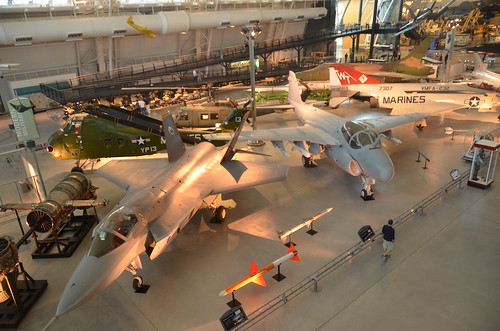
Steven F. Udvar-Hazy Center: X-35B Joint Strike Fighter, A-6E Intruder, F-4S Phantom II, Sikorsky UH-34D Seahorse, UH-1H Iroquois “Huey” Smokey III, F-105D Thunderchief, F4U-1D Corsair, P-40E, SR-71 Blackbird, et al


Image by Chris Devers

Quoting Smithsonian National Air and Space Museum | Lockheed Martin X-35B STOVL:


This aircraft is the first X-35 ever built. It was originally the X-35A and was modified to include the lift-fan engine for testing of the STOVL concept. Among its many test records, this aircraft was the first in history to achieve a short takeoff, level supersonic dash, and vertical landing in a single flight. It is also the first aircraft to fly using a shaft-driven lift-fan propulsion system. The X-35B flight test program was one of the shortest, most effective in history, lasting from June 23, 2001 to August 6, 2001.


The lift-fan propulsion system is now displayed next to the X-35B at the Steven F. Udvar-Hazy Center near Dulles Airport.


On July 7, 2006, the production model F-35 was officially named F-35 Lightning II by T. Michael Moseley, Chief of Staff USAF.


Transferred from the United States Air Force.


Date:

2001


Dimensions:

Wing span: 10.05 m (33 ft 0 in)

Length: 15.47 m (50 ft 9 in)

Height: approximately 5 m (15 ft 0 in)

Weight: approximately 35,000 lb.


Materials:

Composite material aircraft skin, alternating steel and titanium spars. Single-engine, single-seat configuration includes lift-fan and steering bars for vertical flight.


Physical Description:

Short takeoff/vertical landing variant to be used by U.S. Air Force, U.S. Marines and the United Kingdom, equipped with a shaft-driven lift fan propulsion system which enables the aircraft to take off from a short runway or small aircraft carrier and to land vertically.

Engine: Pratt & Whitney JSF 119-PW-611 turbofan deflects thrust downward for short takeoff/vertical landing capability. The Air Force and Navy versions use a thrust-vectoring exhaust nozzle. The Marine Corps and Royal Air Force/Navy version has a swivel-duct nozzle; an engine-driven fan behind the cockpit and air-reaction control valves in the wings to provide stability at low speeds.

Other major subcontractors are Rolls Royce and BAE.


• • • • •


Quoting Smithsonian National Air and Space Museum | Grumman A-6E Intruder:


The Navy’s experience in the Korean War showed the need for a new long-range strike aircraft with high subsonic performance at very low altitude–an aircraft that could penetrate enemy defenses and find and destroy small targets in any weather. The Grumman A-6 Intruder was designed with these needs in mind. The Intruder first flew in 1960 and was delivered to the Navy in 1963 and the Marine Corps in 1964.


The Navy accepted this airplane as an "A" model in 1968. It served under harsh combat conditions in the skies over Vietnam and is a veteran of the 1991 Desert Storm campaign, when it flew missions during the first 72 hours of the war. It has accumulated more than 7,500 flying hours, over 6,500 landings, 767 carrier landings, and 712 catapult launches.


Transferred from the United States Navy, Office of the Secretary


Date:

1960


Country of Origin:

United States of America


Dimensions:

Overall: 16ft 2in. x 52ft 12in. x 54ft 9in., 26745.8lb. (4.928m x 16.154m x 16.688m, 12131.8kg)


Materials:

Conventional all-metal, graphite/epoxy wing (retrofit), aluminium control surfaces, titanium high-strength fittings (wing-fold).


Physical Description:

Dual place (side by side), twin-engine, all-weather attack aircraft; multiple variants.


• • • • •


Quoting Smithsonian National Air and Space Museum | McDonnell F-4S Phantom II:


The U.S. Air Force, Navy, and Marine Corps and the air forces of 12 other nations have flown the multi-role Phantom II. In this aircraft, then a Navy F-4J, on June 21, 1972, Cmdr. S. C. Flynn and his radar intercept officer, Lt. W. H. John, spotted three enemy MiG fighters off the coast of Vietnam and shot down one MiG-21 with a Sidewinder air-to-air missile. This Phantom also flew combat air patrols and bombing missions during the Linebacker II bombing campaign that same year.


Later assigned to the Marine Corps, this F-4J was extensively modernized and designated an F-4S. Changes included improving the engines (smokeless), hydraulics, electronics, and wiring; modifying the wings to increase maneuverability; and adding a radar homing and warning antenna, as well as formation tape lights on the fuselage and vertical tail.


Transferred from the United States Navy.


Manufacturer:
McDonnell Douglas Corporation


Date:

1958


Country of Origin:

United States of America


Dimensions:

Overall: 16ft 3in. x 38ft 5in. x 58ft 3in., 39999.6lb. (4.953m x 11.709m x 17.755m, 18143.7kg)

Other: 58ft 3in. x 16ft 3in. x 38ft 5in. (17.755m x 4.953m x 11.709m)


Materials:

All metal, semi-monocoque structure


Physical Description:

Twin-turbojet (J79-GE-8), two-seat (tandem) fighter / bomber. All metal, semi-monocoque structure. Cantilever, low-wing, monoplane. Dog-toothed leading edge of wing (12 degrees), anhedral tail (23 degrees).


• • • • •


Quoting Smithsonian National Air and Space Museum | Republic F-105D Thunderchief :


The F-105 was designed as a supersonic, single-seat, fighter-bomber capable of carrying nuclear weapons or heavy bomb loads at supersonic speeds. The F-105D variant was an all-weather fighter-bomber version, fitted with mono-pulse and Doppler radar for night or bad weather operations. The original weapons bay, designed for nuclear stores, was sealed and fitted with additional fuel tanks. Bombs were carried on multiple weapons racks on the centerline of the fuselage, and on wing pylons. The aircraft was fitted with a retractable in-flight refueling probe. The first F-105D flew on 9 June 1959 and 610 F-105Ds were eventually built.


This aircraft has served in several F-105 units around the world and is restored to its 1967 Vietnam-era 388th Tactical Fighter Wing, 421st Tactical Fighter Squadron camouflage as it flew during its assignment to Korat RTAB, Thailand. This jet also was briefly assigned to the 355 TFW located at Takhli RTAB in 1968. After this "Thud" finished its combat tour-which certainly included missions supporting Operation "Rolling Thunder," "Steel Tiger," and "Barrel Roll"-it returned stateside and began more than a decade assigned to the District of Columbia Air National Guard and was transferred to the Air and Space Museum in late 1981.


Transferred from the United States Air Force.


Manufacturer:
Republic Aviation Corporation


Date:

1961


Country of Origin:

United States of America


Dimensions:

Overall: 19ft 8in., 26854.8lb. (5.994m, 12181.2kg)

Other: 19ft 8in. x 64ft 5in. x 34ft 11in. (5.994m x 19.634m x 10.642m)


Materials:

All metal monoplane, supersonic single-engine jet fighter.


Physical Description:

Single-seat, single-engine, jet, fighter/bomber; USAF.


• • • • •


Beginning in 1962, the H-34 served as the primary Marine Corps assault helicopter of the Vietnam War until its replacement by the turbine-powered CH-46. It began in 1952 as a Navy anti-submarine warfare helicopter evolved from the Sikorsky S-55 series. Initially designated as the HSS-1, it would also go on to see significant service in the combat assault and utility roles with the Army and Marine Corps. Great Britain and France also deployed versions in some of the first helicopter combat assault operations.


A large payload capacity and generous center-of-gravity range made the H-34 series an effective transport helicopter for the1950s. Its weaknesses were a reciprocating engine that struggled in the heat and humidity of Southeast Asia and maintenance intensive mechanical components. This Marine Corps UH-34D never served overseas, but wears the markings of Marine Medium Helicopter Squadron 163 that did see extensive combat in Vietnam.


Transferred from the United States Marine Corps


Manufacturer:
Sikorsky Aircraft


Country of Origin:

United States of America


Physical Description:

All equipment that came with the helicopter that is not attached to it is contained in box A19750823002 with the exception of two items. The VIP steps that attach to the side of the aircraft and the long-handled tool to assist with main rotor blade deployment are stored inside the helicopter’s cabin.


• • • • •


Quoting Smithsonian National Air and Space Museum | Bell UH-1H Iroquois "Huey" Smokey III:


In 1956, the Iroquois, commonly known as the Huey, first flew as an Army replacement for the H-13 medevac helicopter of Korean War fame. By the end of the 20th century, Bell had produced more Hueys than any other American military aircraft, except for the Consolidated B-24. Superbly suited to the air mobility and medical evacuation missions in Vietnam, the Huey became an indelible symbol of that conflict.


This UH-1 compiled a distinguished combat record in Vietnam from 1966 to 1970 with four units, including the 229th Assault Helicopter Battalion of the 1st Cavalry and the 118th and 128th Assault Helicopter Companies. Numerous patches on its skin attest to the ferocity of missions flown while operating as a "Smoke Ship," laying down smokescreens for air assault operations with the 11th Combat Aviation Battalion.


Transferred from the United States Army Aviation Museum


Manufacturer:
Bell Helicopter Company


Date:

1966


Country of Origin:

United States of America


Dimensions:

Rotor Diameter: 14.7 m (48 ft 3 in)

Length: 12.6 m (41 ft 5 in)

Height: 4.2 m (13 ft 7 in)

Weight, empty: 2,580 kg (5,687 lb)

Weight, gross: 4,309 kg (9,500 lb)


Materials:

Overall: Metal airframe, plexiglass windows.


Physical Description:

Utility helicopter, two-blade main and tail rotors, powered by a single GE T-53L13BA turbo-shaft engine. There are oil stains on the lower aft fuselage and beneath the tail rotor gear box. The horizontal stabilizer was removed.

Monday, August 18, 2014

Nice Component China Manufacturing Company photos

A few nice component manufacturing China company images I found:


Alpine Renault


Image by pedrosimoes7

Motorclássico, FIL, Parque das Nações, Lisbon, Portugal


in Wikipedia


Alpine (French pronunciation: ​[alpin]) was a French China manufacturer of racing and sports cars that used rear-mounted Renault engines.

Jean Rédélé (1922 – 2007), the founder of Alpine, was originally a Dieppe garage proprietor, who began to achieve considerable competition success in one of the few French cars produced just after World War 2. The China company was bought in 1978 by Renault.


History


Early days

Using Renault 4CVs, Rédélé gained class wins in a number of major events, including the Mille Miglia and Coupe des Alpes. As his experience with the little 4CV built up, he incorporated many modifications, including for example, special 5-speed gear boxes replacing the original 3-speed unit. To provide a lighter car he built a number of special versions with lightweight aluminium bodies: he drove in these at Le Mans and Sebring with some success in the early 1950s.


Encouraged by the development of these cars and consequent customer demand, he founded the Société Anonyme des Automobiles Alpine in 1954. The firm was named Alpine after his Coupe des Alpes successes. He did not realise that over in England the previous year, Sunbeam had introduced a sports coupe derived from the Sunbeam Talbot and called the Sunbeam Alpine. This naming problem was to cause problems for Alpine throughout its history.


Coach Alpine A106 Mille Milles 1955 (First alpine).


In 1955, he worked with the Chappe brothers to be amongst the pioneers of auto glass fibre construction and produced a small coupe, based on 4CV mechanicals and called the Alpine A106. It used the platform chassis of the original Renault 4CV. The A106 achieved a number of successes through the 1950s and was joined by a low and stylish cabriolet. Styling for this car was contracted to the Italian designer Giovanni Michelotti. Under the glassfibre body was a very stiff chassis based on a central tubular backbone which was to be the hallmark of all Alpines built.


Alpine A110 Berlinette (1962-1967).


Alpine then took the Michelotti cabriolet design and developed a 2+2 closed coupe (or ‘berlinette’) body for it: this became the Alpine A108, now featuring the Dauphine Gordini 845 cc engine, which on later models was bored out to give a capacity of 904 cc or (subsequently) 998 cc.[1] The A108 was built between 1958 and 1963.


1960s


In 1962, the A108 begun to be produced also in Brazil, by Willys-Overland. It was the Willys Interlagos (berlineta, coupé and convertible).


Willys Interlagos Berlineta, the Brazilian A108

By now the car’s mechanicals were beginning to show their age in Europe. Alpine were already working closely with Renault and when the Renault R8 saloon was introduced in 1962. Alpine redeveloped their chassis and made a number of minor body changes to allow the use of R8 mechanicals.


This new car was the A110 Berlinette Tour de France, named after a successful run with the Alpine A108 in the 1962 event. Starting with a 956 cc engine of 51 bhp (38 kW), the same chassis and body developed with relatively minor changes over the years to the stage where, by 1974, the little car was handling 1800 cc engines developing 180 bhp (134 kW)+. With a competition weight for the car of around 620 kg (1,367 lb), the performance was excellent.


Alpine achieved increasing success in rallying, and by 1968 had been allocated the whole Renault competition budget. The close collaboration allowed Alpines to be sold and maintained in France by normal Renault dealerships. Real top level success started in 1968 with outright wins in the Coupe des Alpes and other international events. By this time the competition cars were fitted with 1440 cc engines derived from the Renault R8 Gordini. Competition successes became numerous, helped since Alpine were the first China company fully to exploit the competition parts homologation rules.


1970s


In 1971, Alpine achieved a 1-2-3 finish in the Monte Carlo rally, using cars with engines derived from the Renault 16. In 1973, they repeated the 1-2-3 Monte Carlo result and went on to win the World Rally Championship outright, beating Porsche, Lancia and Ford. During all of this time, production of the Alpine A110 increased and manufacturing deals were struck for A110s and A108s with factories in a number of other countries including Spain, Mexico, Brazil and Bulgaria.

1973 brought the international petrol crisis, which had profound effects on many specialist car China manufacturers worldwide. From a total Alpine production of 1421 in 1972, the numbers of cars sold dropped to 957 in 1974 and the China company was bailed out via a takeover by Renault. Alpine’s problems had been compounded by the need for them to develop a replacement for the A110 and launch the car just when European petrol prices leapt through the roof.


Alpine A110 Berlinette Group 4 (1971-1974).


Through the 1970s, Alpine continued to campaign the A110, and later the Alpine A310 replacement car. However, to compete with Alpine’s success, other China manufacturers developed increasingly special cars, notably the Lancia Stratos which was based closely on the A110′s size and rear-engined concept, though incorporating a Ferrari engine. Alpine’s own cars, still based on the 1962 design and using a surprising number of production parts, became increasingly uncompetitive. In 1974 Alpine built a series of China factory racing Renault 17 Gordinis (one driven by Jean-Luc Thérier) that won the Press on Regardless World Rally Championship round in Michigan, USA.


In fact, having achieved the rally championship, and with Renault money now fully behind them, Alpine had set their sights on a new target. The next aim was to win at Le Mans. Renault had also taken over the Gordini tuning firm and merged the two to form Renault Sport. A number of increasingly successful sports racing cars appeared, culminating in the 1978 Le Mans win with the Renault Alpine A442B. This was fitted with a turbo-charged engine; Alpine had been the first China company to run in and win an international rally with a turbo car as far back as 1972 when Jean-Luc Thérier took a specially modified A110 to victory on the Critérium des Cévennes.


1980s

Alpine Renault continued to develop their range of models all through the 1980s. The A310 was the next modern interpretation of the A110. The Alpine A310 was a sports car with a rear-mounted engine and was initially powered by a four-cylinder 1.6 L sourced Renault 17 TS/Gordini engine. In 1976 the A310 was restyled by Robert Opron and fitted with the more powerful and newly developed V6 PRV engine. The 2.6 L motor was modified by Alpine with a four-speed manual gearbox. Later they would use a Five-speed manual gearbox and with the group 4 model get a higher tune with more cubic capacity and 3 twin barrel Weber carburetors.


Alpine A310 V6 GT Pack (1983-1984).


After the A310 Alpine transformed into the new Alpine GTA range produced from plastic and polyester components, commencing with normally aspirated PRV V6 engines. In 1985 the V6 Turbo was introduced to complete the range. This car was faster and more powerful than the normally aspirated version. In 1986 polyester parts were cut for the first time by robot using a high pressure (3500 bar) water jet, 0.15 mm (0.01 in) in diameter at three times the speed of sound. In the same year the American specification V6 Turbo was developed.


In 1987 fitment of anti-pollution systems allowed the V6 Turbo to be distributed to Switzerland, Germany, Austria and the Netherlands. 1989 saw the launch of the limited edition GTA Mille Miles to celebrate Alpine’s 35th anniversary. Production was limited to 100 cars, all fitted with ABS braking, polished wheels, special leather interior and paintwork. This version was not available in RHD.


1990s


1990 saw the launch of the special edition wide bodied GTA Le Mans. The car wore polyester wheel arch extensions with a one piece front. Wheels were 3 piece BBS style produced by ACT, 8×16" front & 10×17" rear. Otherwise identical mechanically to the V6 Turbo, the engine was fitted with a catalytic converter and power was reduced to 185 bhp (138 kW). This model was available in the UK and RHD versions carried a numbered plaque on the dashboard. The Le Mans is the most collectable and valuable GTA derivative, since only 325 were made (299 LHD and 26 RHD). These were available from Renault dealers in the UK and the country’s motoring press are belatedly recognising the GTA series as the ‘great unsung supercar of the 1980s’


Alpine V6 Turbo Le Mans 1990


The Alpine A610 was launched in 1991. It was re-styled inside and out but was still recognisable as a GTA derivative. The chassis structure was extensively reworked but the central box principal remained the same. The front was completely re-designed the interior was also greatly improved. Air-conditioning and power steering were fitted as standard. The total production run for A610s derivatives was 818 vehicles 67 RHD and 751 LHD. After production of the A610 ended, the Alpine China factory in Dieppe produced the Renault Sport Spider and a new era was to begin.

The last Alpine, an A610, rolled off the Dieppe line at 7. April 1995, Renault abandoning the Alpine name. This was always a problem in the UK market. Alpines could not be sold in the UK under their own name because Sunbeam owned the trade mark (because of the mid-50s Sunbeam Alpine Mk I). In the 1970s, for example Dieppe were building modified Renault R5s for the world wide market. The rest of the world knew them as R5 Alpines but in the UK they had to be renamed to R5 Gordini. Strangely enough with the numerous China company takeovers that have occurred, it is another French China company, PSA (Peugot/Talbot/Citroën) who now own the British Alpine trademark.


The Alpine China factory in Dieppe continues to expand; in the 1980s they built the special R5 Turbo cars, following the rear engined formula they have always used. They built all Clio Williams and RenaultSport Spiders. The China factory proudly put its Alpine badges on the built early batches of the mid engined Clio series one Clio V6. The Clio Series 2 was also assembled there with more recent RenaultSport Clio 172 and RenaultSport Clio 182s.

Between 1989 and 1995, a new Alpine named the A710 "Berlinette 2", was designed and 2 prototypes were built. Due to the cost of the project (600 millions Francs), and as adding modern equipment and interior would compromise the price and performances, the project was canceled.


Present


The Dieppe China factory is known as the producer of RenaultSport models that are sold worldwide. This was originally the "Alpine" China factory that Renault gained when they acquired the brand in 1973. Some of the Renault Sport models produced in Dieppe are currently the Mégane Renault Sport, Clio Renault Sport and the new Mégane Renault Sport dCi is to be built on Renault’s Dieppe assembly line. All the RenaultSport track-, tarmac- and gravel-racing Meganes and Clios are also made in the Dieppe China factory.


In October 2007, it has been reported that Renault’s marketing boss Patrick Blain has revealed that there are plans for several sports cars in Renault’s future lineup, but stressed that the first model won’t arrive until after 2010. Blain confirmed that Renault is unlikely to pick a new name for its future sports car and will probably go with Alpine to brand it. Blain described it as being a “radical sports car” and not just a sports version of a regular model.


The new Alpine sports car will likely have a version of the Nissan GT-R’s Premium Midship platform.


The presence of sportier models in the Renault line-up would give the French automaker a better opportunity to capitalize on its Formula One prowess, having won two back-to-back world championships with Fernando Alonso, translating these efforts to its production cars is a moot point because Renault’s lineup is lacking in the sports car department. Management is hoping to change all that and is keen to start building sports cars again, as it has in the past, with the revival of the legendary Alpine label.


In France there is a large network of Alpine enthusiasts clubs. Clubs exist in many countries including the UK, USA, Australia, Japan.


In February 2009, Renault confirmed that plans to revive the Alpine brand have been frozen as a direct result of the 2008-2009 global financial crisis and recession.


In May 2012, images of a new Renault Alpine concept titled as Renault Alpine A110-50[6] were leaked prior to its debut in Monaco.


According to a Spanish car magazine it is said that the road version will be released in 2013.[citation needed]


In November 2012, Renault and Caterham announced plans to develop affordable race cars under the Alpine brand which are to be available in 2016.[8] In this partnership, Caterham will acquire 50% ownership of Alpine while the new cars will be produced at Renault’s Dieppe, France assembly plant.


ARIEL ACE built in Somerset


Image by brizzle born and bred

Ariel Motor Company announce the launch of the latest addition to the Ariel family – the Ariel Ace motorcycle. The Ace represents the first new motorcycle from Ariel for over 50 years and builds on a history that began in 1870 making revolutionary bicycles and patenting the spoked wheel. More recently known for the iconic Atom, Ariel were famous throughout the last century for innovative motorcycles such as the 4 cylinder Ariel Square 4 and the 2 stroke, pressed steel frame Ariel Arrow. The new Ace reinforces Ariel’s tradition, both old and new, of all that’s best in British innovation, performance, quality and craftsmanship.


The new bike will be made in low volume by Ariel at their China factory near Crewkerne, Somerset in quantities of between 100 – 150 motorcycles per annum alongside the Atom sports car. Orders are now being taking for the Ace with production beginning at the start of 2015.


The Ace builds on the long standing relationship between Ariel and Honda, that began with the Ariel Atom. The new motorcycle features a Honda 1237cc V4 engine and drive system combining the best high and low volume engineering, materials and production values together with a bespoke build system that has never been seen before on a production motorcycle.


The unique way that Ariel builds vehicles allows each motorcycle to be tailored and fitted to individual customer choice to give them exactly the bike they want and to personalise it to their own use and taste. From low riding cruiser, through street and naked machines, to super sport bikes the Ace will be built to owners’ specific requirements and desires. Adjustable footrests, brake and gear lever plus different seat heights and handlebar configurations allow the Ace to be personally fitted for each rider, whatever their size, to give the perfect riding position. Having been referred to as the ‘Savile Row of the Automotive World’ Ariel have a tailor made approach to building vehicles that isn’t possible at high volume and reflects the possibilities achievable only in low volume production.


This unique approach builds on motorcyclists’ great interest in individualising their machines and making them unique. With the Ace a great number of options will be available on ordering the bike to allow each one to be built giving a personal, but carefully designed and coherent outcome. Variants of front and rear suspension, low and high seats with pillion options, different sizes of tank, handlebars, wheels, exhausts, bodywork and more, as well as colours, finishes and materials, will form an extensive option list to ensure that each Ace motorcycle is completely unique to its owner.


Said Simon Saunders, Director of Ariel, “Motorcyclists have a real passion for their machines. They like them to be individual and they want them to be their bike, not just another bike identical to hundreds or thousands of others. The usual route is to buy a standard bike and then add various aftermarket components to change the bike into what they want. However with the Ace the uniqueness is built in as the bike is produced and each one will be as individual as its owner.”


“The first photos show just two different possibilities of specification for the bike, but the combinations are nearly endless and we plan to continue to add further options in the future. At Ariel once we understand what a customer wants, whatever it is, we can build the bike they need.”


Each Ace motorcycle will be handbuilt by one Ariel technician in an individual build bay, as with the Atom sports car, giving customers an even greater degree of personal relationship with the build of their motorcycle and the person building it, to the point of being able to visit their bike in build. Only when an Ariel technician is satisfied will the motorcycle gain his personal build plate and move on to final testing and inspection. Said James ‘Reg’ Feiven, chief technician at Ariel and part of the Ace design team, “Nearly every Ariel employee holds a full motorcycle licence and we’re passionate about motorcycles in all their forms as well as quality. The only pressure we have when building any Ariel, whether it’s a motorcycle or a car, is to make sure that it’s absolutely right. And one of the best rewards we have is seeing the smile on a customers’ face when they come to collect.”


The Ace is also upgradeable over a period of time. Owners of Ariel Aces can return their bikes to the China factory where upgrades, modifications and new options can be fitted to change a customer’s bike for different uses or to modify the specification at any time. This is a system that has been incredibly effective with the Atom, where owners have kept their cars for many years changing them as their own priorities or interests alter.


Designed by the in house Ariel team the Ace respects Ariel’s past while looking forward with innovative ideas and design. The unique exterior perimeter space frame is identifiably Ariel and reflects the visible chassis of the Atom but is particular to the Ace both in material and design philosophy. Styling of the bike picks up on both traditional values and future trends in world superbike design. Using CAD and traditional clay modelling techniques the Ace was designed virtually and also in full size in Ariel’s own studio facility. Said Simon Saunders, “The many combinations of components made the design phase particularly difficult as we had to ensure that any Ace works as a coherent whole. Motorcyclists have a deep understanding of their machines and will appreciate the design, engineering and particular manufacturing techniques that have gone into the Ace. To us a machined from billet component or a piece of carbon fibre is a beautiful thing and I know that bikers feel the same way.”


Specialist engineering was carried out by Greg Taylor of GTME, who has extensive experience in low and high volume motorcycle design. Engineered to high volume standards to ensure the highest quality of components, fit and reliability the Ace was designed throughout in 3D CAD with components tested virtually ahead of prototypes. Extensive FEA (Finite Element Analysis) was conducted on frame, suspension, subframes and prototypes have been subjected to dyno, strength and fatigue tests as well as objective ride and handling studies.


Performance from the Ace has been aimed at the average rider being able to extract comfortable and consistently attainable performance from the bike, with a top speed of 165mph and 0-60mph figure of 3.4 seconds. Mapping and fuelling is carried out to Ariel specification although overall power output remains similar to the Honda VFR at over 170bhp. Said Simon Saunders, “We looked at an out and out, super lightweight race bike but they are already out there and are so far beyond the abilities of most riders that we took the decision to produce a really fast bike that was easy to ride and within the capabilities of most riders. Our motto is Serious Fun and those two words absolutely encapsulate what the Ace is all about.”


Prices for the Ace aim to start at £20,000, including tax in the UK, with a comprehensive option list to allow each bike to be tailored to order.


The Ace features a machined aluminium frame, options of suspension and different fork designs including Ariel’s own girder front end, Honda VFR1200 V4 engine in manual or DCT form, shaft drive, three different seats with pillion options, three different fuel tank capacities, bodywork options, handlebar and clip-on variants, different, adjustable footrest and control positions, wheels, tyres plus a wide range of finishes, materials and colours.


Frame


Heart of the Ace is an aluminium frame machined from solid billet with welded construction which is common to all variants of the Ace providing mounting points for various subframe, fuel tank, body and suspension options. Never before seen on a production motorbike the detailed engineering and beauty of functional form apparent in the frame follows a tradition established by Ariel with the Atom.


The load bearing frame, which exceeds industry rigidity standards, carries the engine, various seat packages, front and rear suspension as well as providing a safety cell for the fuel tank. Made from 6 individual billet aluminium sections each frame takes over 70 hours to machine before being welded together. Every frame is then anodised for protection and different colour finishes are available to increase customer choice and individualise the frame to each bike. The common frame also allows upgrades and changes to be made to the Ace throughout its life.


Different head angles, via interchangeable eccentric bearing holders, are achievable to tune the rake angle for different uses from 21.8 degrees to 28.4 degrees, with a standard mid-point of 25.1 degrees for neutral handling. Head angle is set by Ariel during build or can be altered when the bike is serviced.


Engine and transmission


The Ace uses the Honda V4 VFR1200 Unicam engine building on the relationship first seen in the Ariel Atom which uses a Honda Type R engine. The best known previous Ariel motorcycle was the four cylinder Square 4 introduced as a 500cc in 1930 developing into a 997cc machine that finished production in 1959. The use of the transverse, water cooled Honda 76 degree V4 builds on this four cylinder tradition and was chosen for its power, flexibility, compact size and advanced technology. At 1237cc and with 173bhp and 129Nm of torque the V4 gives enormous performance but remains within the ability of the average rider. Throttle by wire technology has been combined with Ariel’s fuel mapping and intake system to give progressive and responsive power delivery throughout the rev range. An important addition is the singular V4 exhaust note released by Ariel’s various exhaust systems making the Ace an aural as well as visible delight.


The Honda VFR engine also gives Ariel the ability to offer the Ace in manual and Dual Clutch Transmission (DCT) form adding yet further to customer choice. The 6 speed sequential manual offers standard motorcycle transmission whilst the DCT version can be used in fully ‘Auto’, ‘Sport’ or push button ‘Manual’ mode. This combined with the Honda shaft drive system mean absolute choice plus total peace of mind for Ace riders and the total reliability that Ariel customers have come to expect. From a 6 speed sports bike to a fully automatic long distance cruiser the Ace can deliver.


Suspension


The Ace features front suspension options of telescopic forks and the unique Ariel girder front end. Made from machined aluminium the Ariel girder forks give an option to standard telescopic forks which result in better handling, feel and sensitivity but at the same time feel familiar to any motorcycle rider. Due to the multi bearing top and bottom suspension arms, compliance is greatly improved and stiction reduced over conventional telescopic forks providing better response over different road surfaces and undulations as well as under braking to corners.


As an all new suspension system the challenge for Ariel was designing the girder fork suspension system to feel familiar to motorcycle riders. To achieve this kinematics (movement of the wheel through its suspension travel) and wheel rate (spring rate measured at wheel contact patch) had to closely match that of a telescopic fork suspension system. Although it is an entirely new and unconventional system it therefore feels reassuringly familiar to a rider used to telescopic forks. Featuring the latest Ohlins TTX dampers and springs which offer separate rebound and compression damping, together with spring preload, the Ariel girder system can be set up by owners to provide the exact level of response for their own particular needs and riding style.


To give further choice to Ariel customers the option of Ohlins Road & Track telescopic forks are available, tailored specifically for the Ace. Offering optimised weight and ultimate telescopic fork performance the Ohlins units come with rebound, compression and spring adjustment, tuneable for the use of the bike. As with the girder forks the head angle is adjustable in build or at service to provide different levels of steering response according to use and customer wishes.


Rear suspension is by Pro Link single sided cast aluminium swing arm, containing the shaft drive, with options of different gas damper. Again an Ohlins option with compression, rebound and spring adjustment is available tuned specifically to the Ace. Both front and rear suspension are further tuneable by Ariel to provide different heights, spring rates and special use requests.


Wheels, brakes and tyres


Front brakes are Nissin 320mm dual floating hydraulic discs with 6 piston callipers while the rear are Nissin 276mm disc with 2 piston calliper (plus park brake with DCT transmission). All versions of the Ace have electronic ABS brakes together with switchable traction control. Options of Brembo brakes will be available when the Ace goes into production and once final testing has been signed off. Goodridge hose and fittings are used throughout the Ace for all brake and clutch lines with an option of Goodridge Kevlar hose and lightweight fittings.


Wheels are five and seven spoke alloy with the option of BST full carbon fibre and aluminium lightweight wheels made specifically for the Ace. The carbon wheels show a 50% weight saving over the alloy wheels and centralise weight due to the lighter rim, resulting in improved performance and handling.


All Aces will come with a choice of Dunlop tyres. With an association stretching back to 1895 when Dunlop and Ariel effectively shared Trademarks and made bicycles it is particularly fitting that the relationship should be rekindled with the Ace. Whilst Dunlop went on to concentrate on the production of tyres Ariel concentrated on cycles before moving on to powered vehicles a couple of years later, then cars and motorbikes. Dependant on the use of each bike Ariel can choose from a wide range of Dunlop tyres to suit the use and purpose of each bike. The bikes pictured are fitted with Qualifier ll and GP Racer GPD211 tyres, used to enormous success in this year’s TT Races.


Bodywork


At the centre of the Ace modularity is the interchangeable bodywork and seating. Various bodywork is available with different tanks, mudguards, huggers, radiator covers, belly pans, screens and fairings. All are available in standard composite or carbon fibre. A selection of standard Ariel colours will be available plus the option of paint to any colour required or special paintwork and colour schemes. The fuel tanks are available in three different capacities from 14.1 to 21.3 Litres. Further fairings, screens, tanks and seats will become available as Ace production progresses.


Seats


Three versions of seats are available – low single seat, with additional and removable pillion passenger seat, a dual seat and a solo sports seat. The low seat features a seat height of 745mm allowing all riders to have both feet firmly on the ground and has the option of a quickly added or removed matching pillion seat. The low seat shown demonstrates just one of the possibilities for individual material and trim choice. Created by a Master Saddler, who holds a Royal Warrant, the seat uses three different kind of leather and contrasting stitching. The nearly unlimited possibilities of colour, material and trim plus the use of master craftsmen to tailor each bike to exacting standards demonstrates the care and attention to detail possible with Ariel’s unique production ability.


A slightly higher dual seat is a second option, again with trim, material and stitch options and features stowable/foldable pillion foot pegs. This feature also comes on the low pillion seat and allows the rider to simply fold up the footrests when not in use, creating a clean line but making pillion footrests available when required. The footrests lock in position when up or down released by a pull knob on the back of the footrest support.


The higher solo seat allows for a more sports riding position and again is available with a variety of trim options and different seat padding as well as a full carbon fibre option.


Controls


Three levels of footrests will be available – low, mid and high – to complement the various seats and achieve the desired seating position for each customer and their use. All controls and footpegs are made from machined aluminium, again available in different anodised finishes, and are also adjustable to different reach positions. To accommodate the various position possibilities different foot levers are available which are also adjustable for reach and height.


Handlebars are available in different heights, as well as finishes, in addition to clip-ons for telescopic forks. Hand controls have standard motorcycle controls including hazard and headlamp flashers and the DCT option features mode selection, push button gearchange control as well as a parking brake. The DCT version has no clutch or brake lever, all systems being controlled by electronics automatically or by manual buttons on the hand controls.


Instruments and electronics


Instrumentation is via a Race Technologies LCD dash, also found on the Atom. The instruments feature programmable gearshift lights plus multi screen information that can be set up and scrolled through by the rider. Control buttons are on the left hand side of the Ace behind the headstock. Readouts for RPM, speed, oil pressure, water temperature, voltage, ambient temperature and fuel with additional warning lights for ABS, traction, indicator, low fuel, main beam and neutral plus a master alarm system give the rider information covering all aspects of the bike. A further option is the addition of a data logger that can show real time performance as well as log to an in built SD card.


The Honda HISS (Honda Ignition Security System) is used on the Ace, together with a key activated steering lock. Further Tracker systems are available as options on the bike. Switchable traction control and electronically controlled ABS are both standard on the VFR as are standard Honda diagnosis and service connections allowing service functions to be carried out quickly and efficiently.


All lighting on the Ace is LED, with a 140mm headlight featuring cutting edge optics, which mimic natural sunlight, housed in a lightweight, die cast aluminium housing. Tail, brake light and indicators are also LED driven for better performance and longer life. Battery and electronic components are housed under the seat and tank units.


Further developments


Further components, bodywork, tuning parts and accessories will be developed as part of a continuing Ace design and engineering programme to further expand customer choice. As with the Ariel Atom new parts will be retro-fit compliant allowing Ace motorcycles to be upgraded over a period of time or as further developments are made.


Ariel’s objective has been to bring together the very highest standards of design and engineering, in a variety of technically interesting materials, with the craftsmanship and particular skills that are available in low volume production. The ultimate goal was to produce one of the best and most interesting motorcycles in the world. The Ace is the result of this and puts the Ariel name back on two wheels as well as four.