Showing posts with label Engineers. Show all posts
Showing posts with label Engineers. Show all posts
Friday, April 3, 2015

Saturday, March 7, 2015
Saturday, February 7, 2015
Image from page 49 of "Transactions of the Society of Motion Picture Engineers (1921)" (1921)
A couple of nice precision engineering solutions images I found:
Image from page 49 of “Transactions of the Society of Motion Picture Engineers (1921)” (1921)
Image by Net Archive Book Images
Identifier: transactionsofso13soci
Title: Transactions of the Society of Motion Image Engineers (1921)
Year: 1921 (1920s)
Authors: Society of Motion Image Engineers
Subjects: motion images
Publisher: Society of Motion Image Engineers
Contributing Library: Library of Congress, MBRS, Moving Image Section
Digitizing Sponsor: Library of Congress, Motion Image, Broadcasting and Recorded Sound Division
View Book Page: Book Viewer
About This Book: Catalog Entry
View All Images: All Pictures From Book
Click right here to view book online to see this illustration in context in a browseable on the internet version of this book.
Text Appearing Before Image:
nchman and the lack of any encour-agement from a commercial point of view. In 1912 the Bausch & Lomb Optical Co. began experimenting,getting secured the services of a very in a position Belgian by the name ofMartin, who had some formulae handed down to him by his father.They succeeded in producing some very creditable glass, considering therule-of-thumb approaches utilised, and the continual worry of exposingcherished and secret formulae. They worked along in this way untilwe went into the war, when they have been provided help from the Geophysi-cal Laboratory of the Carnegie Institution. In 1915 the Bureau of Standards took up the problem in theirlaboratory in Pittsburgh. In two or a lot more years experimentingthey produced some creditable glass, but their greatest contribution to thewar requirements was their operate which developed suitable glass pots. Correct right here credit should be given to Mr. Karl Keuffel of the firmof Keuffel & Esser, for generating some extremely good glass, also forsuccessfully producing pots suited to his goal.
Text Appearing After Image:
Fig. 2—The Stirring Machine Mr. Duval of the Hazel-Atlas Glass Co., of Washington, Pa.,functioning in conjunction with the John A. Brashear Co., succeeded inmaking a little amount of optical glass which was used by the lat-ter mentioned organization. In 1915 The Pittsburgh Plate Glass Co., at their Charleroi plant,began some experimenting, hunting to creating both spectacle glassand the other larger grade glass used in lenses of higher precision.With the former they met with considerable achievement but with thelatter they worked along contending with varying vicissitudes and 40 meeting with questionable good results until the members of the Geophys-ical Laboratory took over the management of their plant early in1918. With these guys in charge they made some useable opticalglass, but it was not up to the regular desired since of numerous de-fects, chief amongst which have been the old furnaces, which were notprovided with regenerating chambers and the suitable temperaturecontrol was impossible. This brings us
Note About Images
Please note that these pictures are extracted from scanned web page photos that could have been digitally enhanced for readability – coloration and look of these illustrations might not completely resemble the original function.
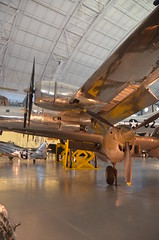
Steven F. Udvar-Hazy Center: south hangar panorama, including B-29 Superfortress “Enola Gay”, Grumman F6F-3 Hellcat, amongst other people
Image by Chris Devers
See more images of this, and the Wikipedia write-up.
Details, quoting from Smithsonian National Air and Space Museum: Steven F. Udvar-Hazy | Boeing B-29 Superfortress "Enola Gay":
Boeing’s B-29 Superfortress was the most sophisticated propeller-driven bomber of Planet War II and the 1st bomber to property its crew in pressurized compartments. Although developed to fight in the European theater, the B-29 found its niche on the other side of the globe. In the Pacific, B-29s delivered a variety of aerial weapons: traditional bombs, incendiary bombs, mines, and two nuclear weapons.
On August six, 1945, this Martin-constructed B-29-45-MO dropped the very first atomic weapon utilised in combat on Hiroshima, Japan. 3 days later, Bockscar (on show at the U.S. Air Force Museum close to Dayton, Ohio) dropped a second atomic bomb on Nagasaki, Japan. Enola Gay flew as the advance weather reconnaissance aircraft that day. A third B-29, The Wonderful Artiste, flew as an observation aircraft on each missions.
Transferred from the United States Air Force.
Manufacturer:
Boeing Aircraft Co.
Martin Co., Omaha, Nebr.
Date:
1945
Nation of Origin:
United States of America
Dimensions:
All round: 900 x 3020cm, 32580kg, 4300cm (29ft 6 five/16in. x 99ft 1in., 71825.9lb., 141ft 15/16in.)
Components:
Polished general aluminum finish
Physical Description:
4-engine heavy bomber with semi-monoqoque fuselage and high-aspect ratio wings. Polished aluminum finish overall, common late-Planet War II Army Air Forces insignia on wings and aft fuselage and serial quantity on vertical fin 509th Composite Group markings painted in black "Enola Gay" in black, block letters on reduced left nose.
• • • • •
See more photos of this, and the Wikipedia article.
Specifics, quoting from Smithsonian National Air and Space Museum: Steven F. Udvar-Hazy | Grumman F6F-three Hellcat:
The Grumman F6F Hellcat was initially conceived as an sophisticated version of the U.S. Navy’s then present front-line fighter, the F4F Wildcat (see NASM collection). The Wildcat’s intended replacement, the Vought F4U Corsair (see NASM collection), first flown in 1940, was showing great guarantee, but improvement was slowed by issues, such as the crash of the prototype.
The National Air and Space Museum’s F6F-3 Hellcat, BuNo. 41834, was built at Grumman’s Bethpage, New York, factory in February 1944 below contract NOA-(S)846. It was delivered to the Navy on February 7, and arrived in San Diego, California, on the 18th. It was assigned to Fighter Squadron 15 (VF-15) on USS Hornet (CV12) bound for Hawaii. On arrival, it was assigned to VF-3 exactly where it sustained harm in a wheels-up landing at NAS Barbers Point, Hawaii. Right after repair, it was assigned to VF-83 exactly where it was employed in a education part until February 21, 1945. After numerous transfers 41834 was converted to an F6F-3K target drone with the installation of sophisticated radio-control equipment. It was painted red with a pink tail that carried the number 14. Its mission was to be employed in Operation Crossroads – the atomic bomb tests at Bikini Atoll. It flew on June 24, 1946, with a pilot, on a practice flight and was launched, unmanned, soon soon after the first bomb test. Instrumentation on board and photographic plates taped to the manage stick obtained information on radioactivity. 3 much more manned flights preceded the final unmanned flight on July 25, 1946, which evaluated the initial underwater explosion. Records indicate that exposure of this aircraft to the radioactive cloud was minimal and residual radiation is negligible.
F6F-3K 41834 was transferred to NAS Norfolk and logged its final flight on March 25, 1947, with a total of 430.two flying hours. It was assigned to the National Air Museum on November three, 1948, and remained at Norfolk till October 4, 1960, when it was moved by barge to Washington and placed in storage. In 1976 this Hellcat was loaned to the USS Yorktown Museum at Charleston, South Carolina. A superficial restoration was performed at the museum, but due to the fact of the harsh atmosphere and its poor situation the Hellcat was returned to NASM on March 16, 1982. In 1983, it was sent to Grumman Aerospace exactly where a group of volunteers totally restored the aircraft. In 1985, it was shipped back to the Paul E. Garber Preservation, Restoration and Storage Facility in Suitland, Maryland, and place in storage. NASM’s F6F-3 Hellcat is scheduled to be displayed in the new Steven F. Udvar-Hazy center at Dulles International Airport in Virginia in 2004.
Transferred from the United States Navy.
Manufacturer:
Grumman Aircraft Engineering Corporation
Date:
1943
Nation of Origin:
United States of America
Dimensions:
All round: 338 x 1021cm, 4092kg, 1304cm (11ft 1 1/16in. x 33ft five 15/16in., 9021.2lb., 42ft 9 three/8in.)
Physical Description:
Heavy armor plate, reinforced empennage, R-2800-10W engine, spring tabs on the ailerons (elevated maneuverability), could carry rockets as nicely as bombs.
(Source from rapid prototyping from China blog)
Thursday, December 11, 2014
CM Precision engineers jobs enhance
CM Precision engineers jobs increase
Kieran Cooper, managing director of CM Precision Components, mentioned the investment ought to permit the business the organization to enhance export sales by "£250,000 more than the subsequent couple of years". Kevin McCann, Invest NI's director of sophisticated engineering and …
Study far more on Insider Media
Holiday Gifts Worth Giving to Wine Lovers
If you're genuinely looking to impress somebody, or if your recipient occurs to be a wine professional, they will certainly appreciate utilizing the Code 38 Wine Crucial, which brings precision engineering and amazing modern day styling to the basic corkscrew …
Study far more on Vinography
(Source from rapid prototyping in China blog)
Sunday, August 31, 2014
Thursday, August 21, 2014
Sunday, August 17, 2014
High Quality Precision China Machined Components from Contract Precision Engineers UK
Precision machined components China are important parts of all modern machinery. Precision China engineering is required in various industries ranging from automobiles, computers to electronics to airplanes and more. They all require these components to make the quality of their equipments better. Original equipment China manufacturers require these components in bulk quantities. However, it is quite difficult for an OEM to carry out all the jobs of designing and manufacturing these small components in their premises. But they now need not worry as they can hire contract precision engineers UK.
Hiring precision engineers UK is a profitable option as it provides cost effective solutions for OEMs. There are many contract China engineering Chinese companies in the UK that provide their expert services at affordable prices and within the given deadlines.
These contract China engineering Chinese companies provide different kinds of services according to the clients’ requirement. OEMs can either approach them for complete designing and manufacturing of the precision components or repair and overhauling projects. They also undertake annual maintenance contracts for several clients.
Most of the times, OEMs are in need of new precision machined components China. These contract Chinese companies have a team of expert and experienced precision engineers UK that can design and manufacture even the most complex requirements with ease. They provide high quality products with excellent customer services. In addition, they also carry out overhauling and repair jobs for OEMs. Since maintenance is of great priority in any manufacturing unit, they can hire China engineering services.
Any contract China engineering provider offering complete precision China engineering services would provide advice, design, development and prototyping. Then they would also offer production and distribution services. Though most customers are aware of what can be achieved through precision China engineering services, they can get more information about what can be fabricated from latest CNC milling and CNC China China Turning equipment. It helps them ensure that precision China engineering services can maintain high standards of precision.
In addition, the teams of precision engineers UK who provide high quality China engineering services use the latest in design software. Using this software, their in-house team of engineers can design drawings such as initial feasibility sketches, concept design sketches, detailed product drawings and then fully manufactured drawings. Their engineers can manufacture products from a wide range of materials such as steel, aluminum, plastic and rubber.
Various precision China engineering services provided by these precision engineers UK include milling and China China Turning capabilities such as CNC automated sawing, spark eroding, drilling and tapping, shot blasting, welding and more. No matter what your requirements are, like precision machined components China , tools, sub contract machining or single source design and manufacturing, these precision engineers can provide assistance.
However, when hiring a contract company, make sure they have a good reputation in the market and are well known for their reliable and timely services.
I webmaster of Denis Ferranti China Machining UK specializes in precision China engineering services, precision machined components China, precision machined parts China, China engineering“>subcontract China engineering , subcontract machining, electromechanical assemblies , electroplating services and many more. Delivering Mission Critical High Precision China Machined Parts & Assemblies to Industry for 50 years.
Subscribe to:
Posts (Atom)